
上海郊区社区老年人中无肥胖型肌肉减少症和肌肉减少性肥胖症的患病率及危险因素:一项横断面研究。
Prevalence and risk factors of sarcopenia without obesity and sarcopenic obesity among Chinese community older people in suburban area of Shanghai: A cross-sectional study.
作者信息
Lu Linqian, He Xiangfeng, Song Yanping, Zhuang Min, Wu Xie, Chen Nan
机构信息
Department of Rehabilitation, Xinhua Hospital Affiliated to Shanghai Jiaotong University School of Medicine, Shanghai, China.
Department of Rehabilitation, Xinhua Hospital Chongming Branch, Shanghai, China.
出版信息
Front Aging Neurosci. 2022 Dec 20;14:1034542. doi: 10.3389/fnagi.2022.1034542. eCollection 2022.
OBJECTIVES
The aim of the present study was to explore the prevalence and risk factors of sarcopenia without obesity (S) and sarcopenic obesity (SO) among community-dwelling older people in the Chongming District of Shanghai, China, according to the Asian Working Group for Sarcopenia (AWGS) 2019 Consensus as the diagnostic criteria of sarcopenia.
METHODS
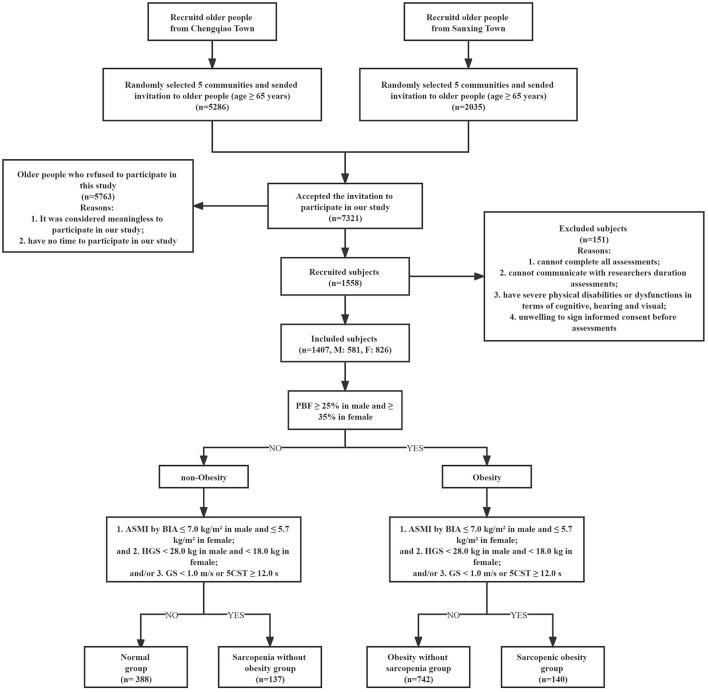
In this cross-sectional study, a total of 1,407 subjects aged ≥65 years were included, where the mean age of the subjects was 71.91 ± 5.59 years and their mean body mass index (BMI) was 24.65 ± 3.32 kg/m. According to the Asian Working Group for Sarcopenia (AWGS) 2019 Consensus, sarcopenia was defined as a low appendicular skeletal muscle mass index (≤7.0 kg/m in males and ≤5.7 kg/m in females), decreased handgrip strength (<28.0 kg in males and <18.0 kg in females), and/or low gait speed (<1.0 m/s) or poor 5-time chair stand test (5CST) (≥12s). The SO met both the diagnostic criteria for sarcopenia and obesity, meanwhile obesity was defined as an increased percentage of body fat (PBF) (≥25% in males and ≥35% in females). Univariate and multiple logistic regression analyses were performed to explore the risk factors of both S and SO.
RESULTS
The prevalence of S and SO was 9.74% (M: 9.29%, F: 10.05%) and 9.95% (M: 13.94%, F: 7.14%). Lower BMI (OR = 0.136, 95% CI: 0.054-0.340, < 0.001), lower hip circumference (OR = 0.858, 95% CI: 0.816-0.903, < 0.001), farming (OR = 1.632, 95% CI: 1.053-2.530, = 0.028), higher high-density lipoprotein cholesterol (HDL-C) level (OR = 2.235, 95% CI: 1.484-3.367, < 0.001), and a sleep duration <7 h (OR = 0.561, 95% CI: 0.346-0.909, = 0.019) were risk factors for S. While aging (70-74 y, OR = 1.923, 95% CI: 1.122-3.295, = 0.017; 75-79 y, OR = 3.185, 95% CI: 1.816-5.585, < 0.001; ≥80 y, OR = 7.192, 95% CI: 4.133-12.513, < 0.001), male (OR = 1.981, 95% CI: 1.351-2.904, < 0.001), higher BMI (OR = 4.865, 95% CI: 1.089-21.736, = 0.038), higher monocyte level (OR = 4.203, 95% CI: 1.340-13.181, = 0.014), and a sleep duration >9 h (OR = 1.881, 95% CI: 1.117-3.166, = 0.017) were risk factors for SO.
CONCLUSION
Our study showed the high prevalence of S and SO among community-dwelling older people in the Chongming District. The SO was more prevalent in males. Behavioral factors and lifestyle (such as farming and sleep duration) were associated more with the development of S, while age and male gender were associated more with the development of SO.
目的
本研究旨在根据亚洲肌少症工作组(AWGS)2019年共识作为肌少症的诊断标准,探讨中国上海崇明区社区居住老年人中无肥胖肌少症(S)和肌少症肥胖(SO)的患病率及危险因素。
方法
在这项横断面研究中,共纳入1407名年龄≥65岁的受试者,受试者的平均年龄为71.91±5.59岁,平均体重指数(BMI)为24.65±3.32kg/m²。根据亚洲肌少症工作组(AWGS)2019年共识,肌少症定义为低四肢骨骼肌质量指数(男性≤7.0kg/m²,女性≤5.7kg/m²)、握力下降(男性<28.0kg,女性<18.0kg)和/或低步速(<1.0m/s)或5次坐立试验(5CST)不佳(≥12秒)。SO符合肌少症和肥胖的诊断标准,同时肥胖定义为体脂百分比(PBF)增加(男性≥25%,女性≥35%)。进行单因素和多因素逻辑回归分析以探讨S和SO的危险因素。
结果
S和SO的患病率分别为9.74%(男性:9.29%,女性:10.05%)和9.95%(男性:13.94%,女性:7.14%)。较低的BMI(OR = 0.136,95%CI:0.054 - 0.340,P < 0.001)、较低的臀围(OR = 0.858,95%CI:0.816 - 0.903,P < 0.001)、从事农业劳动(OR = 1.632,95%CI:1.053 - 2.530,P = 0.028)、较高的高密度脂蛋白胆固醇(HDL-C)水平(OR = 2.235,95%CI:1.484 - 3.367,P < 0.001)和睡眠时间<7小时(OR = 0.561,95%CI:0.346 - 0.909,P = 0.019)是S的危险因素。而年龄增长(70 - 74岁,OR = 1.923,95%CI:1.122 - 3.295,P = 0.017;75 - 79岁,OR = 3.185,95%CI:1.816 - 5.585,P < 0.001;≥80岁,OR = 7.192,95%CI:4.133 - 12.513,P < 0.001)、男性(OR = 1.981,95%CI:1.351 - 2.904,P < 0.001)、较高的BMI(OR = 4.865,95%CI:1.089 - 21.736,P = 0.038)、较高的单核细胞水平(OR = 4.203,95%CI:1.340 - 13.181,P = 0.014)和睡眠时间>9小时(OR = 1.881,95%CI:1.117 - 3.166,P = 0.017)是SO的危险因素。
结论
我们的研究表明崇明区社区居住老年人中S和SO的患病率较高。SO在男性中更普遍。行为因素和生活方式(如从事农业劳动和睡眠时间)与S的发生更相关,而年龄和男性性别与SO的发生更相关。



 Zotero 插件