
澳大利亚维多利亚地区全科医生远程医疗服务在 COVID-19 大流行期间的使用情况:回顾性分析。
Use of General Practitioner Telehealth Services During the COVID-19 Pandemic in Regional Victoria, Australia: Retrospective Analysis.
机构信息
Deakin Health Economics, Institute for Health Transformation, School of Health and Social Development, Deakin University, Burwood, Australia.
Global Centre for Preventive Health and Nutrition, Institute for Health Transformation, School of Health and Social Development, Deakin University, Geelong, Australia.
出版信息
J Med Internet Res. 2023 Feb 7;25:e39384. doi: 10.2196/39384.
BACKGROUND
In March 2020, the Australian Government expanded general practitioner (GP) telehealth services in response to the COVID-19 pandemic.
OBJECTIVE
This study sought to assess use patterns of GP telehealth services in response to changing circumstances (before and during the COVID-19 pandemic and with or without a lockdown) in regional Victoria, Australia.
METHODS
We conducted a secondary analysis of monthly Medicare claims data from July 2019 to June 2021 from 140 regional GP practices in Western Victoria. The longitudinal patterns of proportion of GP telehealth consultations stratified by type of consultation (ie, videoconference vs telephone) and by geographical, consumer, and consultation characteristics were analyzed.
RESULTS
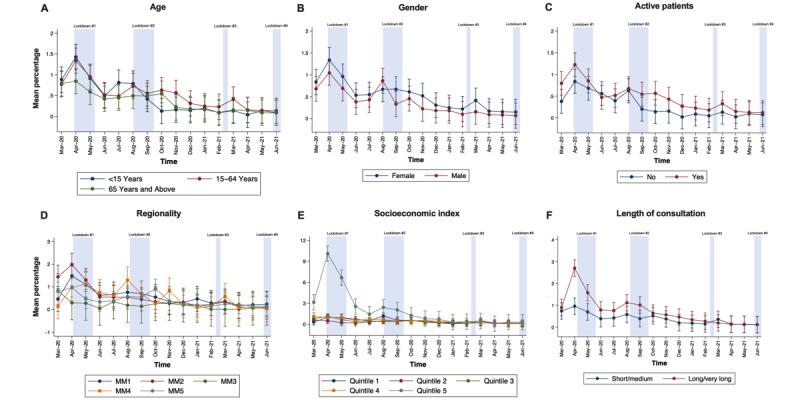
Telehealth comprised 25.8% (522,932/2,025,615) of GP consultations over the 2-year period. After the introduction of the Australian telehealth expansion policy in March 2020, there was a rapid uptake in GP telehealth services (including telephone and video services), from 0% before COVID-19 to 15% (11,854/80,922) of all consultations in March 2020, peaking at 55% (50,828/92,139) in August 2020. Thereafter, the use of telehealth declined steadily to 31% (23,941/77,344) in January 2021 and tapered off to 28% (29,263/103,798) in June 2021. Telephone services and shorter consultations were the most dominant form, and those aged 15-64 years had higher telehealth use rates than younger or older age groups. The proportion of video consultations was higher during periods with government-imposed lockdowns and higher in the most socioeconomically advantaged areas compared to less socioeconomically advantaged areas.
CONCLUSIONS
Our findings support the continuation of telehealth use in rural and regional Australia post pandemic. Future policy must identify mechanisms to reduce existing equity gaps in video consultations and consider patient- and system-level implications of the dominant use of short telephone consultations.
背景
2020 年 3 月,澳大利亚政府扩大了全科医生(GP)远程医疗服务,以应对 COVID-19 大流行。
目的
本研究旨在评估维多利亚州农村地区的全科医生远程医疗服务使用模式,以应对情况变化(在 COVID-19 大流行之前和期间,以及是否封锁)。
方法
我们对 2019 年 7 月至 2021 年 6 月期间来自维多利亚州西部 140 个农村全科医生实践的每月医疗保险索赔数据进行了二次分析。分析了按咨询类型(即视频会议与电话)和地理、消费者和咨询特征分层的 GP 远程医疗咨询比例的纵向模式。
结果
在两年期间,远程医疗占全科医生咨询的 25.8%(522932/2025615)。2020 年 3 月澳大利亚远程医疗扩张政策出台后,GP 远程医疗服务(包括电话和视频服务)迅速普及,从 COVID-19 之前的 0%上升到 2020 年 3 月的所有咨询的 15%(11854/80922),在 2020 年 8 月达到 55%(50828/92139)的峰值。此后,远程医疗的使用稳步下降,到 2021 年 1 月降至 31%(23941/77344),到 2021 年 6 月降至 28%(29263/103798)。电话服务和较短的咨询是最主要的形式,15-64 岁年龄组的远程医疗使用率高于其他年龄组。在政府实施封锁期间,视频咨询的比例较高,在社会经济条件较优越的地区高于社会经济条件较差的地区。
结论
我们的研究结果支持澳大利亚农村和地区在大流行后继续使用远程医疗。未来的政策必须确定机制,以减少视频咨询方面现有的公平差距,并考虑到主要使用短电话咨询对患者和系统层面的影响。


 Zotero 插件