
长期接触芬太尼蒸汽自我给药会导致小鼠出现成瘾样行为:血液趋化因子/细胞因子水平作为潜在生物标志物。
Extended access to fentanyl vapor self-administration leads to addiction-like behaviors in mice: Blood chemokine/cytokine levels as potential biomarkers.
作者信息
Marchette Renata C N, Carlson Erika R, Said Nadia, Koob George F, Vendruscolo Leandro F
机构信息
Neurobiology of Addiction Section, National Institute on Drug Abuse, Intramural Research Program, National Institutes of Health, 251 Bayview Boulevard, BRC 08A505.16, Baltimore, MD 21224, USA.
Stress & Addiction Neuroscience Unit, National Institute on Drug Abuse and National Institute on Alcohol Abuse and Alcoholism Intramural Research Programs, National Institutes of Health, Baltimore, MD, USA.
出版信息
Addict Neurosci. 2023 Mar;5. doi: 10.1016/j.addicn.2022.100057. Epub 2022 Dec 9.
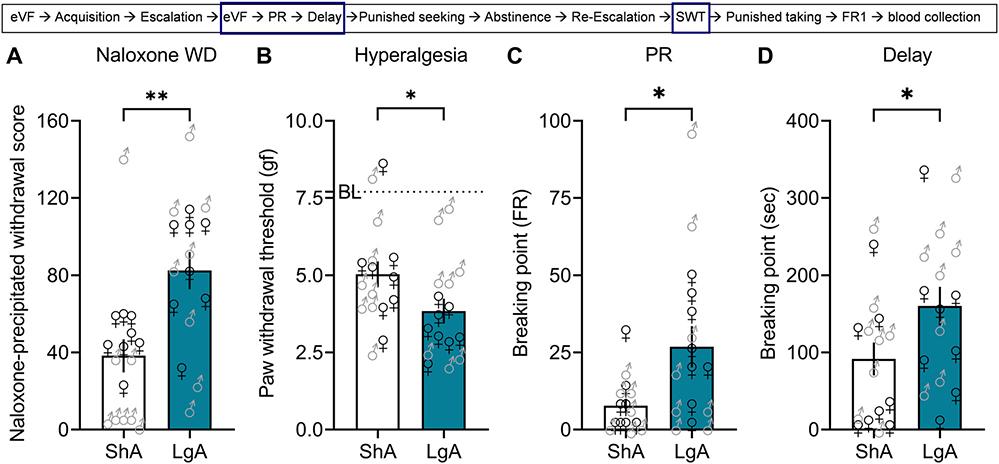
Rodent models are useful for understanding the mechanisms that underlie opioid addiction, but most preclinical studies have focused on rewarding and consummatory aspects of opioids without components of dependence-induced escalation of drug taking or seeking. We characterized several opioid-related behaviors in mice using a model of vaporized fentanyl self-administration. Male and female C57BL/6J mice were assigned to short-access (ShA; 1 h, nondependent) or long-access (LgA; 6 h, dependent) fentanyl vapor self-administration and subsequently tested in a battery of behavioral tests, followed by blood collection during withdrawal. Compared with mice in the ShA group, mice in the LgA group escalated their fentanyl intake, were more motivated to work to obtain the drug, exhibited greater hyperalgesia, and exhibited greater signs of naloxone-precipitated withdrawal. Principal component analysis indicated the emergence of two independent behavioral constructs: "intake/motivation" and "hyperalgesia/punished seeking." In mice in the LgA condition only, "hyperalgesia/punished seeking" was associated with plasma levels of proinflammatory interleukin-17 (IL-17), chemokine (C-C motif) ligand 4 (CCL-4), and tumor necrosis factor (TNF-). Overall, the results suggest that extended access to opioids leads to addiction-like behavior, and some constructs that are associated with addiction-like behavior may be associated with levels of the proinflammatory cytokines/chemokines IL-17, TNF-, and CCL-4 in blood.
啮齿动物模型对于理解阿片类药物成瘾的潜在机制很有用,但大多数临床前研究都集中在阿片类药物的奖赏和摄取方面,而没有涉及依赖诱导的药物服用或觅药行为升级的成分。我们使用汽化芬太尼自我给药模型对小鼠的几种阿片类药物相关行为进行了表征。将雄性和雌性C57BL/6J小鼠分配到短时间给药(ShA;1小时,非依赖)或长时间给药(LgA;6小时,依赖)的芬太尼蒸汽自我给药组,随后在一系列行为测试中进行测试,然后在戒断期间采集血液。与ShA组的小鼠相比,LgA组的小鼠芬太尼摄入量增加,为获得药物而工作的动机更强,表现出更大的痛觉过敏,并且表现出更强的纳洛酮诱发的戒断症状。主成分分析表明出现了两种独立的行为结构:“摄入量/动机”和“痛觉过敏/受惩罚的觅药行为”。仅在LgA条件下的小鼠中,“痛觉过敏/受惩罚的觅药行为”与促炎白细胞介素-17(IL-17)、趋化因子(C-C基序)配体4(CCL-4)和肿瘤坏死因子(TNF-)的血浆水平相关。总体而言,结果表明长时间接触阿片类药物会导致成瘾样行为,并且一些与成瘾样行为相关的结构可能与血液中促炎细胞因子/趋化因子IL-17、TNF-和CCL-4的水平相关。




 Zotero 插件