
五岁儿童会根据道歉中是否包含原因来评价信念性意外事件。
Five-year-old children value reasons in apologies for belief-based accidents.
机构信息
Division of Psychology, Communication and Human Neuroscience, School of Health Sciences, University of Manchester, Manchester, UK.
Georg-Elias-Müller-Institute for Psychology, Georg-August-University Göttingen, Göttingen, Germany.
出版信息
Child Dev. 2023 May;94(3):e143-e153. doi: 10.1111/cdev.13893. Epub 2023 Jan 24.
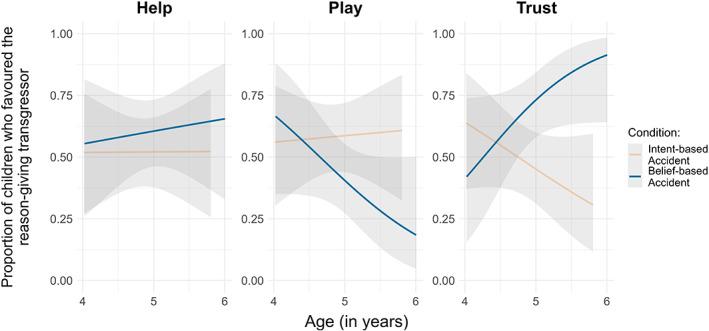
Accidents can be intent-based (unintended action-unintended outcome) or belief-based (intended action-unintended outcome). As compared to intent-based accidents, giving reasons is more crucial for belief-based accidents because the transgressor appears to have intentionally transgressed. In Study 1, UK-based preschoolers who were native English speakers (N = 96, 53 girls, collected 2020-2021) witnessed two intent-based or belief-based accidents; one transgressor apologized, the other apologized with a reason. Five-year-olds, but not 4-year-olds, favored the reason-giving transgressor following a belief-based accident but not an intent-based accident (where an apology sufficed). In Study 2, 5-year-olds (N = 48, 25 girls, collected 2021) distinguished between "good" and "bad" reasons for the harm caused. Thus, 5-year-old children recognize when reasons should accompany apologies and account for the quality of these reasons.
事故可以是有意的(非故意行为-非故意结果)或基于信念的(有意行为-非故意结果)。与有意事故相比,基于信念的事故更需要给出理由,因为违规者似乎是故意违规的。在研究 1 中,以英语为母语的英国学龄前儿童(N=96,53 名女孩,2020-2021 年收集)目睹了两个基于信念或基于意图的事故;一个违规者道歉了,另一个道歉并给出了理由。只有 5 岁的儿童,而不是 4 岁的儿童,在基于信念的事故(道歉就足够了)和基于意图的事故后更喜欢给出理由的违规者。在研究 2 中,5 岁儿童(N=48,25 名女孩,2021 年收集)区分了造成伤害的“好”和“坏”理由。因此,5 岁儿童认识到何时应该在道歉时附上理由,并考虑这些理由的质量。




 Zotero 插件