
2021 年肯尼亚 Panbio COVID-19 抗原快速检测设备对 SARS-CoV-2 检测的诊断准确性:现场评估。
Diagnostic accuracy of the Panbio COVID-19 antigen rapid test device for SARS-CoV-2 detection in Kenya, 2021: A field evaluation.
机构信息
Field Epidemiology and Laboratory Training Program, Ministry of Health, Nairobi, Kenya.
U.S. Centers for Disease Control and Prevention, Nairobi, Kenya.
出版信息
PLoS One. 2023 Jan 25;18(1):e0277657. doi: 10.1371/journal.pone.0277657. eCollection 2023.
BACKGROUND
Accurate and timely diagnosis is essential in limiting the spread of SARS-CoV-2 infection. The reference standard, rRT-PCR, requires specialized laboratories, costly reagents, and a long turnaround time. Antigen RDTs provide a feasible alternative to rRT-PCR since they are quick, relatively inexpensive, and do not require a laboratory. The WHO requires that Ag RDTs have a sensitivity ≥80% and specificity ≥97%.
METHODS
This evaluation was conducted at 11 health facilities in Kenya between March and July 2021. We enrolled persons of any age with respiratory symptoms and asymptomatic contacts of confirmed COVID-19 cases. We collected demographic and clinical information and two nasopharyngeal specimens from each participant for Ag RDT testing and rRT-PCR. We calculated the diagnostic performance of the Panbio™ Ag RDT against the US Centers for Disease Control and Prevention's (CDC) rRT-PCR test.
RESULTS
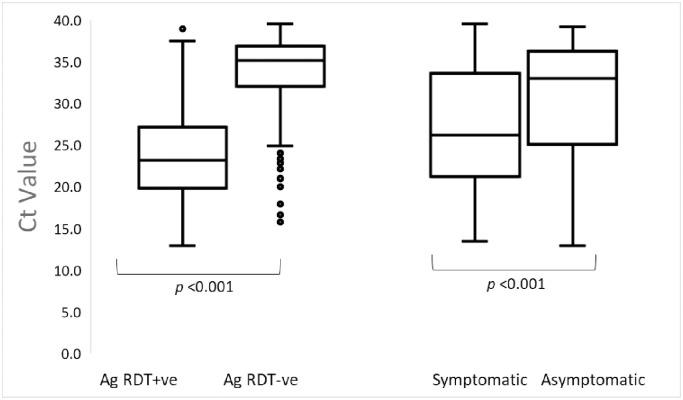
We evaluated the Ag RDT in 2,245 individuals where 551 (24.5%, 95% CI: 22.8-26.3%) tested positive by rRT-PCR. Overall sensitivity of the Ag RDT was 46.6% (95% CI: 42.4-50.9%), specificity 98.5% (95% CI: 97.8-99.0%), PPV 90.8% (95% CI: 86.8-93.9%) and NPV 85.0% (95% CI: 83.4-86.6%). Among symptomatic individuals, sensitivity was 60.6% (95% CI: 54.3-66.7%) and specificity was 98.1% (95% CI: 96.7-99.0%). Among asymptomatic individuals, sensitivity was 34.7% (95% CI 29.3-40.4%) and specificity was 98.7% (95% CI: 97.8-99.3%). In persons with onset of symptoms <5 days (594/876, 67.8%), sensitivity was 67.1% (95% CI: 59.2-74.3%), and 53.3% (95% CI: 40.0-66.3%) among those with onset of symptoms >7 days (157/876, 17.9%). The highest sensitivity was 87.0% (95% CI: 80.9-91.8%) in symptomatic individuals with cycle threshold (Ct) values ≤30.
CONCLUSION
The overall sensitivity and NPV of the Panbio™ Ag RDT were much lower than expected. The specificity of the Ag RDT was high and satisfactory; therefore, a positive result may not require confirmation by rRT-PCR. The kit may be useful as a rapid screening tool only for symptomatic patients in high-risk settings with limited access to rRT-PCR. A negative result should be interpreted based on clinical and epidemiological information and may require retesting by rRT-PCR.
背景
准确及时的诊断对于限制 SARS-CoV-2 感染的传播至关重要。参考标准 rRT-PCR 需要专门的实验室、昂贵的试剂和较长的周转时间。抗原 RDT 提供了一种可行的替代 rRT-PCR 的方法,因为它们快速、相对便宜且不需要实验室。世界卫生组织要求 Ag RDT 的灵敏度≥80%,特异性≥97%。
方法
本评估在肯尼亚的 11 个卫生设施中于 2021 年 3 月至 7 月进行。我们招募了有呼吸道症状的任何年龄的人和确诊 COVID-19 病例的无症状接触者。我们收集了每位参与者的人口统计学和临床信息以及两个鼻咽标本,用于 Ag RDT 检测和 rRT-PCR。我们计算了 Panbio™Ag RDT 与美国疾病控制与预防中心 (CDC) rRT-PCR 检测的诊断性能。
结果
我们评估了 2245 名 Ag RDT 检测呈阳性的个体,其中 551 名(24.5%,95%CI:22.8-26.3%)经 rRT-PCR 检测呈阳性。Ag RDT 的总体敏感性为 46.6%(95%CI:42.4-50.9%),特异性为 98.5%(95%CI:97.8-99.0%),PPV 为 90.8%(95%CI:86.8-93.9%),NPV 为 85.0%(95%CI:83.4-86.6%)。在有症状的个体中,敏感性为 60.6%(95%CI:54.3-66.7%),特异性为 98.1%(95%CI:96.7-99.0%)。在无症状个体中,敏感性为 34.7%(95%CI 29.3-40.4%),特异性为 98.7%(95%CI:97.8-99.3%)。在症状出现 <5 天的个体(594/876,67.8%)中,敏感性为 67.1%(95%CI:59.2-74.3%),在症状出现 >7 天的个体(157/876,17.9%)中,敏感性为 53.3%(95%CI:40.0-66.3%)。最高敏感性为 87.0%(95%CI:80.9-91.8%),见于 Ct 值≤30 的有症状个体。
结论
Panbio™Ag RDT 的总体敏感性和 NPV 远低于预期。Ag RDT 的特异性较高且令人满意;因此,阳性结果可能不需要 rRT-PCR 确认。该试剂盒可能仅适用于有症状的高危环境中的患者作为快速筛选工具,这些患者获得 rRT-PCR 的机会有限。阴性结果应根据临床和流行病学信息进行解释,可能需要通过 rRT-PCR 进行重新检测。

 Zotero 插件