
利用定量 CT 预测严重慢性阻塞性肺疾病恶化:一项回顾性模型开发和外部验证研究。
Predicting severe chronic obstructive pulmonary disease exacerbations using quantitative CT: a retrospective model development and external validation study.
机构信息
The Roy J Carver Department of Biomedical Engineering, University of Iowa, Iowa City, IA, USA.
Department of Radiology, University of Iowa, Iowa City, IA, USA; Department of Internal Medicine, Division of Pulmonary, Critical Care and Occupational Medicine, University of Iowa, Iowa City, IA, USA; The Roy J Carver Department of Biomedical Engineering, University of Iowa, Iowa City, IA, USA.
出版信息
Lancet Digit Health. 2023 Feb;5(2):e83-e92. doi: 10.1016/S2589-7500(22)00232-1.
BACKGROUND
Quantitative CT is becoming increasingly common for the characterisation of lung disease; however, its added potential as a clinical tool for predicting severe exacerbations remains understudied. We aimed to develop and validate quantitative CT-based models for predicting severe chronic obstructive pulmonary disease (COPD) exacerbations.
METHODS
We analysed the Subpopulations and Intermediate Outcome Measures In COPD Study (SPIROMICS) cohort, a multicentre study done at 12 clinical sites across the USA, of individuals aged 40-80 years from four strata: individuals who never smoked, individuals who smoked but had normal spirometry, individuals who smoked and had mild to moderate COPD, and individuals who smoked and had severe COPD. We used 3-year follow-up data to develop logistic regression classifiers for predicting severe exacerbations. Predictors included age, sex, race, BMI, pulmonary function, exacerbation history, smoking status, respiratory quality of life, and CT-based measures of density gradient texture and airway structure. We externally validated our models in a subset from the Genetic Epidemiology of COPD (COPDGene) cohort. Discriminative model performance was assessed using the area under the receiver operating characteristic curve (AUC), which was also compared with other predictors, including exacerbation history and the BMI, airflow obstruction, dyspnoea, and exercise capacity (BODE) index. We evaluated model calibration using calibration plots and Brier scores.
FINDINGS
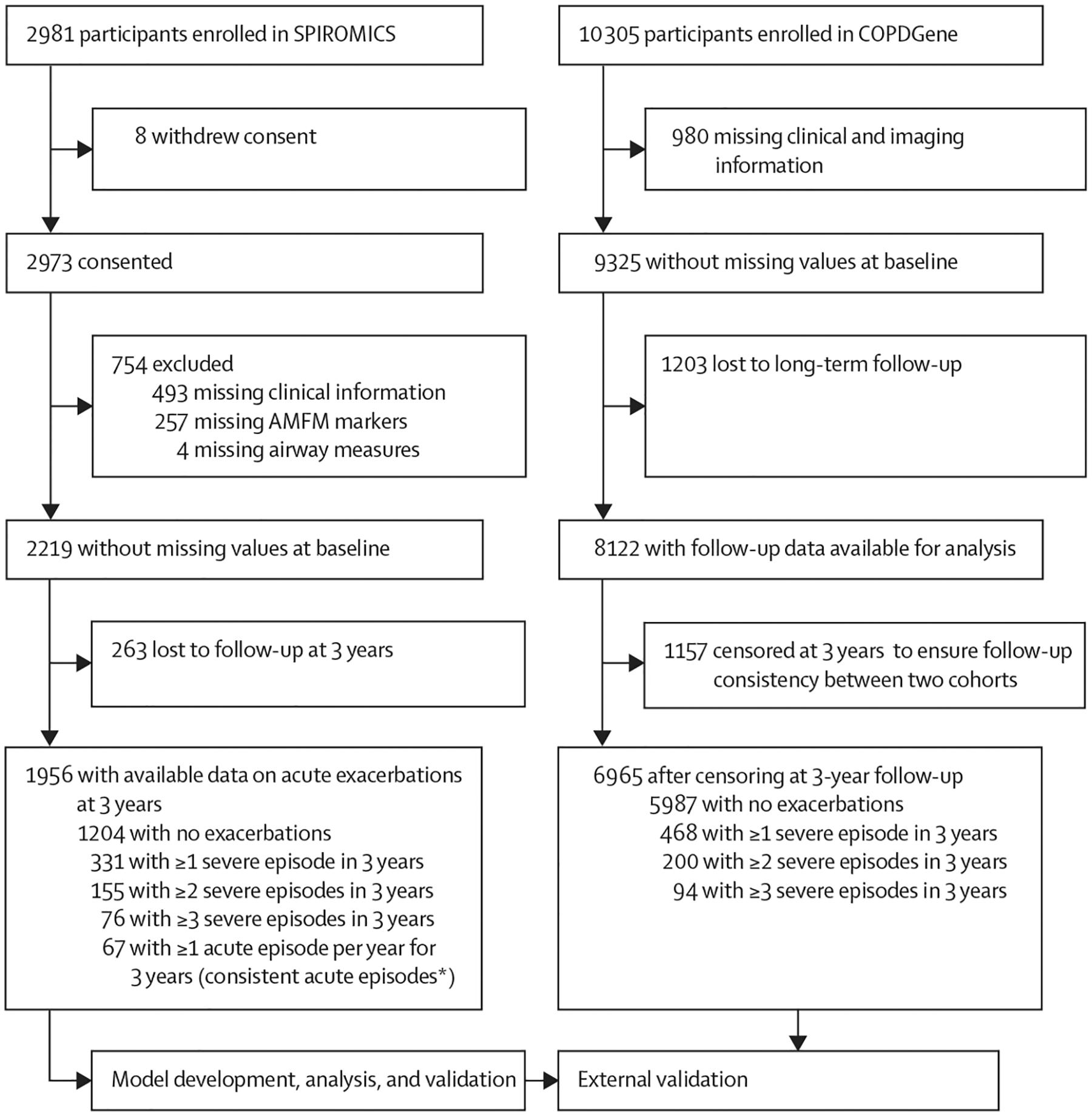
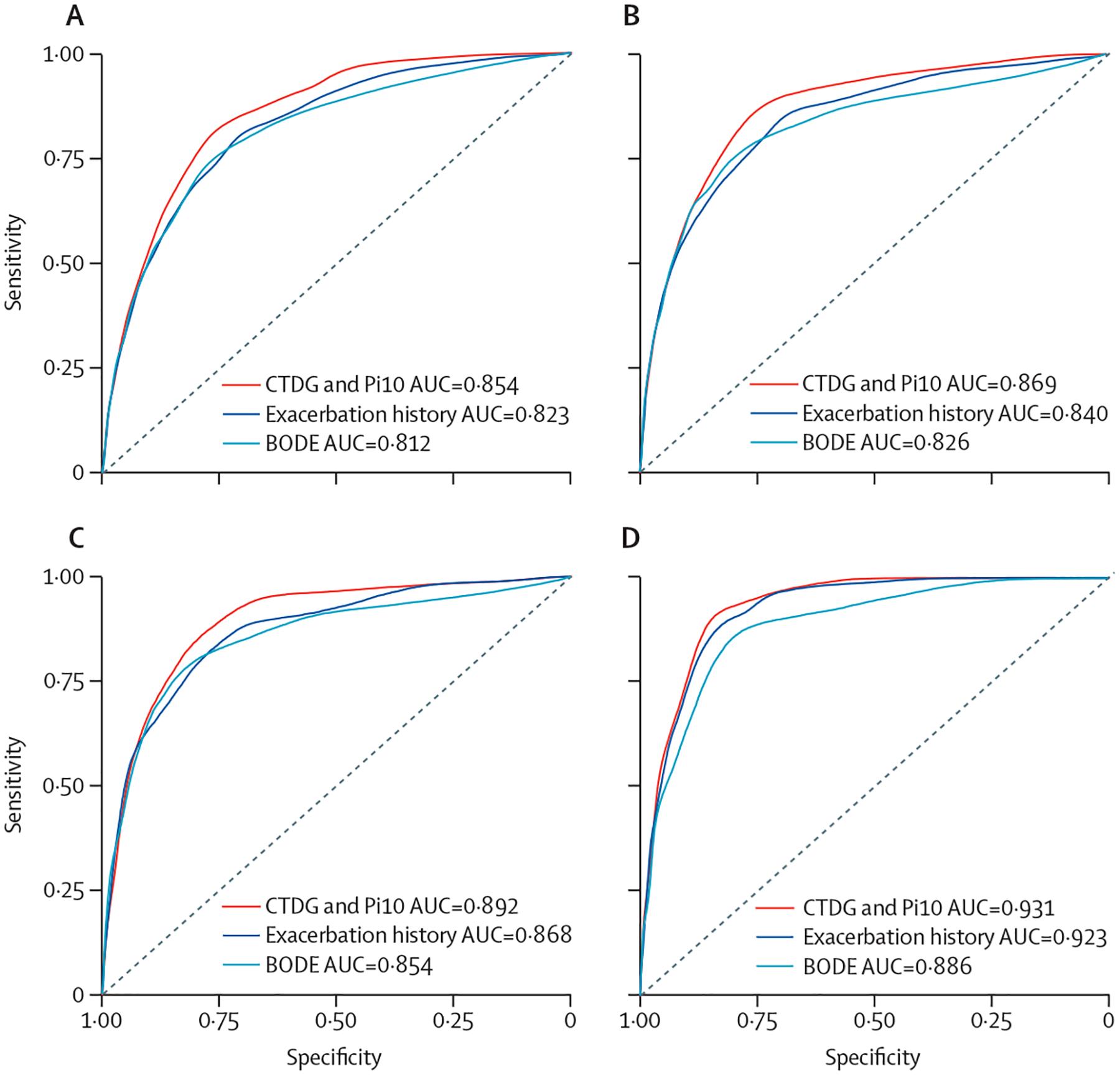
Participants in SPIROMICS were enrolled between Nov 12, 2010, and July 31, 2015. Participants in COPDGene were enrolled between Jan 10, 2008, and April 15, 2011. We included 1956 participants from the SPIROMICS cohort who had complete 3-year follow-up data: the mean age of the cohort was 63·1 years (SD 9·2) and 1017 (52%) were men and 939 (48%) were women. Among the 1956 participants, 434 (22%) had a history of at least one severe exacerbation. For the CT-based models, the AUC was 0·854 (95% CI 0·852-0·855) for at least one severe exacerbation within 3 years and 0·931 (0·930-0·933) for consistent exacerbations (defined as ≥1 acute episode in each of the 3 years). Models were well calibrated with low Brier scores (0·121 for at least one severe exacerbation; 0·039 for consistent exacerbations). For the prediction of at least one severe event during 3-year follow-up, AUCs were significantly higher with CT biomarkers (0·854 [0·852-0·855]) than exacerbation history (0·823 [0·822-0·825]) and BODE index 0·812 [0·811-0·814]). 6965 participants were included in the external validation cohort, with a mean age of 60·5 years (SD 8·9). In this cohort, AUC for at least one severe exacerbation was 0·768 (0·767-0·769; Brier score 0·088).
INTERPRETATION
CT-based prediction models can be used for identification of patients with COPD who are at high risk of severe exacerbations. The newly identified CT biomarkers could potentially enable investigation into underlying disease mechanisms responsible for exacerbations.
FUNDING
National Institutes of Health and the National Heart, Lung, and Blood Institute.
背景
定量 CT 越来越常用于肺部疾病的特征描述;然而,其作为预测严重恶化的临床工具的潜在用途仍有待研究。我们旨在开发和验证基于定量 CT 的模型,用于预测严重慢性阻塞性肺疾病(COPD)恶化。
方法
我们分析了来自美国 12 个临床地点的多中心研究 Subpopulations and Intermediate Outcome Measures In COPD Study(SPIROMICS)队列,年龄在 40-80 岁之间的个体分为四个层次:从不吸烟的个体、吸烟但肺功能正常的个体、吸烟且患有轻度至中度 COPD 的个体以及吸烟且患有严重 COPD 的个体。我们使用 3 年的随访数据来开发用于预测严重恶化的逻辑回归分类器。预测因子包括年龄、性别、种族、BMI、肺功能、恶化史、吸烟状况、呼吸质量、以及基于密度梯度纹理和气道结构的 CT 测量值。我们在来自 Genetic Epidemiology of COPD(COPDGene)队列的子集中对我们的模型进行了外部验证。使用接收者操作特征曲线(ROC)下的面积(AUC)评估判别模型性能,该 AUC 也与其他预测因子(包括恶化史、BMI、气流阻塞、呼吸困难和运动能力(BODE)指数)进行了比较。我们使用校准图和 Brier 分数评估模型校准。
结果
SPIROMICS 参与者于 2010 年 11 月 12 日至 2015 年 7 月 31 日期间入组。COPDGene 参与者于 2008 年 1 月 10 日至 2011 年 4 月 15 日期间入组。我们纳入了 SPIROMICS 队列中 1956 名完成 3 年随访数据的参与者:队列的平均年龄为 63.1 岁(SD 9.2),1017 名(52%)为男性,939 名(48%)为女性。在 1956 名参与者中,434 名(22%)有至少一次严重恶化史。对于基于 CT 的模型,在 3 年内至少有一次严重恶化的 AUC 为 0.854(95%CI 0.852-0.855),持续恶化的 AUC 为 0.931(0.930-0.933)。模型具有较低的 Brier 分数(至少一次严重恶化的为 0.121;持续恶化的为 0.039),校准良好。对于预测 3 年随访期间至少有一次严重事件,CT 生物标志物的 AUC(0.854 [0.852-0.855])明显高于恶化史(0.823 [0.822-0.825])和 BODE 指数(0.812 [0.811-0.814])。6965 名参与者纳入了外部验证队列,平均年龄为 60.5 岁(SD 8.9)。在该队列中,至少有一次严重恶化的 AUC 为 0.768(0.767-0.769;Brier 分数为 0.088)。
解释
基于 CT 的预测模型可用于识别 COPD 患者中发生严重恶化的高危患者。新发现的 CT 生物标志物可能有助于研究导致恶化的潜在疾病机制。
资金来源
美国国立卫生研究院和美国国家心肺血液研究所。



 Zotero 插件