
残疾数字鸿沟:对有和没有障碍的人感知的电子健康服务可及性的调查。
Disability digital divide: survey of accessibility of eHealth services as perceived by people with and without impairment.
机构信息
Center for Clinical Research Dalarna, Uppsala University, Nissers Väg 3, SE-791 82, Falun, Sweden.
Department of Public Health and Caring Sciences, Uppsala University, Box 564, SE-751 22, Uppsala, Sweden.
出版信息
BMC Public Health. 2023 Jan 27;23(1):181. doi: 10.1186/s12889-023-15094-z.
BACKGROUND
Sustainable and effective eHealth requires accessibility for everyone. Little is known about how accessibility of eHealth is perceived among people with various impairments. The aim of this study was to compare use and perceived difficulty in the use of eHealth among people with and without impairment, and how different types of impairment were associated with perceived difficulty in the use of eHealth.
METHODS
This study used data collected in a nationwide survey in Sweden. Snowball sampling was used to recruit participants with self-reported impairment, from June to October 2019. In February 2020, the survey was posted to people in the general population who were matched to the participants with impairment by age, gender and county of residence. Multiple logistic regression was used to analyse the use of four eHealth services, and perceived difficulty in the use of six eHealth services.
RESULTS
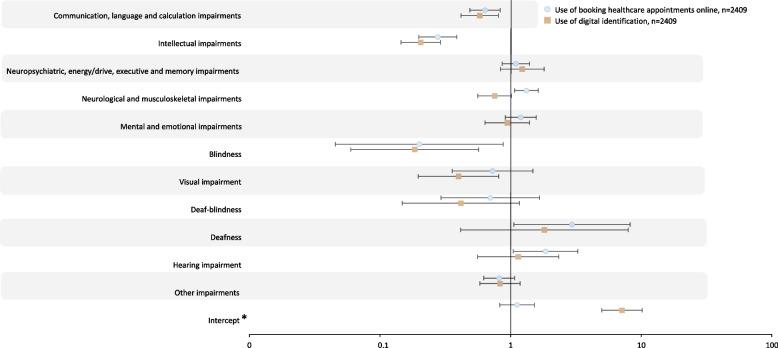
In total, 1631 participants with, and 1084 participants without impairment responded to the survey. Participants with impairment reported less use and more difficulty in the use of all eHealth services as compared to participants without impairment. When comparing types of impairment, booking healthcare appointments online was least used and most avoided by participants with communication, language and calculation impairments (adjusted odds ratio (aOR) use 0.64, 95% confidence interval (95%CI) 0.49-0.83; aOR avoid 1.64, 95%CI 1.19-2.27), and intellectual impairments (aOR use 0.28, 95%CI 0.20-0.39; aOR avoid 2.88, 95%CI 1.86-4.45). The Swedish national web-portal for health information and services, 1177.se, was reported difficult to use the most among participants with communication, language and calculation impairments (aOR 2.24, 95%CI 1.50-3.36), deaf-blindness (aOR 11.24, 95%CI 3.49-36.23) and hearing impairment (aOR 2.50, 95%CI 1.17-5.35).
CONCLUSIONS
The results confirm the existence of an eHealth disability digital divide. People with impairment were not one homogeneous group, but differed in perceived difficulties in regard to eHealth. Based on a purposeful subgrouping of impairments, we showed that people with communication, language and calculation impairments, and intellectual impairments, reported least use and most difficulty in using eHealth. The findings can guide further research in creating eHealth that is accessible for all, including those with the most significant difficulties.
背景
可持续且有效的电子健康需要每个人都能获得。人们对不同残疾人群体对电子健康的可及性感知知之甚少。本研究的目的是比较有和无残疾人群体在使用电子健康方面的使用情况和感知难度,并探讨不同类型的残疾与使用电子健康的感知难度之间的关系。
方法
本研究使用了 2019 年 6 月至 10 月在瑞典进行的一项全国性调查中收集的数据。采用滚雪球抽样的方法招募自报告有残疾的参与者。2020 年 2 月,向与有残疾的参与者在年龄、性别和居住县匹配的一般人群中的参与者发布了该调查。采用多变量逻辑回归分析了四种电子健康服务的使用情况,以及六种电子健康服务使用的感知难度。
结果
共有 1631 名有残疾的参与者和 1084 名无残疾的参与者对该调查做出了回应。与无残疾的参与者相比,有残疾的参与者报告称他们使用所有电子健康服务的频率较低,感知难度较大。在比较不同类型的残疾时,在线预约医疗服务的使用频率最低,并且最容易被有沟通、语言和计算障碍(调整后的优势比(aOR)使用 0.64,95%置信区间(95%CI)0.49-0.83;aOR 避免 1.64,95%CI 1.19-2.27)和智力障碍(aOR 使用 0.28,95%CI 0.20-0.39;aOR 避免 2.88,95%CI 1.86-4.45)的参与者所回避。瑞典国家健康信息和服务门户网站 1177.se 被报告为沟通、语言和计算障碍(aOR 2.24,95%CI 1.50-3.36)、聋盲(aOR 11.24,95%CI 3.49-36.23)和听力障碍(aOR 2.50,95%CI 1.17-5.35)的参与者中感知难度最大。
结论
研究结果证实了电子健康残疾数字鸿沟的存在。有残疾的人并不是一个同质的群体,他们在电子健康方面的感知困难程度存在差异。基于对障碍的有针对性的分组,我们发现有沟通、语言和计算障碍以及智力障碍的参与者报告称他们使用电子健康的频率最低,感知难度最大。这些发现可以为进一步研究创造所有人都能获得的电子健康提供指导,包括那些有最大困难的人。



 Zotero 插件