
一种简化的、基于机器学习的方法,用于心力衰竭伴继发性三尖瓣反流患者的风险分层。
A streamlined, machine learning-derived approach to risk-stratification in heart failure patients with secondary tricuspid regurgitation.
机构信息
Department of Internal Medicine II, Medical University of Vienna, Währinger Gürtel 18-20, 1090 Vienna, Austria.
Department of Internal Medicine III, Medical University of Vienna, Währinger Gürtel 18-20, 1090 Vienna, Austria.
出版信息
Eur Heart J Cardiovasc Imaging. 2023 Apr 24;24(5):588-597. doi: 10.1093/ehjci/jead009.
AIMS
Secondary tricuspid regurgitation (sTR) is the most frequent valvular heart disease and has a significant impact on mortality. A high burden of comorbidities often worsens the already dismal prognosis of sTR, while tricuspid interventions remain underused and initiated too late. The aim was to examine the most powerful predictors of all-cause mortality in moderate and severe sTR using machine learning techniques and to provide a streamlined approach to risk-stratification using readily available clinical, echocardiographic and laboratory parameters.
METHODS AND RESULTS
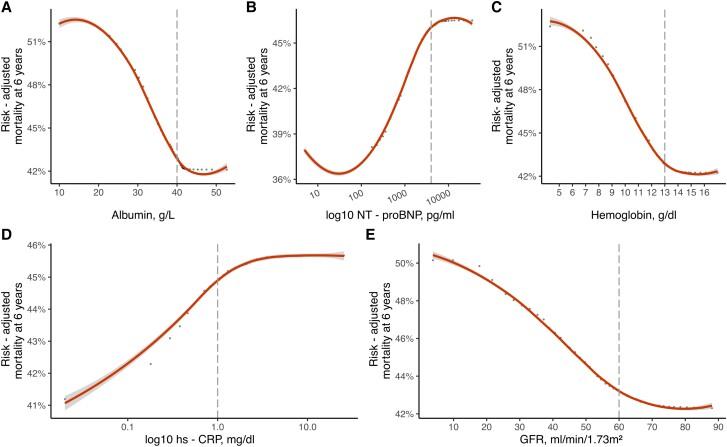
This large-scale, long-term observational study included 3359 moderate and 1509 severe sTR patients encompassing the entire heart failure spectrum (preserved, mid-range and reduced ejection fraction). A random survival forest was applied to investigate the most important predictors and group patients according to their number of adverse features.The identified predictors and thresholds, that were associated with significantly worse mortality were lower glomerular filtration rate (<60 mL/min/1.73m2), higher NT-proBNP, increased high sensitivity C-reactive protein, serum albumin < 40 g/L and hemoglobin < 13 g/dL. Additionally, grouping patients according to the number of adverse features yielded important prognostic information, as patients with 4 or 5 adverse features had a fourfold risk increase in moderate sTR [4.81(3.56-6.50) HR 95%CI, P < 0.001] and fivefold risk increase in severe sTR [5.33 (3.28-8.66) HR 95%CI, P < 0.001].
CONCLUSION
This study presents a streamlined, machine learning-derived and internally validated approach to risk-stratification in patients with moderate and severe sTR, that adds important prognostic information to aid clinical-decision-making.
目的
三尖瓣反流(sTR)是最常见的瓣膜性心脏病,对死亡率有重大影响。合并症负担高往往使已经不乐观的 sTR 预后恶化,而三尖瓣介入治疗的应用不足且启动太晚。本研究旨在使用机器学习技术,检测中重度 sTR 全因死亡率的最强预测因素,并提供一种使用易于获得的临床、超声心动图和实验室参数进行风险分层的简化方法。
方法和结果
这项大规模、长期的观察性研究纳入了涵盖整个心力衰竭谱(射血分数保留、中间范围和降低)的 3359 例中重度和 1509 例重度 sTR 患者。随机生存森林用于调查最重要的预测因素,并根据不良特征的数量对患者进行分组。与死亡率显著相关的识别出的预测因素和阈值包括肾小球滤过率较低(<60 mL/min/1.73m2)、NT-proBNP 升高、高敏 C 反应蛋白增加、血清白蛋白<40 g/L 和血红蛋白<13 g/dL。此外,根据不良特征的数量对患者进行分组可提供重要的预后信息,因为中重度 sTR 中具有 4 或 5 个不良特征的患者风险增加了四倍[4.81(3.56-6.50)HR 95%CI,P<0.001],重度 sTR 风险增加了五倍[5.33(3.28-8.66)HR 95%CI,P<0.001]。
结论
本研究提出了一种简化的、基于机器学习的、内部验证的中重度 sTR 风险分层方法,为辅助临床决策提供了重要的预后信息。



 Zotero 插件