
植物病原细菌利用宿主葡萄糖作为信号,通过 LuxR 同源物刺激毒力。
Phytopathogenic bacteria utilize host glucose as a signal to stimulate virulence through LuxR homologues.
机构信息
State Key Laboratory of Plant Genomics, Institute of Microbiology, Chinese Academy of Sciences, Beijing, China.
University of Chinese Academy of Sciences, Beijing, China.
出版信息
Mol Plant Pathol. 2023 Apr;24(4):359-373. doi: 10.1111/mpp.13302. Epub 2023 Feb 10.
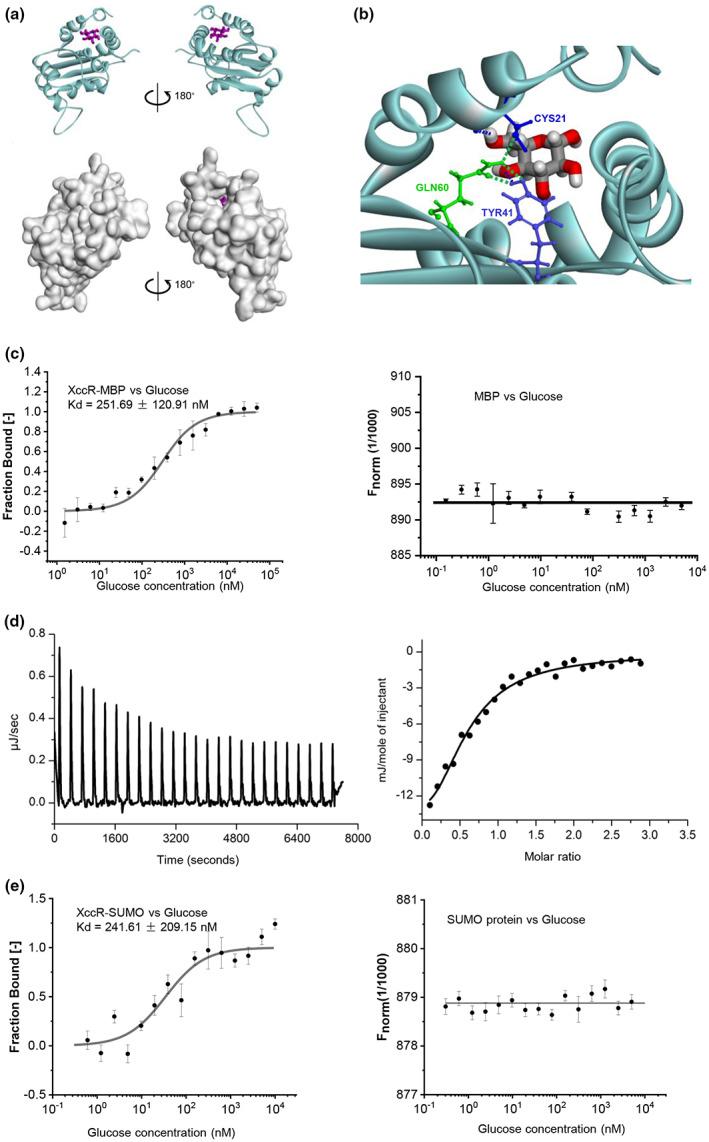
Chemical signal-mediated biological communication is common within bacteria and between bacteria and their hosts. Many plant-associated bacteria respond to unknown plant compounds to regulate bacterial gene expression. However, the nature of the plant compounds that mediate such interkingdom communication and the underlying mechanisms remain poorly characterized. Xanthomonas campestris pv. campestris (Xcc) causes black rot disease on brassica vegetables. Xcc contains an orphan LuxR regulator (XccR) which senses a plant signal that was validated to be glucose by HPLC-MS. The glucose concentration increases in apoplast fluid after Xcc infection, which is caused by the enhanced activity of plant sugar transporters translocating sugar and cell-wall invertases releasing glucose from sucrose. XccR recruits glucose, but not fructose, sucrose, glucose 6-phosphate, and UDP-glucose, to activate pip expression. Deletion of the bacterial glucose transporter gene sglT impaired pathogen virulence and pip expression. Structural prediction showed that the N-terminal domain of XccR forms an alternative pocket neighbouring the AHL-binding pocket for glucose docking. Substitution of three residues affecting structural stability abolished the ability of XccR to bind to the luxXc box in the pip promoter. Several other XccR homologues from plant-associated bacteria can also form stable complexes with glucose, indicating that glucose may function as a common signal molecule for pathogen-plant interactions. The conservation of a glucose/XccR/pip-like system in plant-associated bacteria suggests that some phytopathogens have evolved the ability to utilize host compounds as virulence signals, indicating that LuxRs mediate an interkingdom signalling circuit.
化学信号介导的生物通讯在细菌内部以及细菌与其宿主之间很常见。许多与植物相关的细菌会对未知的植物化合物做出反应,以调节细菌基因的表达。然而,介导这种跨界交流的植物化合物的性质以及潜在的机制仍未得到很好的描述。野油菜黄单胞菌 pv. 甘蓝型(Xcc)会导致十字花科蔬菜的黑腐病。Xcc 含有一个孤儿 LuxR 调节剂(XccR),它可以感知一种被 HPLC-MS 验证为葡萄糖的植物信号。在 Xcc 感染后,质外体液中的葡萄糖浓度会增加,这是由于植物糖转运蛋白的活性增强,将糖转运到质外体,细胞壁转化酶将蔗糖中的葡萄糖释放出来。XccR 招募葡萄糖,而不是果糖、蔗糖、葡萄糖 6-磷酸和 UDP-葡萄糖,以激活 pip 的表达。细菌葡萄糖转运基因 sglT 的缺失会损害病原体的毒力和 pip 的表达。结构预测表明,XccR 的 N 端结构域形成了一个替代口袋,位于 AHL 结合口袋旁边,用于葡萄糖结合。三个影响结构稳定性的残基的取代,会使 XccR 丧失与 pip 启动子上 luxXc 盒结合的能力。来自其他几种与植物相关的细菌的 XccR 同源物也可以与葡萄糖形成稳定的复合物,这表明葡萄糖可能是病原体与植物相互作用的一种常见信号分子。与植物相关的细菌中葡萄糖/XccR/pip 样系统的保守性表明,一些植物病原体已经进化出利用宿主化合物作为毒力信号的能力,这表明 LuxR 介导了一个跨界信号回路。




 Zotero 插件