
机器人辅助运动训练对慢性脊髓损伤患者痉挛、疼痛及生活质量的影响:一项随机对照试验的初步研究
Robotic locomotor training for spasticity, pain, and quality of life in individuals with chronic SCI: A pilot randomized controlled trial.
作者信息
Shackleton Claire, Evans Robert, West Sacha, Derman Wayne, Albertus Yumna
机构信息
Department of Human Biology, Physical Activity, Lifestyle and Sport Research Centre (HPALS), University of Cape Town, Cape Town, South Africa.
Department of Sport Management, Cape Peninsula University of Technology, Cape Town, Western cape, South Africa.
出版信息
Front Rehabil Sci. 2023 Jan 30;4:1003360. doi: 10.3389/fresc.2023.1003360. eCollection 2023.
OBJECTIVE
The prevention and treatment of secondary complications is a key priority for people with spinal cord injury and a fundamental goal of rehabilitation. Activity-based Training (ABT) and Robotic Locomotor Training (RLT) demonstrate promising results for reducing secondary complications associated with SCI. However, there is a need for increased evidence through randomized controlled trials. Therefore, we aimed to investigate the effect of RLT and ABT interventions on pain, spasticity, and quality of life in individuals with spinal cord injuries.
METHODS
Participants with chronic motor incomplete tetraplegia ( = 16) were recruited. Each intervention involved 60-minute sessions, 3× per week, over 24-weeks. RLT involved walking in an Ekso GT exoskeleton. ABT involved a combination of resistance, cardiovascular and weight-bearing exercise. Outcomes of interest included the Modified Ashworth Scale, the International SCI Pain Basic Data Set Version 2, and the International SCI Quality of Life Basic Data Set.
RESULTS
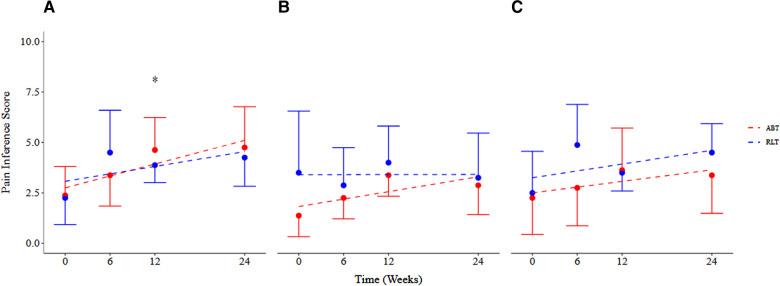
Neither intervention altered symptoms of spasticity. Pain intensity increased from pre-post intervention for both groups, with a mean increase of 1.55 [-0.82, 3.92] ( = 0.03) and 1.56 [-0.43, 3.55] ( = 0.02) points for the RLT and ABT group, respectively. The ABT group had an increase in pain interference scores of 100%, 50%, and 109% for the daily activity, mood, and sleep domain, respectively. The RLT group had an increase in pain interference scores of 86% and 69% for the daily activity and mood domain respectively, but no change in the sleep domain. The RLT group had increased perceptions of quality of life with changes of 2.37 [0.32, 4.41], 2.00 [0.43, 3.56] and 0.25 [-1.63, 2.13] points, = 0.03, for the general, physical, and psychological domains, respectively. The ABT group had increased perceptions of general, physical and psychological quality of life with changes of 0.75 [-1.38, 2.88], 0.62 [-1.83, 3.07] and 0.63 [-1.87, 3.13] points, respectively.
CONCLUSIONS
Despite increased pain ratings and no change in symptoms of spasticity, there was an increase in perceived quality of life for both groups over 24-weeks. This dichotomy warrants additional investigation in future large-scale randomized controlled trials.
目的
预防和治疗继发性并发症是脊髓损伤患者的关键优先事项,也是康复的基本目标。基于活动的训练(ABT)和机器人辅助运动训练(RLT)在减少与脊髓损伤相关的继发性并发症方面显示出有前景的结果。然而,需要通过随机对照试验增加证据。因此,我们旨在研究RLT和ABT干预对脊髓损伤个体的疼痛、痉挛和生活质量的影响。
方法
招募了慢性运动不完全性四肢瘫患者(n = 16)。每次干预包括60分钟的训练课程,每周3次,共24周。RLT包括在Ekso GT外骨骼中行走。ABT包括阻力、心血管和负重运动的组合。感兴趣的结果包括改良Ashworth量表、国际脊髓损伤疼痛基本数据集第2版和国际脊髓损伤生活质量基本数据集。
结果
两种干预均未改变痉挛症状。两组干预前后疼痛强度均增加,RLT组和ABT组平均分别增加1.55 [-0.82, 3.92](p = 0.03)和1.56 [-0.43, 3.55](p = 0.02)分。ABT组在日常活动、情绪和睡眠领域的疼痛干扰评分分别增加了100%、50%和109%。RLT组在日常活动和情绪领域的疼痛干扰评分分别增加了86%和69%,但在睡眠领域没有变化。RLT组在总体、身体和心理领域的生活质量感知有所提高,分别变化2.37 [0.32, 4.41]、2.00 [0.43, 3.56]和0.25 [-1.63, 2.13]分,p = 0.03。ABT组在总体、身体和心理生活质量方面的感知分别增加了0.75 [-1.38, 2.88]、0.62 [-1.83, 3.07]和0.63 [-1.87, 3.13]分。
结论
尽管疼痛评分增加且痉挛症状无变化,但两组在24周内生活质量感知均有所提高。这种二分法值得在未来的大规模随机对照试验中进一步研究。


 Zotero 插件