
退火工艺和分子量对聚(1-丁烯)从II型到I型多晶型转变的影响。
Effect of Annealing Process and Molecular Weight on the Polymorphic Transformation from Form II to Form I of Poly(1-butene).
作者信息
Zhang Zhenkang, Xue Yanhu, Li Rui, Liu Wei, Liu Peng, Ji Xiangling
机构信息
College of Chemical Engineering and Materials Science, Tianjin University of Science and Technology, Tianjin 300457, China.
State Key Laboratory of Polymer Physics and Chemistry, Changchun Institute of Applied Chemistry, Chinese Academy of Sciences, Changchun 130022, China.
出版信息
Polymers (Basel). 2023 Feb 5;15(4):800. doi: 10.3390/polym15040800.
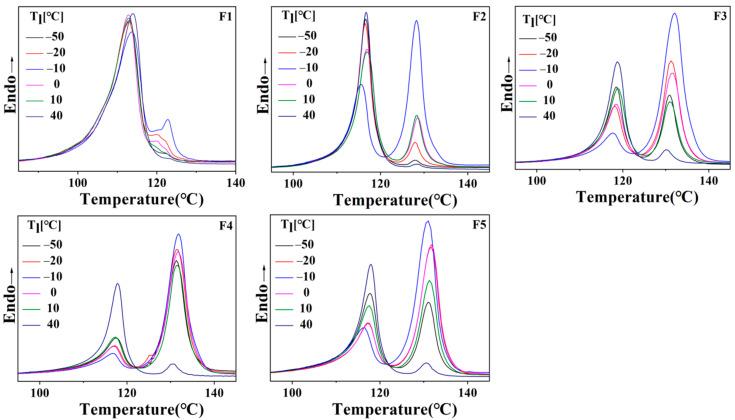
Poly(1-butene) (PB-1) resin has excellent mechanical properties, outstanding creep resistance, environmental stress crack resistance and other excellent properties. However, PB-1 resin experiences a crystal transformation for a period, which seriously affects the production efficiency and directly restricts its large-scale commercial production and application. The factors affecting the crystal transformation of PB-1 are mainly divided into external and internal factors. External factors include crystallization temperature, thermal history, nucleating agent, pressure, solvent induction, etc., and internal factors include chain length, copolymerization composition, isotacticity, its distribution, etc. In this study, to avoid the interference of molecular weight distribution on crystallization behavior, five PB-1 samples with narrow molecular weight distribution (between 1.09 and 1.44) and different molecular weights (from 23 to 710 k) were chosen to research the influence of temperature and time in the step-by-step annealing process and molecular weight on the crystal transformation by differential scanning calorimetry (DSC). When the total annealing time was the same, the step-by-step annealing process can significantly accelerate the rate of transformation from crystal form II to I. PB-1 samples with different molecular weights have the same dependence on annealing temperature, and the optimal nucleation temperature (i.e., low annealing temperature, T) and growth temperature (i.e., high annealing temperature, T) were -10 °C and 40 °C, respectively. At these two temperatures, the crystal form I obtained by step-by-step annealing had the highest content; other lower or higher annealing temperatures would reduce the rate of crystal transformation. When the annealing temperature was the same, crystal form I first increased with annealing time t, then gradually reached a plateau, but the time to reach a plateau was different. The crystalline form I contents of the samples with lower molecular weight increased linearly with annealing time t. However, the crystalline form I contents of the samples with higher molecular weight increased rapidly with annealing time t at the beginning, and then transformation speed from form II to form I slowed down, which implied that controlling T/t and T/t can tune the different contents of form I and form II. At the same T/t or T/t, with increasing molecular weight, the transformation speed from form II to form I via the step-by-step annealing process firstly increased and then slowed down due to the competition of the number of linked molecules and molecular chain mobility during crystallization. This study definitely provides an effective method for accelerating the transformation of poly(1-butene) crystal form, which not only has important academic significance, but also has vital industrial application.
聚1-丁烯(PB-1)树脂具有优异的机械性能、出色的抗蠕变性、耐环境应力开裂性等优良性能。然而,PB-1树脂在一段时间内会发生晶型转变,这严重影响生产效率,直接限制了其大规模商业化生产和应用。影响PB-1晶型转变的因素主要分为外部因素和内部因素。外部因素包括结晶温度、热历史、成核剂、压力、溶剂诱导等,内部因素包括链长、共聚组成、全同立构规整度及其分布等。在本研究中,为避免分子量分布对结晶行为的干扰,选择了五种分子量分布窄(在1.09至1.44之间)且分子量不同(从23至710k)的PB-1样品,通过差示扫描量热法(DSC)研究分步退火过程中的温度和时间以及分子量对晶型转变的影响。当总退火时间相同时,分步退火过程可显著加快从晶型II向I的转变速率。不同分子量的PB-1样品对退火温度具有相同的依赖性,最佳成核温度(即低退火温度,T)和生长温度(即高退火温度,T)分别为-10℃和40℃。在这两个温度下,通过分步退火获得的晶型I含量最高;其他更低或更高的退火温度会降低晶型转变速率。当退火温度相同时,晶型I首先随退火时间t增加,然后逐渐达到平稳状态,但达到平稳状态的时间不同。分子量较低的样品的晶型I含量随退火时间t呈线性增加。然而,分子量较高的样品的晶型I含量在开始时随退火时间t迅速增加,然后从晶型II向晶型I的转变速度减慢,这意味着控制T/t和T/t可以调节晶型I和晶型II的不同含量。在相同的T/t或T/t下,随着分子量的增加,由于结晶过程中连接分子数量和分子链流动性的竞争,通过分步退火过程从晶型II向晶型I的转变速度首先增加,然后减慢。本研究无疑为加速聚1-丁烯晶型转变提供了一种有效方法,这不仅具有重要的学术意义,而且具有至关重要的工业应用价值。




 Zotero 插件