
尼日利亚第一波和第二波新冠疫情期间的死亡率及其相关因素。
COVID-19 mortality rate and its associated factors during the first and second waves in Nigeria.
作者信息
Elimian Kelly, Musah Anwar, King Carina, Igumbor Ehimario, Myles Puja, Aderinola Olaolu, Erameh Cyril, Nwanchukwu William, Akande Oluwatosin, Nicaise Ndembi, Ogunbode Oladipo, Egwuenu Abiodun, Crawford Emily, Gaudenzi Giulia, Abdus-Salam Ismail, Olopha Olubunmi, Disu Yahya, Bowale Abimbola, Oshoma Cyprian, Ohonsi Cornelius, Arinze Chinedu, Badaru Sikiru, Ebhodaghe Blessing, Habib Zaiyad, Olugbile Michael, Dan-Nwafor Chioma, Abubakar Jafiya, Pembi Emmanuel, Dunkwu Lauryn, Ike Ifeanyi, Tobin Ekaete, Mutiu Bamidele, Luka-Lawal Rejoice, Nwafor Obinna, Okowa Mildred, Ezeokafor Chidiebere, Iwara Emem, Yennan Sebastian, Eziechina Sunday, Olatunji David, Falodun Lanre, Joseph Emmanuel, Abali Ifeanyi, Mohammed Tarik, Yiga Benjamin, Kamaldeen Khadeejah, Agogo Emmanuel, Mba Nwando, Oladejo John, Ilori Elsie, Aruna Olusola, Namara Geoffrey, Obaro Stephen, Hamza Khadeejah, Asuzu Michael, Bello Shaibu, Okonofua Friday, Deeni Yusuf, Abubakar Ibrahim, Alfven Tobias, Ochu Chinwe, Ihekweazu Chikwe
机构信息
Nigeria Centre for Disease Control, Abuja, Nigeria.
Department of Global Public Health, Karolinska Institutet, Stockholm, Sweden.
出版信息
PLOS Glob Public Health. 2022 Jun 9;2(6):e0000169. doi: 10.1371/journal.pgph.0000169. eCollection 2022.
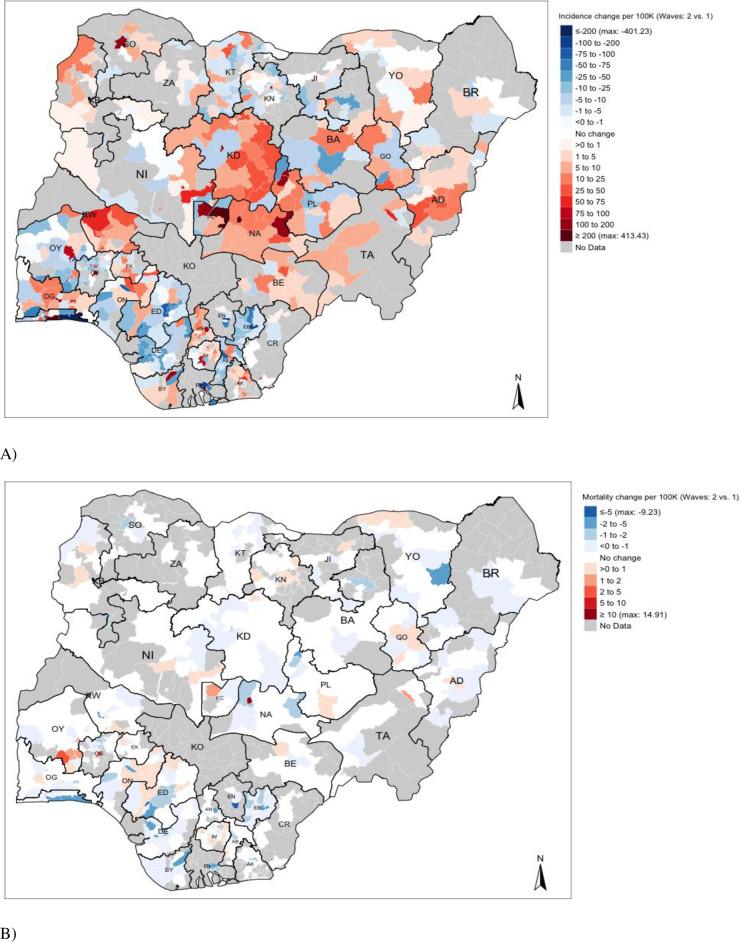
COVID-19 mortality rate has not been formally assessed in Nigeria. Thus, we aimed to address this gap and identify associated mortality risk factors during the first and second waves in Nigeria. This was a retrospective analysis of national surveillance data from all 37 States in Nigeria between February 27, 2020, and April 3, 2021. The outcome variable was mortality amongst persons who tested positive for SARS-CoV-2 by Reverse-Transcriptase Polymerase Chain Reaction. Incidence rates of COVID-19 mortality was calculated by dividing the number of deaths by total person-time (in days) contributed by the entire study population and presented per 100,000 person-days with 95% Confidence Intervals (95% CI). Adjusted negative binomial regression was used to identify factors associated with COVID-19 mortality. Findings are presented as adjusted Incidence Rate Ratios (aIRR) with 95% CI. The first wave included 65,790 COVID-19 patients, of whom 994 (1∙51%) died; the second wave included 91,089 patients, of whom 513 (0∙56%) died. The incidence rate of COVID-19 mortality was higher in the first wave [54∙25 (95% CI: 50∙98-57∙73)] than in the second wave [19∙19 (17∙60-20∙93)]. Factors independently associated with increased risk of COVID-19 mortality in both waves were: age ≥45 years, male gender [first wave aIRR 1∙65 (1∙35-2∙02) and second wave 1∙52 (1∙11-2∙06)], being symptomatic [aIRR 3∙17 (2∙59-3∙89) and 3∙04 (2∙20-4∙21)], and being hospitalised [aIRR 4∙19 (3∙26-5∙39) and 7∙84 (4∙90-12∙54)]. Relative to South-West, residency in the South-South and North-West was associated with an increased risk of COVID-19 mortality in both waves. In conclusion, the rate of COVID-19 mortality in Nigeria was higher in the first wave than in the second wave, suggesting an improvement in public health response and clinical care in the second wave. However, this needs to be interpreted with caution given the inherent limitations of the country's surveillance system during the study.
在尼日利亚,尚未对新冠病毒疾病(COVID-19)的死亡率进行正式评估。因此,我们旨在填补这一空白,并确定尼日利亚第一波和第二波疫情期间相关的死亡风险因素。这是一项对2020年2月27日至2021年4月3日期间尼日利亚所有37个州的国家监测数据进行的回顾性分析。结果变量是通过逆转录聚合酶链反应检测出SARS-CoV-2呈阳性的人员中的死亡率。COVID-19死亡率的发病率通过将死亡人数除以整个研究人群贡献的总人时(以天为单位)来计算,并以每10万人日为单位呈现,同时给出95%置信区间(95%CI)。采用调整后的负二项回归来确定与COVID-19死亡率相关的因素。研究结果以调整后的发病率比(aIRR)及95%CI呈现。第一波疫情包括65790例COVID-19患者,其中994例(1.51%)死亡;第二波疫情包括91089例患者,其中513例(0.56%)死亡。COVID-19死亡率的发病率在第一波疫情中[54.25(95%CI:50.98 - 57.73)]高于第二波疫情[19.19(17.60 - 20.93)]。在两波疫情中,与COVID-19死亡风险增加独立相关的因素包括:年龄≥45岁、男性[第一波aIRR 1.65(1.35 - 2.02),第二波1.52(1.11 - 2.06)]、出现症状[aIRR 3.17(2.59 - 3.89)和3.04(2.20 - 4.21)]以及住院治疗[aIRR 4.19(3.26 - 5.39)和7.84(4.90 - 12.54)]。相对于西南部地区,居住在南部和西北部地区在两波疫情中均与COVID-19死亡风险增加相关。总之,尼日利亚COVID-19死亡率在第一波疫情中高于第二波疫情,这表明第二波疫情中公共卫生应对措施和临床护理有所改善。然而,鉴于研究期间该国监测系统存在的固有局限性,对此需要谨慎解读。


 Zotero 插件