
利用大数据评估发展成果:一项系统综述
Using big data for evaluating development outcomes: A systematic map.
作者信息
Rathinam Francis, Khatua Sayak, Siddiqui Zeba, Malik Manya, Duggal Pallavi, Watson Samantha, Vollenweider Xavier
机构信息
Athena Infonomics Chennai India.
3ie New Delhi India.
出版信息
Campbell Syst Rev. 2021 Jul 3;17(3):e1149. doi: 10.1002/cl2.1149. eCollection 2021 Sep.
BACKGROUND
Policy makers need access to reliable data to monitor and evaluate the progress of development outcomes and targets such as sustainable development outcomes (SDGs). However, significant data and evidence gaps remain. Lack of resources, limited capacity within governments and logistical difficulties in collecting data are some of the reasons for the data gaps. Big data-that is digitally generated, passively produced and automatically collected-offers a great potential for answering some of the data needs. Satellite and sensors, mobile phone call detail records, online transactions and search data, and social media are some of the examples of big data. Integrating big data with the traditional household surveys and administrative data can complement data availability, quality, granularity, accuracy and frequency, and help measure development outcomes temporally and spatially in a number of new ways.The study maps different sources of big data onto development outcomes (based on SDGs) to identify current evidence base, use and the gaps. The map provides a visual overview of existing and ongoing studies. This study also discusses the risks, biases and ethical challenges in using big data for measuring and evaluating development outcomes. The study is a valuable resource for evaluators, researchers, funders, policymakers and practitioners in their effort to contributing to evidence informed policy making and in achieving the SDGs.
OBJECTIVES
Identify and appraise rigorous impact evaluations (IEs), systematic reviews and the studies that have innovatively used big data to measure any development outcomes with special reference to difficult contexts.
SEARCH METHODS
A number of general and specialised data bases and reporsitories of organisations were searched using keywords related to big data by an information specialist.
SELECTION CRITERIA
The studies were selected on basis of whether they used big data sources to measure or evaluate development outcomes.
DATA COLLECTION AND ANALYSIS
Data collection was conducted using a data extraction tool and all extracted data was entered into excel and then analysed using Stata. The data analysis involved looking at trends and descriptive statistics only.
MAIN RESULTS
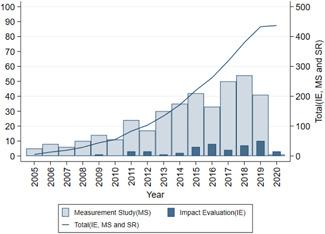
The search yielded over 17,000 records, which we then screened down to 437 studies which became the foundation of our systematic map. We found that overall, there is a sizable and rapidly growing number of measurement studies using big data but a much smaller number of IEs. We also see that the bulk of the big data sources are machine-generated (mostly satellites) represented in the light blue. We find that satellite data was used in over 70% of the measurement studies and in over 80% of the IEs.
AUTHORS' CONCLUSIONS: This map gives us a sense that there is a lot of work being done to develop appropriate measures using big data which could subsequently be used in IEs. Information on costs, ethics, transparency is lacking in the studies and more work is needed in this area to understand the efficacies related to the use of big data. There are a number of outcomes which are not being studied using big data, either due to the lack to applicability such as education or due to lack of awareness about the new methods and data sources. The map points to a number of gaps as well as opportunities where future researchers can conduct research.
背景
政策制定者需要获取可靠数据,以监测和评估可持续发展成果等发展成果与目标的进展情况。然而,数据和证据方面仍存在重大差距。资源匮乏、政府内部能力有限以及数据收集方面的后勤困难是造成数据差距的部分原因。大数据——即数字生成、被动产生和自动收集的数据——为满足部分数据需求提供了巨大潜力。卫星和传感器、手机通话详单记录、在线交易和搜索数据以及社交媒体都是大数据的一些例子。将大数据与传统的住户调查和行政数据相结合,可以补充数据的可得性、质量、粒度、准确性和频率,并有助于以多种新方式在时间和空间上衡量发展成果。本研究将不同的大数据来源映射到发展成果(基于可持续发展目标)上,以确定当前的证据基础、用途和差距。该图谱提供了现有和正在进行的研究的可视化概述。本研究还讨论了使用大数据来衡量和评估发展成果时存在的风险、偏差和伦理挑战。对于评估人员、研究人员、资助者、政策制定者和从业者而言,本研究是一份宝贵资源,有助于他们为基于证据的政策制定做出贡献并实现可持续发展目标。
目标
识别并评估严格的影响评估、系统评价以及创新性地使用大数据来衡量任何发展成果(特别针对困难背景)的研究。
检索方法
一名信息专家使用与大数据相关的关键词,对多个通用和专业数据库以及组织的报告库进行了检索。
选择标准
根据研究是否使用大数据来源来衡量或评估发展成果进行选择。
数据收集与分析
使用数据提取工具进行数据收集,所有提取的数据都录入Excel,然后使用Stata进行分析。数据分析仅涉及查看趋势和描述性统计。
主要结果
检索得到超过17000条记录,随后我们筛选出437项研究,这些研究成为我们系统图谱的基础。我们发现,总体而言,使用大数据的测量研究数量可观且在迅速增长,但影响评估的数量要少得多。我们还看到,大部分大数据来源是机器生成的(主要是卫星),如浅蓝色所示。我们发现,超过70%的测量研究和超过80%的影响评估使用了卫星数据。
作者结论
该图谱让我们感觉到,正在开展大量工作来利用大数据制定合适的测量方法,这些方法随后可用于影响评估。研究中缺乏关于成本、伦理、透明度的信息,在这一领域需要开展更多工作来了解与使用大数据相关的效果。由于缺乏适用性(如教育方面)或对新方法和数据源缺乏认识,有一些成果尚未使用大数据进行研究。该图谱指出了一些差距以及未来研究人员可以开展研究的机会。




 Zotero 插件