
人输卵管中精子相互作用涉及的分子:组织化学和免疫组织化学方法。
Molecules involved in the sperm interaction in the human uterine tube: a histochemical and immunohistochemical approach.
机构信息
Escuela de Medicina, Centro de Investigación Biomédica y Aplicada (CIBAP), Laboratorio de ingeniería de tejidos, Universidad de Santiago de Chile (USACH), Santiago.
Facultad de Química y Biología, Laboratorio de Inmunología de la Reproducción, Universidad de Santiago de Chile (USACH); Advanced Center for Chronic Diseases (ACCDiS), Facultad de Ciencias Químicas y Farmacéuticas and Facultad de Medicina, Universidad de Chile, Santiago.
出版信息
Eur J Histochem. 2023 Apr 13;67(2):3513. doi: 10.4081/ejh.2023.3513.
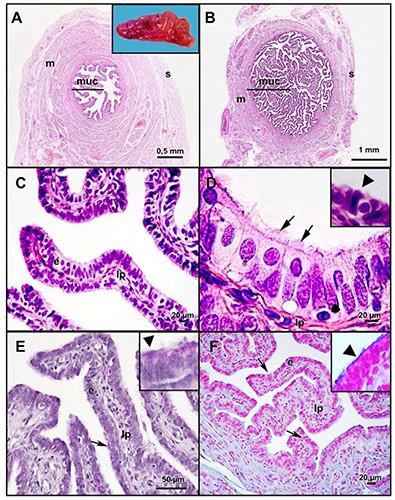
In humans, even where millions of spermatozoa are deposited upon ejaculation in the vagina, only a few thousand enter the uterine tube (UT). Sperm transiently adhere to the epithelial cells lining the isthmus reservoir, and this interaction is essential in coordinating the availability of functional spermatozoa for fertilization. The binding of spermatozoa to the UT epithelium (mucosa) occurs due to interactions between cell-adhesion molecules on the cell surfaces of both the sperm and the epithelial cell. However, in humans, there is little information about the molecules involved. The aim of this study was to perform a histological characterization of the UT focused on determining the tissue distribution and deposition of some molecules associated with cell adhesion (F-spondin, galectin-9, osteopontin, integrin αV/β3) and UT's contractile activity (TNFα-R1, TNFα-R2) in the follicular and luteal phases. Our results showed the presence of galectin-9, F-spondin, osteopontin, integrin αV/β3, TNFα-R1, and TNFα-R2 in the epithelial cells in ampullar and isthmic segments during the menstrual cycle. Our results suggest that these molecules could form part of the sperm-UT interactions. Future studies will shed light on the specific role of each of the identified molecules.
在人类中,即使在射精时有数百万精子被注入阴道,也只有几千个进入子宫管(UT)。精子会短暂地附着在峡部储精囊的上皮细胞上,这种相互作用对于协调可用于受精的功能性精子的可用性至关重要。精子与 UT 上皮(黏膜)的结合是由于精子和上皮细胞表面上的细胞粘附分子之间的相互作用。然而,在人类中,关于涉及的分子的信息很少。本研究的目的是对 UT 进行组织学表征,重点确定与细胞粘附(F-蛛丝蛋白、半乳糖凝集素-9、骨桥蛋白、整合素αV/β3)和 UT 的收缩活性(TNFα-R1、TNFα-R2)相关的一些分子在卵泡期和黄体期的组织分布和沉积情况。我们的结果表明,在月经周期中,在壶腹部和峡部的上皮细胞中存在半乳糖凝集素-9、F-蛛丝蛋白、骨桥蛋白、整合素αV/β3、TNFα-R1 和 TNFα-R2。我们的结果表明,这些分子可能是精子与 UT 相互作用的一部分。未来的研究将阐明每个已鉴定分子的具体作用。



 Zotero 插件