
肠道微生物组在肝胆癌发展中的作用。
The role of the gut microbiome in the development of hepatobiliary cancers.
机构信息
Cancer Biology and Therapeutics Laboratory, Conway Institute, School of Biomedical and Biomolecular Sciences, University College Dublin, Dublin, Ireland.
Nutrition and Metabolism Branch, International Agency for Research on Cancer, Lyon, France.
出版信息
Hepatology. 2024 Nov 1;80(5):1252-1269. doi: 10.1097/HEP.0000000000000406. Epub 2023 Apr 15.
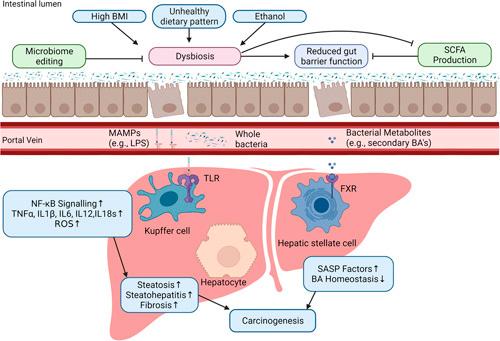
Hepatobiliary cancers, including hepatocellular carcinoma and cancers of the biliary tract, share high mortality and rising incidence rates. They may also share several risk factors related to unhealthy western-type dietary and lifestyle patterns as well as increasing body weights and rates of obesity. Recent data also suggest a role for the gut microbiome in the development of hepatobiliary cancer and other liver pathologies. The gut microbiome and the liver interact bidirectionally through the "gut-liver axis," which describes the interactive relationship between the gut, its microbiota, and the liver. Here, we review the gut-liver interactions within the context of hepatobiliary carcinogenesis by outlining the experimental and observational evidence for the roles of gut microbiome dysbiosis, reduced gut barrier function, and exposure to inflammatory compounds as well as metabolic dysfunction as contributors to hepatobiliary cancer development. We also outline the latest findings regarding the impact of dietary and lifestyle factors on liver pathologies as mediated by the gut microbiome. Finally, we highlight some emerging gut microbiome editing techniques currently being investigated in the context of hepatobiliary diseases. Although much work remains to be done in determining the relationships between the gut microbiome and hepatobiliary cancers, emerging mechanistic insights are informing treatments, such as potential microbiota manipulation strategies and guiding public health advice on dietary/lifestyle patterns for the prevention of these lethal tumors.
肝胆癌包括肝细胞癌和胆管癌,其死亡率和发病率都很高。它们可能还有一些与不健康的西式饮食和生活方式模式以及体重增加和肥胖率相关的共同风险因素。最近的数据还表明肠道微生物组在肝胆癌和其他肝脏病变的发展中起作用。肠道微生物组和肝脏通过“肠道-肝脏轴”双向相互作用,该轴描述了肠道、其微生物群和肝脏之间的相互关系。在这里,我们通过概述肠道微生物组失调、肠道屏障功能降低和炎症化合物暴露以及代谢功能障碍作为导致肝胆癌发展的因素的实验和观察证据,在肝胆癌发生的背景下综述肠道-肝脏相互作用。我们还概述了最新发现,即饮食和生活方式因素通过肠道微生物组对肝脏病理的影响。最后,我们强调了一些新兴的肠道微生物组编辑技术,这些技术目前正在肝胆疾病的背景下进行研究。尽管在确定肠道微生物组与肝胆癌之间的关系方面还有很多工作要做,但新兴的机制见解正在为治疗提供信息,例如潜在的微生物组操纵策略,并为预防这些致命肿瘤提供关于饮食/生活方式模式的公共卫生建议。

 Zotero 插件