
使用带有混合器安装采样系统的室式测试对三维打印机的颗粒物排放进行精确测量。
Accurate measurements of particle emissions from a three-dimensional printer using a chamber test with a mixer-installed sampling system.
机构信息
Department of Environmental Engineering, Inha University, 100 Inha-ro, Michuhol-gu, Incheon, 22212, Republic of Korea.
Particle Technology Laboratory, Mechanical Engineering, University of Minnesota, 111 Church St., Minneapolis, S.E., 55455, USA.
出版信息
Sci Rep. 2023 Apr 20;13(1):6495. doi: 10.1038/s41598-023-33538-9.
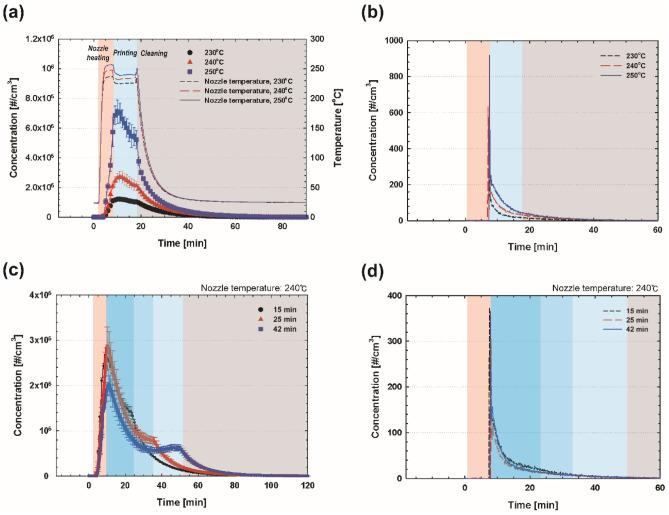
Recently, three-dimensional (3D) printing has attracted attention as a new manufacturing technology. However, there is lack of data and regulations regarding the emissions of ultrafine particles from 3D printers. Therefore, we investigated particle emissions from a 3D printer using a chamber system. The test system was improved by installing a developed mixer for accurate measurement. Without a mixer, the particle concentration was unstable depending on the sampling point; however, reliable data with good uniformity were obtained by installing a mixer. Using the test system with a mixer, we investigated particle emissions from a 3D printer during operation. Filaments made each of acrylonitrile butadiene styrene (ABS) and polylactic acid (PLA) were used as the printing material. The effects of nozzle temperature and printing time were investigated. Compared to the effect of the printing time, the nozzle temperature had greater impact on the particle emissions. The dominant particle size for the emissions from a 3D printer is less than 10 nm, and the particle concentration decreased with increasing particle size.
最近,三维(3D)打印作为一种新的制造技术引起了人们的关注。然而,关于 3D 打印机超细颗粒排放的数据和法规还很缺乏。因此,我们使用腔室系统研究了 3D 打印机的颗粒排放情况。通过安装开发的混合器,改进了测试系统,以进行准确测量。如果没有混合器,颗粒浓度会根据采样点的不同而不稳定;但是,通过安装混合器,可以获得具有良好均匀性的可靠数据。使用带有混合器的测试系统,我们研究了 3D 打印机在运行过程中的颗粒排放情况。使用丙烯腈丁二烯苯乙烯(ABS)和聚乳酸(PLA)制成的长丝作为打印材料。研究了喷嘴温度和打印时间的影响。与打印时间的影响相比,喷嘴温度对颗粒排放的影响更大。3D 打印机排放的主要颗粒尺寸小于 10nm,并且颗粒浓度随颗粒尺寸的增加而降低。




 Zotero 插件