
骨-髌腱-骨与双股和四股腘绳肌腱自体移植物重建青壮年前交叉韧带:贝叶斯网状meta 分析。
Bone-patellar tendon-bone versus two- and four-strand hamstring tendon autografts for ACL reconstruction in young adults: a Bayesian network meta-analysis.
机构信息
Department of Orthopaedic, Trauma, and Reconstructive Surgery, RWTH University Hospital, Pauwelsstraße 30, 52074, Aachen, Germany.
Department of Medicine, Surgery and Dentistry, University of Salerno, Via S. Allende, 84081, Baronissi, SA, Italy.
出版信息
Sci Rep. 2023 Apr 27;13(1):6883. doi: 10.1038/s41598-023-33899-1.
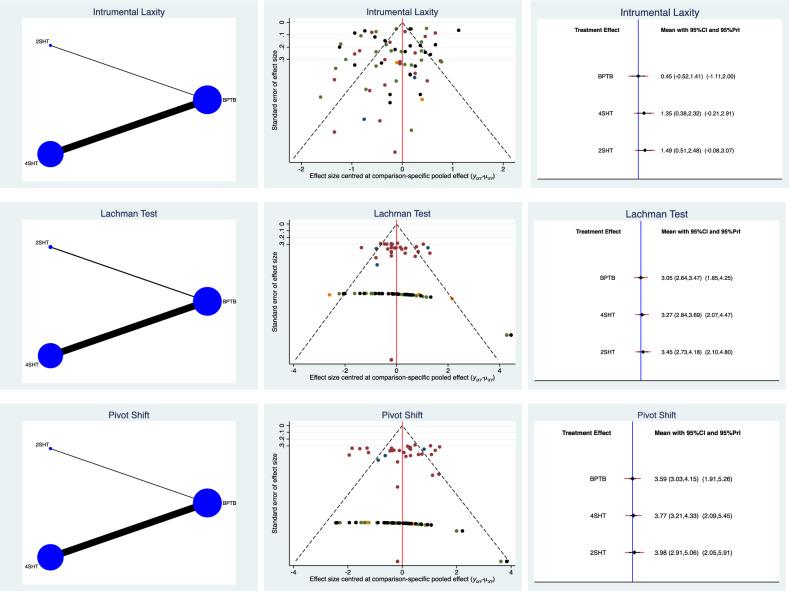
Bone-patellar tendon-bone (BPTB), two- and four-strand hamstring tendon (4SHT and 2SHT, respectively) are the most common autografts used for anterior cruciate ligament (ACL) reconstruction. The present study compared BPTB, 2SHT, and 4SHT for ACL reconstruction in terms of joint laxity, patient reported outcome measures (PROMs), rate of failure and anterior knee pain (AKP). The time to return to sport and the peak torque between the autografts were also compared. Finally, prognostic factors leading to worse outcomes were also investigated. It was hypothesized that all grafts yield similar proprieties in terms of joint laxity, patient reported outcome measures (PROMs) and rate of failure, but that the BPTB autograft causes a greater rate of anterior knee pain (AKP). The literature search was conducted. All clinical trials comparing BTPB and/or 2SHT, and/or 4SHT were accessed. Grafts other than BTPB and/or 4SHT and/or 2SHT were not considered. Articles reporting outcomes of allografts or synthetic grafts were not eligible, nor were those concerning revision settings. Articles reporting ACL reconstruction in patients with multi-ligament damage were also not eligible. Data from 95,575 procedures were retrieved. The median length of follow-up was 36 months. The median age of the patients was 27.5 years. With regard to joint laxity, similarity was found in terms of Lachman and Pivot shift tests between all three autografts. The BPTB demonstrated the greatest stability in terms of instrumental laxity. BPTB demonstrated the greatest PROMs. BPTB demonstrated the greatest rate of AKP, while AKP in 2SHT and 4SHT was similar. Concerning failure, statistically significant inconsistency was found (P = 0.008). The 4SHT demonstrated the quickest return to sport, followed by BPTB, and 2SHT. There was evidence of a negative association between the time span between injury to surgery, Lysholm score (P = 0.04), and Tegner scale (P = 0.04). Furthermore, there was evidence of a weak positive association between the time span between injury to surgery and return to sport (P = 0.01). BPTB may result in lower joint laxity, greater PROMs, and greater peak flexion torque compared to 2SHT and 4SHT autografts. On the other hand, BPTB reported the lowest peak extension torque and the greatest rate of AKP. Finally, a longer time span between injury and surgery negatively influences outcome.
骨-髌腱-骨(BPTB)、双股和四股腘绳肌腱(4SHT 和 2SHT)是最常用于前交叉韧带(ACL)重建的自体移植物。本研究比较了 BPTB、2SHT 和 4SHT 在 ACL 重建方面的关节松弛度、患者报告的结果测量(PROMs)、失败率和前膝痛(AKP)。还比较了自体移植物的重返运动时间和峰值扭矩。最后,还研究了导致不良结果的预测因素。假设所有移植物在关节松弛度、患者报告的结果测量(PROMs)和失败率方面都具有相似的特性,但 BPTB 自体移植物会导致更大的前膝痛(AKP)。进行了文献检索。访问了所有比较 BTPB 和/或 2SHT 和/或 4SHT 的临床试验。未考虑 BTPB 和/或 4SHT 和/或 2SHT 以外的移植物。不包括报告同种异体移植物或合成移植物结果的文章,也不包括涉及修订设置的文章。还不包括报告多韧带损伤患者 ACL 重建的文章。检索到 95575 例手术的数据。中位随访时间为 36 个月。患者的中位年龄为 27.5 岁。在关节松弛度方面,所有三种自体移植物的 Lachman 和 Pivot 移位试验均相似。BPTB 在仪器松弛度方面表现出最大的稳定性。BPTB 表现出最大的 PROMs。BPTB 表现出最大的 AKP 发生率,而 2SHT 和 4SHT 的 AKP 相似。关于失败,发现统计学上存在不一致(P=0.008)。4SHT 表现出最快的重返运动,其次是 BPTB 和 2SHT。受伤至手术的时间间隔、Lysholm 评分(P=0.04)和 Tegner 量表(P=0.04)之间存在负相关的证据。此外,受伤至手术的时间间隔与重返运动之间存在弱正相关的证据(P=0.01)。与 2SHT 和 4SHT 自体移植物相比,BPTB 可能导致较低的关节松弛度、更大的 PROMs 和更大的峰值屈曲扭矩。另一方面,BPTB 报告的峰值伸展扭矩最低,AKP 发生率最高。最后,受伤和手术之间的时间间隔较长会对结果产生负面影响。



 Zotero 插件