
无线物联网网络中 MISO 下行链路传输协调的联合数据传输和能量收集。
Joint Data Transmission and Energy Harvesting for MISO Downlink Transmission Coordination in Wireless IoT Networks.
机构信息
Department of Computer Science and Information Engineering, Providence University, Taichung 433, Taiwan.
Department of Computer Science and Engineering, National Sun Yat-sen University, Kaohsiung 804, Taiwan.
出版信息
Sensors (Basel). 2023 Apr 11;23(8):3900. doi: 10.3390/s23083900.
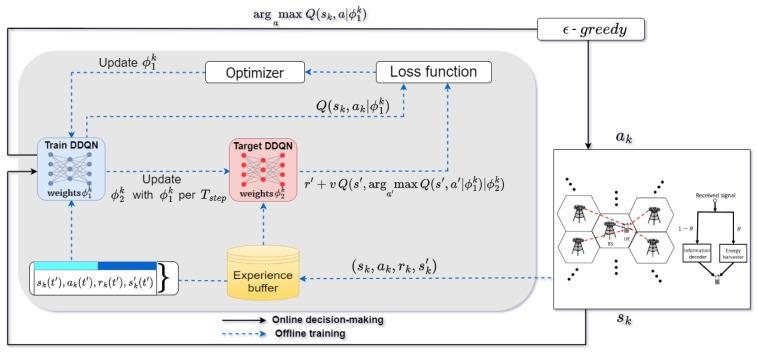
The advent of simultaneous wireless information and power (SWIPT) has been regarded as a promising technique to provide power supplies for an energy sustainable Internet of Things (IoT), which is of paramount importance due to the proliferation of high data communication demands of low-power network devices. In such networks, a multi-antenna base station (BS) in each cell can be utilized to concurrently transmit messages and energies to its intended IoT user equipment (IoT-UE) with a single antenna under a common broadcast frequency band, resulting in a multi-cell multi-input single-output (MISO) interference channel (IC). In this work, we aim to find the trade-off between the spectrum efficiency (SE) and energy harvesting (EH) in SWIPT-enabled networks with MISO ICs. For this, we derive a multi-objective optimization (MOO) formulation to obtain the optimal beamforming pattern (BP) and power splitting ratio (PR), and we propose a fractional programming (FP) model to find the solution. To tackle the nonconvexity of FP, an evolutionary algorithm (EA)-aided quadratic transform technique is proposed, which recasts the nonconvex problem as a sequence of convex problems to be solved iteratively. To further reduce the communication overhead and computational complexity, a distributed multi-agent learning-based approach is proposed that requires only partial observations of the channel state information (CSI). In this approach, each BS is equipped with a double deep Q network (DDQN) to determine the BP and PR for its UE with lower computational complexity based on the observations through a limited information exchange process. Finally, with the simulation experiments, we verify the trade-off between SE and EH, and we demonstrate that, apart from the FP algorithm introduced to provide superior solutions, the proposed DDQN algorithm also shows its performance gain in terms of utility to be up to 1.23-, 1.87-, and 3.45-times larger than the Advantage Actor Critic (A2C), greedy, and random algorithms, respectively, in comparison in the simulated environment.
同时无线信息与功率传输 (SWIPT) 的出现被认为是为能源可持续物联网 (IoT) 提供电源的一项有前途的技术,由于低功率网络设备的数据通信需求不断增长,因此这一点至关重要。在这样的网络中,每个小区的多天线基站 (BS) 可以利用单个天线在公共广播频带下同时向其预期的物联网用户设备 (IoT-UE) 发送消息和能量,从而形成多小区多输入单输出 (MISO) 干扰信道 (IC)。在这项工作中,我们旨在找到具有 MISO IC 的 SWIPT 网络中频谱效率 (SE) 和能量收集 (EH) 之间的折衷。为此,我们推导出一个多目标优化 (MOO) 公式来获得最优的波束形成模式 (BP) 和功率分割比 (PR),并提出了一个分式规划 (FP) 模型来找到解决方案。为了解决 FP 的非凸性问题,提出了一种基于进化算法 (EA) 的二次变换技术,该技术将非凸问题转化为一系列凸问题,然后进行迭代求解。为了进一步降低通信开销和计算复杂度,提出了一种基于分布式多智能体学习的方法,该方法只需要部分信道状态信息 (CSI) 的观测值。在这种方法中,每个 BS 都配备了一个双深度 Q 网络 (DDQN),根据通过有限信息交换过程进行观测的结果,为其 UE 确定 BP 和 PR,从而降低计算复杂度。最后,通过仿真实验,验证了 SE 和 EH 之间的折衷关系,并表明除了提出的 FP 算法可以提供更好的解决方案之外,所提出的 DDQN 算法在效用方面也表现出了性能优势,在模拟环境中,其效用分别比 Advantage Actor Critic (A2C)、贪婪和随机算法高出 1.23 倍、1.87 倍和 3.45 倍。




 Zotero 插件