
新型计算生物学建模系统可准确预测早期乳腺癌新辅助治疗的反应。
Novel computational biology modeling system can accurately forecast response to neoadjuvant therapy in early breast cancer.
机构信息
SimBioSys, Inc., 180 N La Salle St. Suite 3250, Chicago, IL, 60601, USA.
Department of Radiation Oncology, University of Cincinnati, College of Medicine, Cincinnati, OH, USA.
出版信息
Breast Cancer Res. 2023 May 10;25(1):54. doi: 10.1186/s13058-023-01654-z.
BACKGROUND
Generalizable population-based studies are unable to account for individual tumor heterogeneity that contributes to variability in a patient's response to physician-chosen therapy. Although molecular characterization of tumors has advanced precision medicine, in early-stage and locally advanced breast cancer patients, predicting a patient's response to neoadjuvant therapy (NAT) remains a gap in current clinical practice. Here, we perform a study in an independent cohort of early-stage and locally advanced breast cancer patients to forecast tumor response to NAT and assess the stability of a previously validated biophysical simulation platform.
METHODS
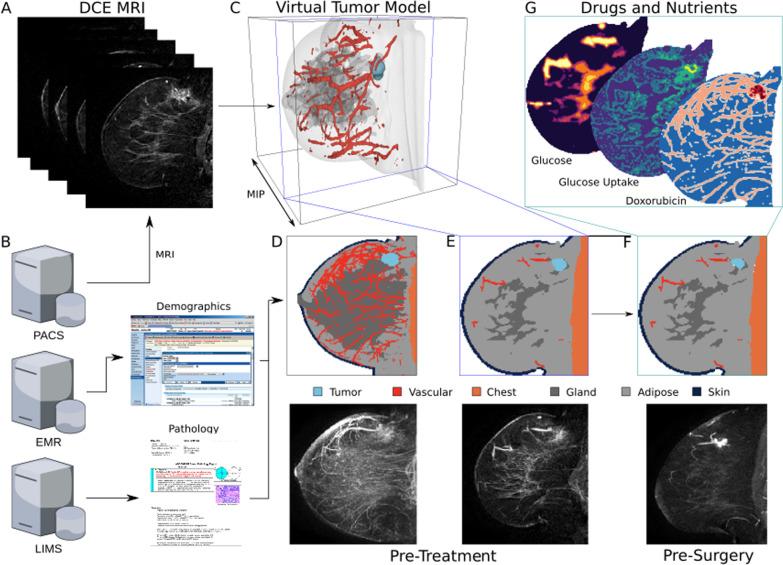
A single-blinded study was performed using a retrospective database from a single institution (9/2014-12/2020). Patients included: ≥ 18 years with breast cancer who completed NAT, with pre-treatment dynamic contrast enhanced magnetic resonance imaging. Demographics, chemotherapy, baseline (pre-treatment) MRI and pathologic data were input into the TumorScope Predict (TS) biophysical simulation platform to generate predictions. Primary outcomes included predictions of pathological complete response (pCR) versus residual disease (RD) and final volume for each tumor. For validation, post-NAT predicted pCR and tumor volumes were compared to actual pathological assessment and MRI-assessed volumes. Predicted pCR was pre-defined as residual tumor volume ≤ 0.01 cm (≥ 99.9% reduction).
RESULTS
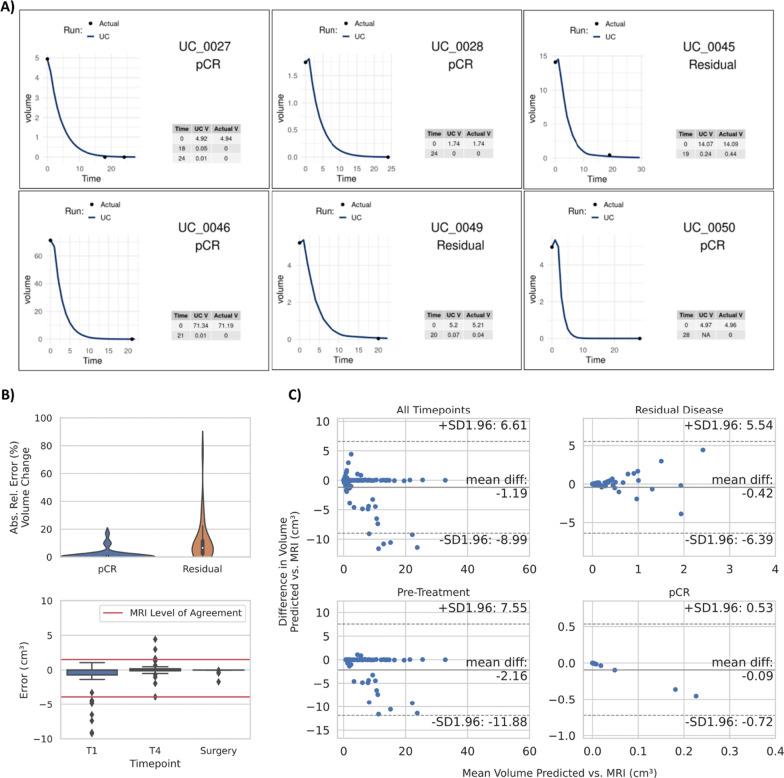
The cohort consisted of eighty patients; 36 Caucasian and 40 African American. Most tumors were high-grade (54.4% grade 3) invasive ductal carcinomas (90.0%). Receptor subtypes included hormone receptor positive (HR+)/human epidermal growth factor receptor 2 positive (HER2+, 30%), HR+/HER2- (35%), HR-/HER2+ (12.5%) and triple negative breast cancer (TNBC, 22.5%). Simulated tumor volume was significantly correlated with post-treatment radiographic MRI calculated volumes (r = 0.53, p = 1.3 × 10, mean absolute error of 6.57%). TS prediction of pCR compared favorably to pathological assessment (pCR: TS n = 28; Path n = 27; RD: TS n = 52; Path n = 53), for an overall accuracy of 91.2% (95% CI: 82.8% - 96.4%; Clopper-Pearson interval). Five-year risk of recurrence demonstrated similar prognostic performance between TS predictions (Hazard ratio (HR): - 1.99; 95% CI [- 3.96, - 0.02]; p = 0.043) and clinically assessed pCR (HR: - 1.76; 95% CI [- 3.75, 0.23]; p = 0.054).
CONCLUSION
We demonstrated TS ability to simulate and model tumor in vivo conditions in silico and forecast volume response to NAT across breast tumor subtypes.
背景
基于人群的可推广研究无法解释导致患者对医生选择的治疗反应存在差异的个体肿瘤异质性。尽管肿瘤的分子特征已经推动了精准医学的发展,但在早期和局部晚期乳腺癌患者中,预测患者对新辅助治疗(NAT)的反应仍然是当前临床实践中的一个空白。在这里,我们在一个独立的早期和局部晚期乳腺癌患者队列中进行了一项研究,以预测肿瘤对 NAT 的反应,并评估先前验证的生物物理模拟平台的稳定性。
方法
使用单一机构的回顾性数据库(2014 年 9 月至 2020 年 12 月)进行单盲研究。纳入患者标准为:年龄≥18 岁,患有乳腺癌并完成了 NAT,具有治疗前动态对比增强磁共振成像。将人口统计学、化疗、基线(治疗前)MRI 和病理数据输入 TumorScope Predict(TS)生物物理模拟平台,以生成预测。主要结局包括预测病理完全缓解(pCR)与残留疾病(RD)和每个肿瘤的最终体积。为了验证,比较了 post-NAT 预测的 pCR 和肿瘤体积与实际病理评估和 MRI 评估的体积。预测的 pCR 定义为残留肿瘤体积≤0.01cm(≥99.9%减少)。
结果
该队列包括 80 名患者;36 名白人和 40 名非裔美国人。大多数肿瘤为高级别(54.4%为 3 级)浸润性导管癌。受体亚型包括激素受体阳性(HR+)/人表皮生长因子受体 2 阳性(HER2+,30%)、HR+/HER2-(35%)、HR-/HER2+(12.5%)和三阴性乳腺癌(TNBC,22.5%)。模拟肿瘤体积与治疗后放射学 MRI 计算的体积显著相关(r=0.53,p=1.3×10⁻⁵,平均绝对误差为 6.57%)。TS 对 pCR 的预测与病理评估结果相比具有良好的可比性(pCR:TS n=28;Path n=27;RD:TS n=52;Path n=53),总体准确率为 91.2%(95%CI:82.8%-96.4%;Clopper-Pearson 区间)。五年复发风险表明,TS 预测(风险比(HR):-1.99;95%CI [-3.96,-0.02];p=0.043)和临床评估的 pCR(HR:-1.76;95%CI [-3.75,0.23];p=0.054)之间具有相似的预后性能。
结论
我们证明了 TS 能够模拟和建模体内肿瘤状况,并预测不同乳腺癌肿瘤亚型对 NAT 的体积反应。


 Zotero 插件