
寄生虫诱导“僵尸”出现登顶行为的神经机制。
Neural mechanisms of parasite-induced summiting behavior in 'zombie' .
机构信息
Department of Organismic and Evolutionary Biology, Harvard University, Cambridge, United States.
出版信息
Elife. 2023 May 15;12:e85410. doi: 10.7554/eLife.85410.
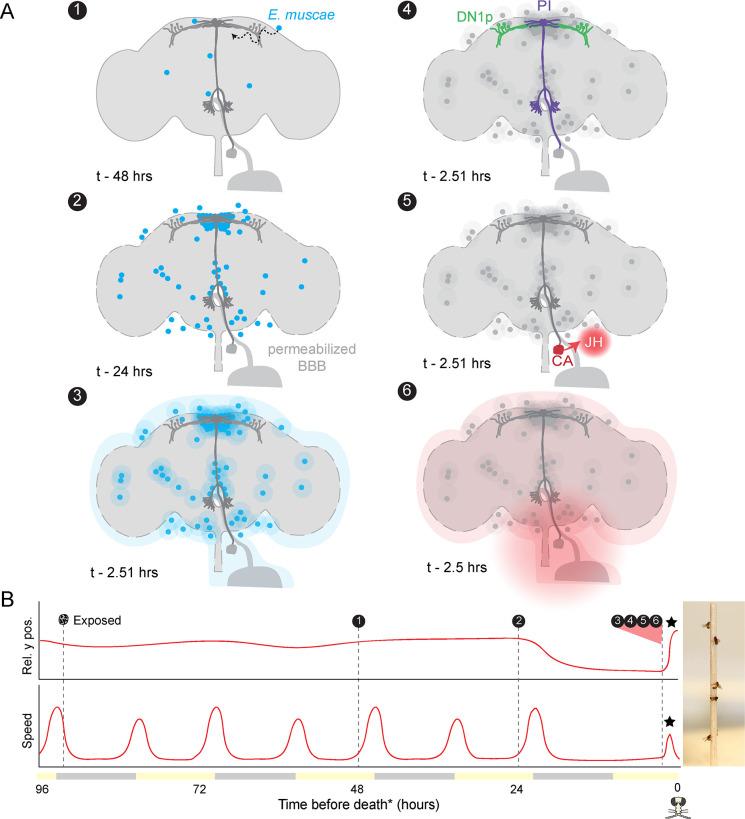
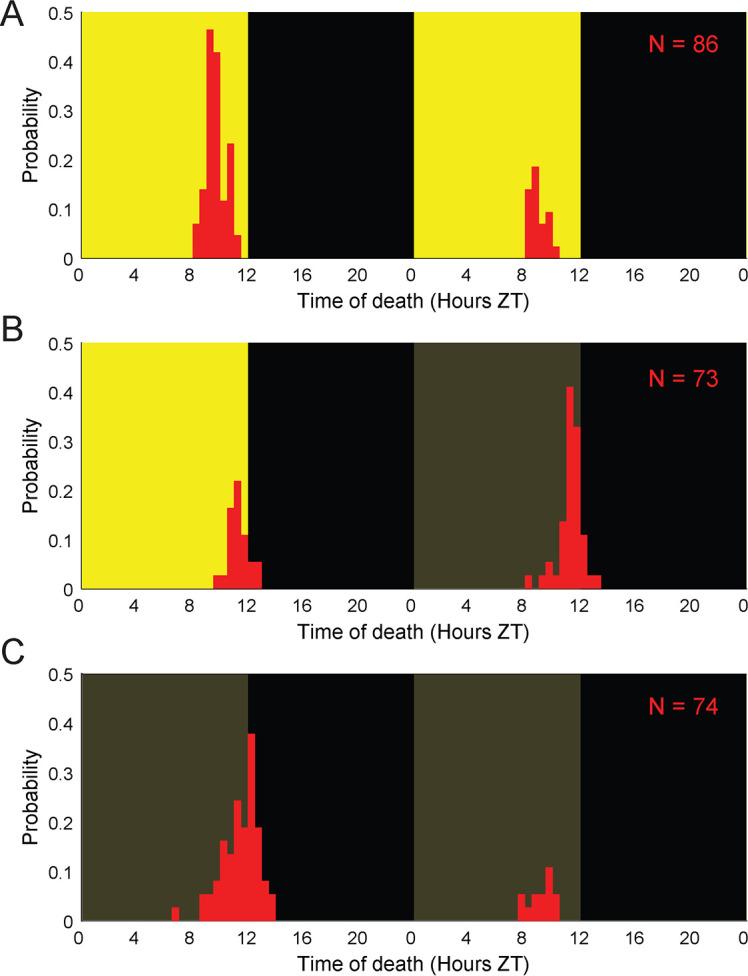
For at least two centuries, scientists have been enthralled by the "zombie" behaviors induced by mind-controlling parasites. Despite this interest, the mechanistic bases of these uncanny processes have remained mostly a mystery. Here, we leverage the - "zombie fly" system to reveal the mechanistic underpinnings of summit disease, a manipulated behavior evoked by many fungal parasites. Using a high-throughput approach to measure summiting, we discovered that summiting behavior is characterized by a burst of locomotion and requires the host circadian and neurosecretory systems, specifically DN1p circadian neurons, pars intercerebralis to corpora allata projecting (PI-CA) neurons and corpora allata (CA), the latter being solely responsible for juvenile hormone (JH) synthesis and release. Using a machine learning classifier to identify summiting animals in real time, we observed that PI-CA neurons and CA appeared intact in summiting animals, despite invasion of adjacent regions of the "zombie fly" brain by cells and extensive host tissue damage in the body cavity. The blood-brain barrier of flies late in their infection was significantly permeabilized, suggesting that factors in the hemolymph may have greater access to the central nervous system during summiting. Metabolomic analysis of hemolymph from summiting flies revealed differential abundance of several compounds compared to non-summiting flies. Transfusing the hemolymph of summiting flies into non-summiting recipients induced a burst of locomotion, demonstrating that factor(s) in the hemolymph likely cause summiting behavior. Altogether, our work reveals a neuro-mechanistic model for summiting wherein fungal cells perturb the fly's hemolymph, activating a neurohormonal pathway linking clock neurons to juvenile hormone production in the CA, ultimately inducing locomotor activity in their host.
至少两个世纪以来,科学家们一直着迷于受大脑控制的寄生虫引起的“僵尸”行为。尽管对此很感兴趣,但这些不可思议的过程的机械基础在很大程度上仍然是个谜。在这里,我们利用“僵尸苍蝇”系统来揭示由许多真菌寄生虫引起的操控行为的峰会病的机械基础。我们使用高通量方法来测量登顶行为,发现登顶行为的特征是突然的运动,需要宿主的昼夜节律和神经分泌系统,特别是 DN1p 昼夜节律神经元、脑间核到脑前体(PI-CA)神经元和脑垂体(CA),后者是唯一负责保幼激素(JH)合成和释放的。使用机器学习分类器实时识别登顶动物,我们观察到在登顶动物中,PI-CA 神经元和 CA 似乎完好无损,尽管细胞入侵了“僵尸苍蝇”大脑的相邻区域,并且在体腔中宿主组织受到了广泛的损伤。苍蝇感染后期的血脑屏障明显通透性增加,这表明血液中的因素在登顶期间可能更容易进入中枢神经系统。与非登顶苍蝇相比,登顶苍蝇的血液代谢组学分析显示出几种化合物的丰度存在差异。将登顶苍蝇的血液注入非登顶接受者中会引起突然的运动,这表明血液中的某种因素可能导致了登顶行为。总的来说,我们的工作揭示了一种登顶的神经机械模型,其中真菌细胞扰乱了苍蝇的血液,激活了一个连接生物钟神经元和 CA 中保幼激素产生的神经激素途径,最终导致宿主的运动活动。



 Zotero 插件