
基于生长特性的快速自动化酵母菌抗真菌药敏检测系统。
Rapid automated antifungal susceptibility testing system for yeasts based on growth characteristics.
机构信息
Department of Clinical Laboratory, State Key Laboratory of Complex Severe and Rare Diseases, Peking Union Medical College Hospital, Chinese Academy of Medical Science and Peking Union Medical College, Beijing, China.
Graduate School, Chinese Academy of Medical Sciences and Peking Union Medical College, Beijing, China.
出版信息
Front Cell Infect Microbiol. 2023 May 2;13:1153544. doi: 10.3389/fcimb.2023.1153544. eCollection 2023.
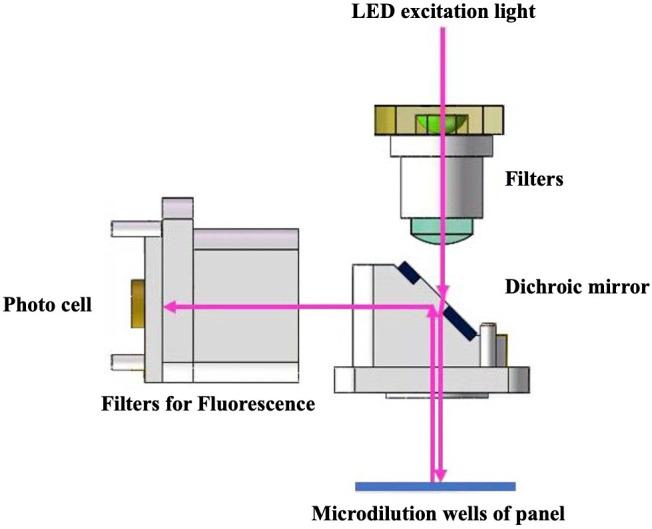
Fungal pathogens are a major threat to public health, as they are becoming increasingly common and resistant to treatment, with only four classes of antifungal medicines currently available and few candidates in the clinical development pipeline. Most fungal pathogens lack rapid and sensitive diagnostic techniques, and those that exist are not widely available or affordable. In this study, we introduce a novel automated antifungal susceptibility testing system, Droplet 48, which detects the fluorescence of microdilution wells in real time and fits growth characteristics using fluorescence intensity over time. We concluded that all reportable ranges of Droplet 48 were appropriate for clinical fungal isolates in China. Reproducibility within ±2 two-fold dilutions was 100%. Considering the Sensititre YeastOne Colorimetric Broth method as a comparator method, eight antifungal agents (fluconazole, itraconazole, voriconazole, caspofungin, micafungin, anidulafungin, amphotericin B, and 5-flucytosine) showed an essential agreement of >90%, except for posaconazole (86.62%). Category agreement of four antifungal agents (fluconazole, caspofungin, micafungin, and anidulafungin) was >90%, except for voriconazole (87.93% agreement). Two isolates and anidulafungin showed a major discrepancy (MD) (2.60%), and no other MD or very MD agents were found. Therefore, Droplet 48 can be considered as an optional method that is more automated and can obtain results and interpretations faster than previous methods. However, the optimization of the detection performance of posaconazole and voriconazole and promotion of Droplet 48 in clinical microbiology laboratories still require further research involving more clinical isolates in the future.
真菌病原体对公共健康构成重大威胁,因为它们越来越常见且对治疗具有抗药性,目前仅有四类抗真菌药物,而临床开发管道中几乎没有候选药物。大多数真菌病原体缺乏快速而敏感的诊断技术,现有的技术也不是广泛可用或负担得起的。在本研究中,我们引入了一种新颖的自动化抗真菌药敏测试系统,即 Droplet 48,它可以实时检测微稀释孔的荧光,并通过随时间变化的荧光强度拟合生长特征。我们得出结论,Droplet 48 的所有报告范围都适用于中国的临床真菌分离株。在 ±2 倍稀释度内的重现性为 100%。考虑将 Sensititre YeastOne 比色肉汤法作为比较方法,八种抗真菌药物(氟康唑、伊曲康唑、伏立康唑、卡泊芬净、米卡芬净、阿尼芬净、两性霉素 B 和 5-氟胞嘧啶)的敏感性协议率>90%,除了泊沙康唑(86.62%)。四种抗真菌药物(氟康唑、卡泊芬净、米卡芬净和阿尼芬净)的类别协议率>90%,除了伏立康唑(87.93%)。有两个分离株和阿尼芬净表现出主要差异(MD)(2.60%),未发现其他 MD 或非常 MD 药物。因此,Droplet 48 可以被认为是一种可选方法,它比以前的方法更自动化,并且可以更快地获得结果和解释。然而,需要进一步研究更多的临床分离株来优化泊沙康唑和伏立康唑的检测性能,并促进 Droplet 48 在临床微生物学实验室中的应用。



 Zotero 插件