
关于人工电子受体在光系统 II 中的作用机制的结构见解。
Structural insights into the action mechanisms of artificial electron acceptors in photosystem II.
机构信息
Faculty of Science, Okayama University, Okayama, Japan.
Research Institute for Interdisciplinary Science and Graduate School of Natural Science and Technology, Okayama University, Okayama, Japan.
出版信息
J Biol Chem. 2023 Jul;299(7):104839. doi: 10.1016/j.jbc.2023.104839. Epub 2023 May 19.
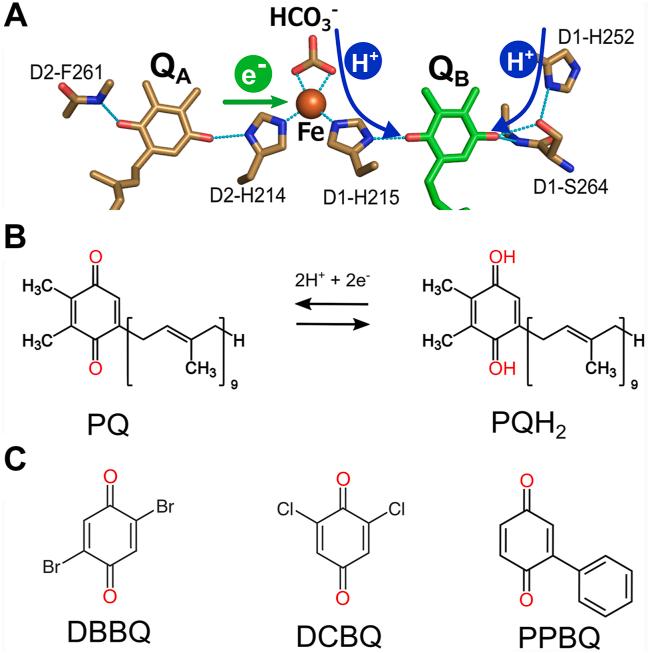
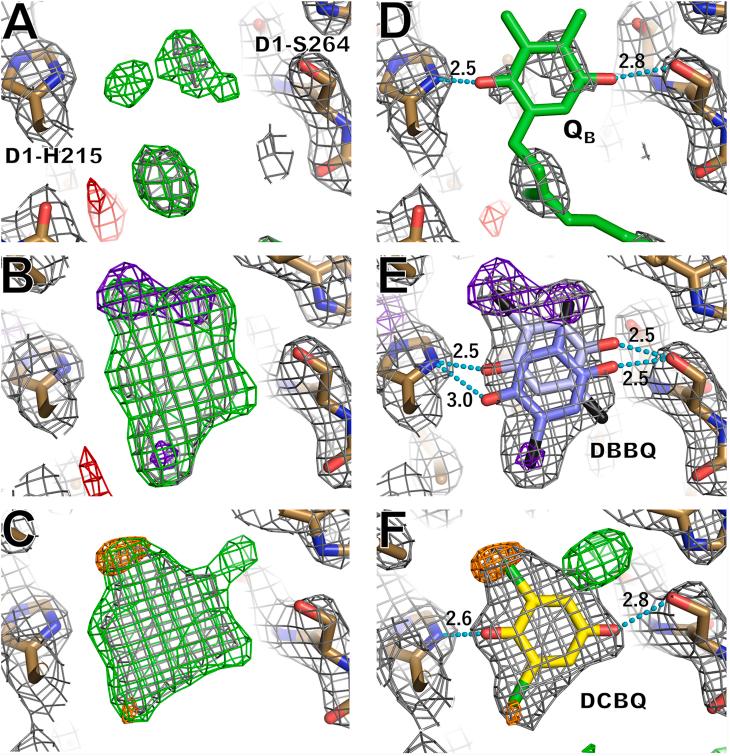
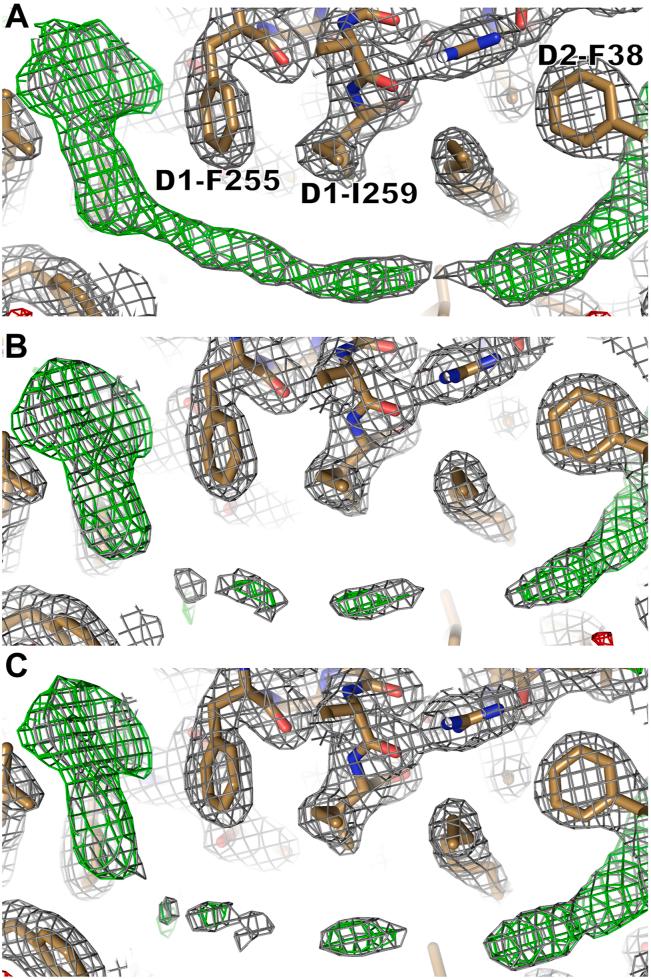
Photosystem II (PSII) utilizes light energy to split water, and the electrons extracted from water are transferred to Q, a plastoquinone molecule bound to the D1 subunit of PSII. Many artificial electron acceptors (AEAs) with molecular structures similar to that of plastoquinone can accept electrons from PSII. However, the molecular mechanism by which AEAs act on PSII is unclear. Here, we solved the crystal structure of PSII treated with three different AEAs, 2,5-dibromo-1,4-benzoquinone, 2,6-dichloro-1,4-benzoquinone, and 2-phenyl-1,4-benzoquinone, at 1.95 to 2.10 Å resolution. Our results show that all AEAs substitute for Q and are bound to the Q-binding site (Q site) to receive electrons, but their binding strengths are different, resulting in differences in their efficiencies to accept electrons. The acceptor 2-phenyl-1,4-benzoquinone binds most weakly to the Q site and showed the highest oxygen-evolving activity, implying a reverse relationship between the binding strength and oxygen-evolving activity. In addition, a novel quinone-binding site, designated the Q site, was discovered, which is located in the vicinity of Q site and close to Q site, a binding site reported previously. This Q site is expected to play a role as a channel or a storage site for quinones to be transported to the Q site. These results provide the structural basis for elucidating the actions of AEAs and exchange mechanism of Q in PSII and also provide information for the design of more efficient electron acceptors.
光系统 II(PSII)利用光能分解水,从水中提取的电子被转移到与 PSII 的 D1 亚基结合的质体醌(plastoquinone)分子 Q 上。许多具有与质体醌相似分子结构的人工电子受体(AEAs)可以从 PSII 接受电子。然而,AEAs 作用于 PSII 的分子机制尚不清楚。在这里,我们解析了 PSII 与三种不同的 AEA(2,5-二溴-1,4-苯醌、2,6-二氯-1,4-苯醌和 2-苯基-1,4-苯醌)处理后的晶体结构,分辨率为 1.95 到 2.10Å。我们的结果表明,所有的 AEAs 都替代 Q 并结合到 Q 结合位点(Q 位)接受电子,但它们的结合强度不同,导致它们接受电子的效率不同。受体 2-苯基-1,4-苯醌与 Q 位的结合最弱,但表现出最高的产氧活性,这表明结合强度与产氧活性之间存在反向关系。此外,还发现了一个新的醌结合位点,命名为 Q 位,它位于 Q 位附近,靠近先前报道的 Q 位结合位点。这个 Q 位预计在醌的运输到 Q 位的过程中起到通道或储存位点的作用。这些结果为阐明 AEA 的作用以及 PSII 中 Q 的交换机制提供了结构基础,也为设计更有效的电子受体提供了信息。




 Zotero 插件