
星形胶质细胞调制的爆发式脉冲神经网络中的信息编码
Information Encoding in Bursting Spiking Neural Network Modulated by Astrocytes.
作者信息
Stasenko Sergey V, Kazantsev Victor B
机构信息
Laboratory of Advanced Methods for High-Dimensional Data Analysis, Lobachevsky State University of Nizhny Novgorod, 603022 Nizhny Novgorod, Russia.
出版信息
Entropy (Basel). 2023 May 1;25(5):745. doi: 10.3390/e25050745.
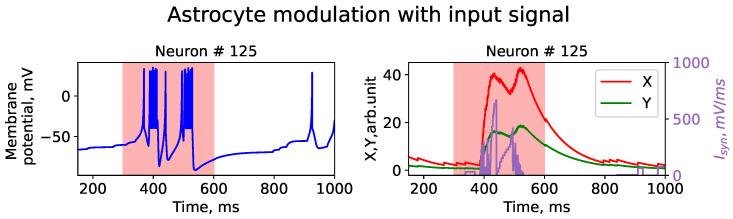
We investigated a mathematical model composed of a spiking neural network (SNN) interacting with astrocytes. We analysed how information content in the form of two-dimensional images can be represented by an SNN in the form of a spatiotemporal spiking pattern. The SNN includes excitatory and inhibitory neurons in some proportion, sustaining the excitation-inhibition balance of autonomous firing. The astrocytes accompanying each excitatory synapse provide a slow modulation of synaptic transmission strength. An information image was uploaded to the network in the form of excitatory stimulation pulses distributed in time reproducing the shape of the image. We found that astrocytic modulation prevented stimulation-induced SNN hyperexcitation and non-periodic bursting activity. Such homeostatic astrocytic regulation of neuronal activity makes it possible to restore the image supplied during stimulation and lost in the raster diagram of neuronal activity due to non-periodic neuronal firing. At a biological point, our model shows that astrocytes can act as an additional adaptive mechanism for regulating neural activity, which is crucial for sensory cortical representations.
我们研究了一个由与星形胶质细胞相互作用的脉冲神经网络(SNN)组成的数学模型。我们分析了二维图像形式的信息内容如何以时空脉冲模式的形式由SNN表示。SNN包含一定比例的兴奋性和抑制性神经元,维持自主放电的兴奋-抑制平衡。伴随每个兴奋性突触的星形胶质细胞对突触传递强度提供缓慢调节。一个信息图像以兴奋性刺激脉冲的形式上传到网络中,这些脉冲在时间上分布,再现图像的形状。我们发现星形胶质细胞调制可防止刺激诱导的SNN过度兴奋和非周期性爆发活动。这种对神经元活动的稳态星形胶质细胞调节使得恢复刺激期间提供的图像成为可能,该图像在神经元活动的光栅图中由于非周期性神经元放电而丢失。从生物学角度来看,我们的模型表明星形胶质细胞可以作为调节神经活动的额外适应性机制,这对于感觉皮层表征至关重要。




 Zotero 插件