
自组装聚芳醚基板在柔性有机发光二极管中的应用。
Application of Self-Assembled Polyarylether Substrate in Flexible Organic Light-Emitting Diodes.
作者信息
Wen Hsin-Yi, Lu Yu-Shien, Guo Cheng-Yan, Chang Mei-Ying, Huang Wen-Yao, Hsieh Tung-Li
机构信息
Department of Chemical and Materials Engineering, National Kaohsiung University of Science and Technology, Kaohsiung 80778, Taiwan.
Department of Photonics, National Sun Yat-sen University, Kaohsiung 80424, Taiwan.
出版信息
Micromachines (Basel). 2023 Apr 24;14(5):920. doi: 10.3390/mi14050920.
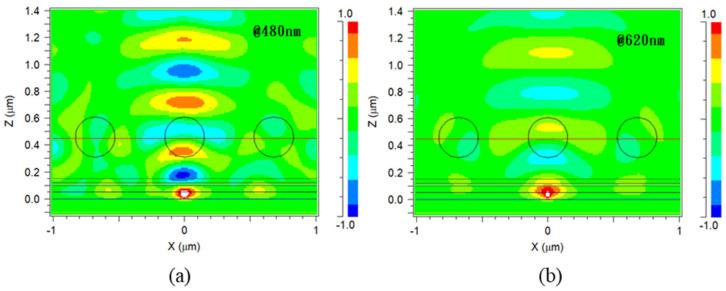
The structure used in this study is as follows: substrate/PMMA/ZnS/Ag/MoO3/NPB/Alq3/LiF/Al. Here, PMMA serves as the surface flattening layer, ZnS/Ag/MoO3 as the anode, NPB as the hole injection layer, Alq3 as the emitting layer, LiF as the electron injection layer, and aluminum as the cathode. The properties of the devices with different substrates were investigated using P4 and glass, developed in the laboratory, as well as commercially available PET. After film formation, P4 creates holes on the surface. The light field distribution of the device was calculated at wavelengths of 480 nm, 550 nm, and 620 nm using optical simulation. It was found that this microstructure contributes to light extraction. The maximum brightness, external quantum efficiency, and current efficiency of the device at a P4 thickness of 2.6 μm were 72,500 cd/m, 1.69%, and 5.68 cd/A, respectively. However, the maximum brightness of the same structure with PET (130 μm) was 9500 cd/m. The microstructure of the P4 substrate was found to contribute to the excellent device performance through analysis of the AFM surface morphology, film resistance, and optical simulation results. The holes formed by the P4 substrate were created solely by spin-coating the material and then placing it on a heating plate to dry, without any special processing. To confirm the reproducibility of the naturally formed holes, devices were fabricated again with three different emitting layer thicknesses. The maximum brightness, external quantum efficiency, and current efficiency of the device at an Alq3 thickness of 55 nm were 93,400 cd/m, 1.7%, and 5.6 cd/A, respectively.
本研究中使用的结构如下
衬底/聚甲基丙烯酸甲酯(PMMA)/硫化锌(ZnS)/银(Ag)/三氧化钼(MoO₃)/N,N'-二苯基-N,N'-二(1-萘基)-联苯-4,4'-二胺(NPB)/三(8-羟基喹啉)铝(Alq₃)/氟化锂(LiF)/铝(Al)。在此,PMMA用作表面平整层,ZnS/Ag/MoO₃用作阳极,NPB用作空穴注入层,Alq₃用作发光层,LiF用作电子注入层,铝用作阴极。使用实验室开发的P4和玻璃以及市售的聚对苯二甲酸乙二酯(PET)研究了具有不同衬底的器件的性能。成膜后,P4在表面形成孔洞。使用光学模拟计算了该器件在480nm、550nm和620nm波长下的光场分布。发现这种微观结构有助于光提取。在P4厚度为2.6μm时,该器件的最大亮度、外量子效率和电流效率分别为72500cd/m²、1.69%和5.68cd/A。然而,相同结构的PET(130μm)的最大亮度为9500cd/m²。通过对原子力显微镜(AFM)表面形貌、薄膜电阻和光学模拟结果的分析,发现P4衬底的微观结构有助于实现优异的器件性能。P4衬底形成的孔洞仅通过旋涂材料然后将其放置在加热板上干燥而形成,无需任何特殊处理。为了确认自然形成孔洞的可重复性,再次制造了具有三种不同发光层厚度的器件。在Alq₃厚度为55nm时,该器件的最大亮度、外量子效率和电流效率分别为93400cd/m²、1.7%和5.6cd/A。




 Zotero 插件