
全生物基聚羟基烷酸酯/单宁酸薄膜作为智能食品包装应用的多功能材料。
Fully Biobased Polyhydroxyalkanoate/Tannin Films as Multifunctional Materials for Smart Food Packaging Applications.
机构信息
Department of Civil, Chemical, Environmental and Materials Engineering (DICAM), University of Bologna, Via Terracini 28, 40131 Bologna, Italy.
National Interuniversity Consortium of Materials Science and Technology (INSTM), Via Giusti 9, 50121 Firenze, Italy.
出版信息
ACS Appl Mater Interfaces. 2023 Jun 14;15(23):28594-28605. doi: 10.1021/acsami.3c04611. Epub 2023 Jun 2.
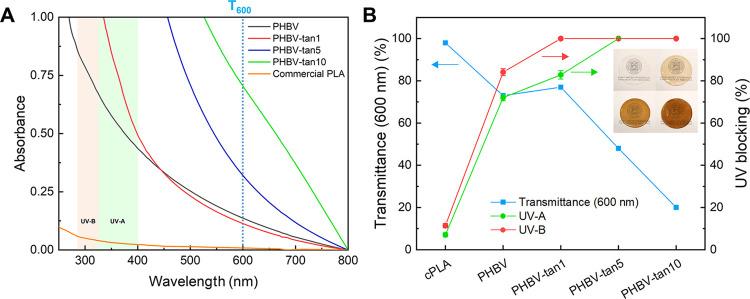
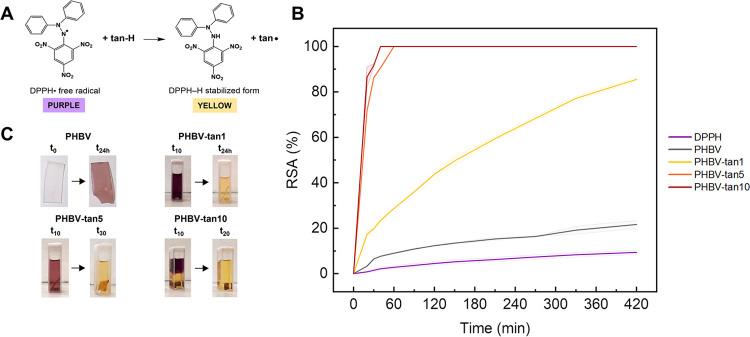
Fully biobased and biodegradable materials have attracted a growing interest in the food packaging sector as they can help to reduce the negative impact of fossil-based plastics on the environment. Moreover, the addition of functionalities to these materials by introducing active molecules has become an essential requirement to create modern packaging able to extend food's shelf-life while informing the consumer about food quality and freshness. In this study, we present an innovative bioplastic formulation for food packaging based on poly(hydroxybutyrate--valerate) (PHBV) and tannins as multifunctional additives. As a proof of concept, PHBV/tannin films were prepared by solvent casting, increasing the tannin content from 1 to 10 per hundred of resin (phr). Formic acid was used to reach a homogeneous distribution of the hydrophilic tannins into hydrophobic PHBV, which is remarkably challenging by using other solvents. Thanks to their well-known properties, the effect of tannins on the antioxidant, UV protection, and gas barrier properties of PHBV was evaluated. Samples containing 5 phr bioadditive revealed the best combination of these properties, also maintaining good transparency. Differential scanning calorimetry (DSC) investigations revealed that films are suitable for application from the fridge to potentially high temperatures for food heating (up to 200 °C). Tensile tests have also shown that Young's modulus (900-1030 MPa) and tensile strength (20 MPa) are comparable with those of the common polymers and biopolymers for packaging. Besides the improvement of the PHBV properties for extending food's shelf-life, it was also observed that PHBV/tannin could colorimetrically detect ammonia vapors, thus making this material potentially applicable as a smart indicator for food spoilage (e.g., detection of fish degradation). The presented outcomes suggest that tannins can add multifunctional properties to a polymeric material, opening up a new strategy to obtain an attractive alternative to petroleum-based plastics for smart food packaging applications.
全生物基和可生物降解材料在食品包装领域引起了越来越多的关注,因为它们有助于减少基于化石的塑料对环境的负面影响。此外,通过引入活性分子为这些材料增加功能已成为创造能够延长食品保质期同时向消费者告知食品质量和新鲜度的现代包装的基本要求。在这项研究中,我们提出了一种基于聚(羟基丁酸酯-戊酸酯)(PHBV)和单宁作为多功能添加剂的创新食品包装生物塑料配方。作为概念验证,通过溶剂浇铸制备了 PHBV/单宁薄膜,将单宁含量从每百份树脂(phr)的 1 增加到 10。使用甲酸来达到亲水单宁在疏水性 PHBV 中的均匀分布,这在使用其他溶剂时极具挑战性。由于单宁众所周知的性质,评估了单宁对 PHBV 的抗氧化、UV 保护和气体阻隔性能的影响。含有 5 phr 生物添加剂的样品显示出这些特性的最佳组合,同时保持良好的透明度。差示扫描量热法(DSC)研究表明,这些薄膜适用于从冰箱到可能用于加热食物的高温(高达 200°C)的应用。拉伸测试还表明,杨氏模量(900-1030 MPa)和拉伸强度(20 MPa)与用于包装的常见聚合物和生物聚合物相当。除了改善 PHBV 性能以延长食品保质期外,还观察到 PHBV/单宁可以比色检测氨蒸气,从而使这种材料有可能作为食品变质的智能指示剂(例如,检测鱼类降解)。所提出的结果表明,单宁可以为聚合物材料增加多功能特性,为获得用于智能食品包装应用的有吸引力的石油基塑料替代品开辟了新策略。




 Zotero 插件