
连续床边压力测绘系统对降低界面压力的影响:一项随机临床试验。
Effect of a Continuous Bedside Pressure Mapping System for Reducing Interface Pressures: A Randomized Clinical Trial.
机构信息
Division of Physical Medicine & Rehabilitation, Department of Medicine, Faculty of Medicine & Dentistry, University of Alberta and Alberta Health Services Neurosciences, Rehabilitation & Vision Strategic Clinical Network, Edmonton, Alberta, Canada.
W21C Research and Innovation Centre, O'Brien Institute for Public Health, University of Calgary, Calgary, Alberta, Canada.
出版信息
JAMA Netw Open. 2023 Jun 1;6(6):e2316480. doi: 10.1001/jamanetworkopen.2023.16480.
IMPORTANCE
Continuous bedside pressure mapping (CBPM) technology can assist in detecting skin areas with excessive interface pressure and inform efficient patient repositioning to prevent the development of pressure injuries (PI).
OBJECTIVE
To evaluate the efficacy of CBPM technology in reducing interface pressure and the incidence of PIs.
DESIGN, SETTING, AND PARTICIPANTS: This parallel, 2-group randomized clinical trial was performed at a tertiary acute care center. The study started to enroll participants in December 2014 and was completed in May 2018. Participants included adults partially or completely dependent for bed mobility. Statistical analysis was performed from September 2018 to December 2022.
INTERVENTION
Nursing staff using visual feedback from CBPM technology for 72 hours.
MAIN OUTCOMES AND MEASURES
Absolute number of sensing points with pressure readings greater than 40 mm Hg, mean interface pressure across all sensing points under a patient's body, proportion of participants who had pressure readings greater than 40 mm Hg, and pressure-related skin and soft tissue changes.
RESULTS
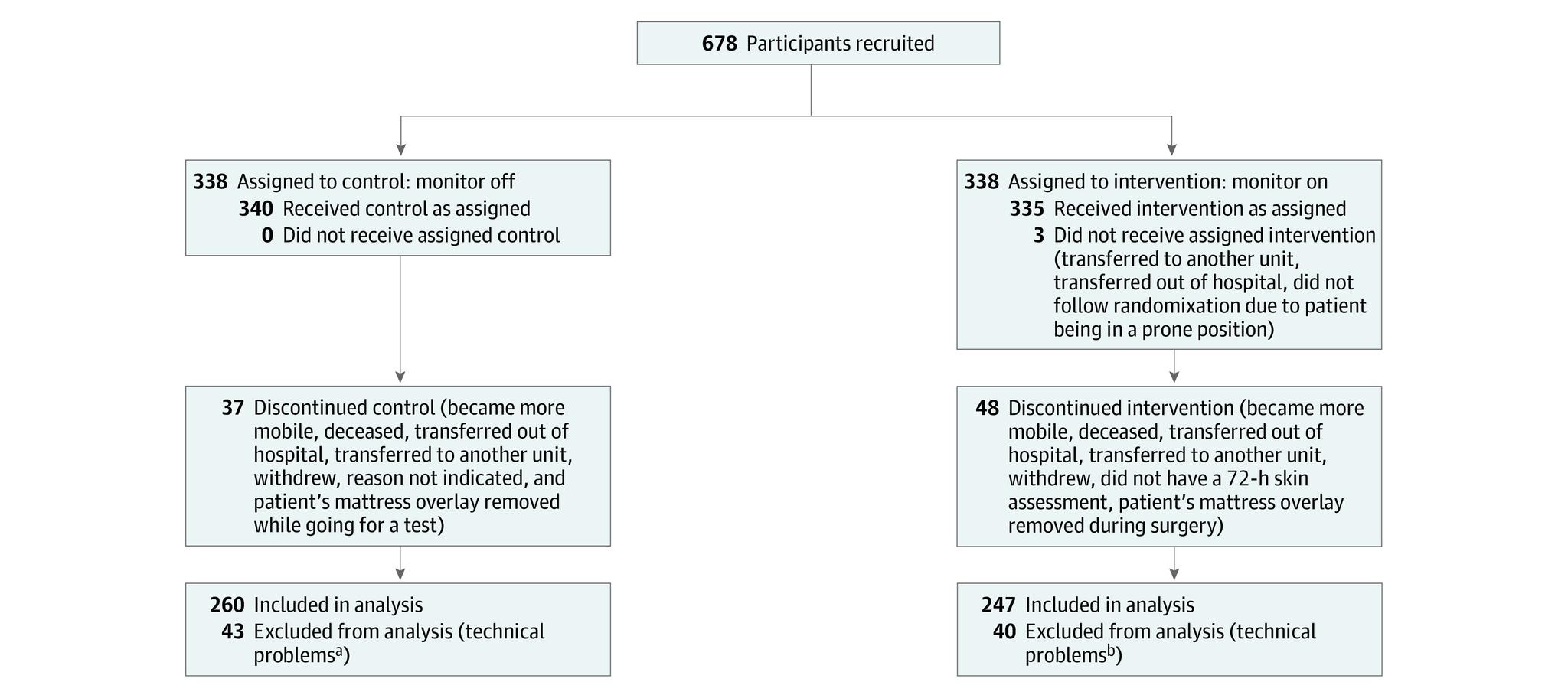
There were 678 patients recruited. After attrition, 260 allocated to the control group (151 [58.1%] male; mean [SD] age, 61.9 [18.5] years) and 247 in the intervention group (147 [59.5%] male; mean [SD] age, 63.6 [18.1] years) were included in analyses. The absolute number of sensing points with pressures greater than 40 mm Hg were 11 033 in the control group vs 9314 in the intervention group (P = .16). The mean (SD) interface pressure was 6.80 (1.63) mm Hg in the control group vs 6.62 (1.51) mm Hg in the intervention group (P = .18). The proportion of participants who had pressure readings greater than 40 mm Hg was 99.6% in both the control and intervention groups.
CONCLUSIONS AND RELEVANCE
In this randomized clinical trial to evaluate the efficacy of CBPM technology in the reduction of interface pressure and the incidence of PIs in a tertiary acute care center, no statistically significant benefit was seen for any of the primary outcomes. These results suggest that longer duration of monitoring and adequately powered studies where CBPM feedback is integrated into a multifaceted intervention to prevent PI are needed.
TRIAL REGISTRATION
ClinicalTrials.gov Identifier: NCT02325388.
重要性
连续床边压力测绘(CBPM)技术可协助检测界面压力过高的皮肤区域,并及时告知患者调整体位,以预防压疮(PI)的发生。
目的
评估 CBPM 技术在降低界面压力和 PI 发生率方面的效果。
设计、设置和参与者:这是一项在三级急症护理中心进行的平行、2 组随机临床试验。研究于 2014 年 12 月开始招募参与者,并于 2018 年 5 月完成。参与者包括部分或完全依赖床旁移动的成年人。统计分析于 2018 年 9 月至 2022 年 12 月进行。
干预措施
护理人员使用 CBPM 技术的视觉反馈持续 72 小时。
主要结局和测量指标
压力读数大于 40mmHg 的感应点绝对数量、患者身体下方所有感应点的平均界面压力、压力读数大于 40mmHg 的参与者比例以及与压力相关的皮肤和软组织变化。
结果
共招募了 678 名患者。经过流失,260 名患者被分配至对照组(151 名[58.1%]男性;平均[标准差]年龄 61.9[18.5]岁),247 名患者被分配至干预组(147 名[59.5%]男性;平均[标准差]年龄 63.6[18.1]岁)。对照组的压力读数大于 40mmHg 的感应点绝对数量为 11033 个,干预组为 9314 个(P = .16)。对照组的平均(标准差)界面压力为 6.80(1.63)mmHg,干预组为 6.62(1.51)mmHg(P = .18)。对照组和干预组的压力读数大于 40mmHg 的参与者比例均为 99.6%。
结论和相关性
在这项评估 CBPM 技术在减少三级急症护理中心界面压力和 PI 发生率方面效果的随机临床试验中,主要结局均未显示出统计学意义上的获益。这些结果表明,需要进行更长时间的监测和更有力的研究,其中将 CBPM 反馈整合到预防 PI 的多方面干预措施中。
试验注册
ClinicalTrials.gov 标识符:NCT02325388。

 Zotero 插件