
对 种(一种抑制 O157:H7 的物种)的全基因组分析。
Complete genome analysis of , a species inhibiting O157:H7.
机构信息
Departamento de Tecnologia de Alimentos, Universidade Federal de Viçosa, Viçosa, Minas Gerais, Brazil.
Departamento de Ingeniería de Alimentos, Universidad de Córdoba, Montería, Colombia.
出版信息
Front Cell Infect Microbiol. 2023 May 16;13:1178248. doi: 10.3389/fcimb.2023.1178248. eCollection 2023.
INTRODUCTION
Bacteriophages infecting human pathogens have been considered potential biocontrol agents, and studying their genetic content is essential to their safe use in the food industry. is a bacteriophage named UFV-AREG1, isolated from cowshed wastewater and previously tested for its ability to inhibit O157:H7.
METHODS
1 was previously isolated using E. O157:H7 (ATCC 43895) as a bacterial host. The same strain was used for bacteriophage propagation and the one-step growth curve. The genome of the T. ufvareg1 was sequenced using 305 Illumina HiSeq, and the genome comparison was calculated by VIRIDIC and VIPTree.
RESULTS
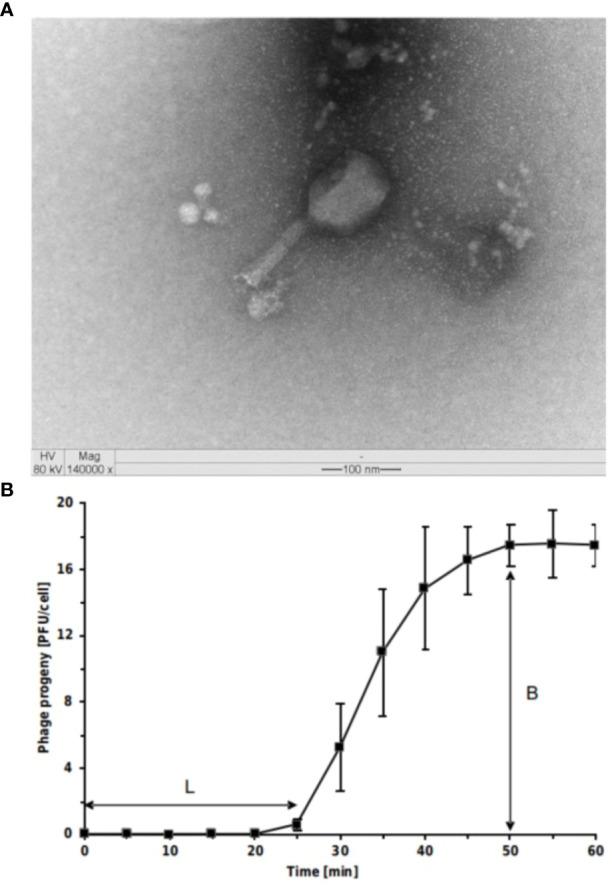
Here, we characterize its genome and compare it to other . virions have an icosahedral head (114 x 86 nm) and a contracted tail (117 x 23 nm), with a latent period of 25 min, and an average burst size was 18 phage particles per infected cell. The genome of the bacteriophage contains 268 coding DNA sequences (CDS) and ten tRNA genes distributed in both negative and positive strains. genome also contains 40 promoters on its regulatory regions and two rho-independent terminators. shares an average intergenomic similarity (VIRIDC) of 88.77% and an average genomic similarity score (VipTree) of 88.91% with eight four reference genomes for available in the NCBI RefSeq database. The pan-genomic analysis confirmed the high conservation of genomes. Among all CDS annotated in the genome, there are 123 core genes, 38 softcore genes, 94 shell genes, and 13 cloud genes. None of 268 CDS was classified as being exclusive of .
CONCLUSION
The results in this paper, combined with other previously published findings, indicate that bacteriophage is a potential candidate for food protection against O157:H7 in foods.
简介
感染人类病原体的噬菌体已被视为潜在的生物防治剂,研究其遗传物质对于其在食品工业中的安全应用至关重要。 是一种从牛舍废水中分离出来的噬菌体,此前曾对其抑制 O157:H7 的能力进行过测试。
方法
使用 E. coli O157:H7 (ATCC 43895) 作为细菌宿主来分离 1 。使用相同的菌株进行噬菌体繁殖和一步生长曲线。使用 305 个 Illumina HiSeq 对 T. ufvareg1 的基因组进行测序,并通过 VIRIDIC 和 VIPTree 计算基因组比较。
结果
在这里,我们描述了它的基因组,并将其与其他 噬菌体进行了比较。 噬菌体的衣壳呈二十面体(114 x 86nm),尾部收缩(117 x 23nm),潜伏期为 25 分钟,平均每个感染细胞释放 18 个噬菌体颗粒。噬菌体的基因组包含 268 个编码 DNA 序列(CDS)和十个 tRNA 基因,分布在正负链上。 基因组的调控区还包含 40 个启动子和两个 rho 非依赖性终止子。 在 NCBI RefSeq 数据库中,有八个可供参考的 噬菌体基因组,其平均基因组间相似度(VIRIDC)为 88.77%,平均基因组相似度得分(VipTree)为 88.91%。泛基因组分析证实了 噬菌体基因组的高度保守性。在 基因组注释的所有 268 个 CDS 中,有 123 个核心基因、38 个软核心基因、94 个壳基因和 13 个云基因。没有一个 CDS 被归类为 噬菌体所特有。
结论
本文的结果结合其他已发表的研究结果表明,噬菌体是一种有潜力的候选物,可以用于保护食品免受食品中 O157:H7 的污染。


 Zotero 插件