
面对反复干旱时农业生计的恢复力:来自埃塞俄比亚东北部的实证证据。
Agricultural livelihood resilience in the face of recurring droughts: Empirical evidence from northeast Ethiopia.
作者信息
Wassie Simachew Bantigegn, Mengistu Daniel Ayalew, Birlie Arega Bazezew
机构信息
Department of geography and Environmental Studies, Bahir Dar University, P.O. Box 79, Bahir Dar, Ethiopia.
出版信息
Heliyon. 2023 May 23;9(6):e16422. doi: 10.1016/j.heliyon.2023.e16422. eCollection 2023 Jun.
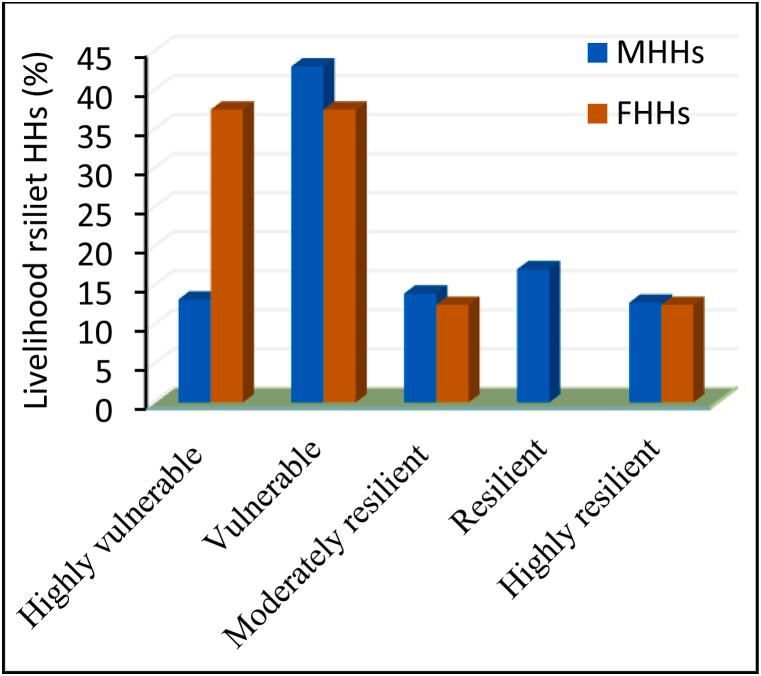
The main purpose of this study was to characterize the livelihood resilience of smallholder farmers in the face of recurring droughts in northeast Ethiopia. The data was collected using a cross-sectional survey of 274 households and five focus group discussions. Principal component analysis and multiple linear regression models were employed to analyze the data. The Livelihood Resilience Index (LRI), framed on absorptive, adaptive, and transformative capacities, was used to quantify the households' livelihood resilience. The results indicated that about 57% of the surveyed respondents were non-resilient, while 43% were resilient to different degrees. Abay Tekeze watershed (ATW) livelihood zone exhibits the highest proportion of resilient households (57.4%), while North Wollo highland has the lowest proportion (22.7%). The high resilience in ATW was attributed to the relatively lower persistence of droughts, better accessibility in enabling institutions, more access to agricultural inputs, and the training and support given to farmers. The better-off were more resilient (90.9%) than the medium (52.1%) and the poor (34.6%) households. Among the latent dimensions, sensitivity with β value -0.372, climate change and variability (-0.33), and enabling institutions and environments (0.288) showed a significant (p < 0.0001) influence on LRI. This was followed by adaptive capacity and food access (0.249), agricultural practice and technology (0.213), and asset possession (0.19), in respective order. It implies that the absorptive capacity of households showed the leading influence in determining LRI, while adaptive and transformative capacities had nearly similar low effects. Thus, it is recommended that future planning for building livelihood resilience and drought risk interventions in the area should address the levels of resilience identified and the relative importance of each latent dimension indicated.
本研究的主要目的是描述埃塞俄比亚东北部小农户在面对反复干旱时的生计恢复力特征。数据收集采用了对274户家庭的横断面调查和五次焦点小组讨论。运用主成分分析和多元线性回归模型对数据进行分析。基于吸收、适应和转型能力构建的生计恢复力指数(LRI)用于量化家庭的生计恢复力。结果表明,约57%的受访受访者缺乏恢复力,而43%具有不同程度的恢复力。阿贝·特克泽流域(ATW)生计区的恢复力强的家庭比例最高(57.4%),而北沃洛高地的比例最低(22.7%)。ATW地区较高的恢复力归因于干旱持续时间相对较短、扶持机构的可达性更好、农业投入获取更多以及给予农民的培训和支持。富裕家庭(90.9%)比中等家庭(52.1%)和贫困家庭(34.6%)更具恢复力。在潜在维度中,β值为-0.372的敏感性、气候变化和变率(-0.33)以及扶持机构和环境(0.288)对LRI有显著(p<0.0001)影响。其次是适应能力和食物获取(0.249)、农业实践和技术(0.213)以及资产拥有(0.19),顺序依次如此。这意味着家庭的吸收能力在决定LRI方面显示出主导影响,而适应和转型能力的影响几乎同样低。因此,建议该地区未来关于增强生计恢复力和干旱风险干预的规划应考虑已确定的恢复力水平以及各潜在维度的相对重要性。


 Zotero 插件