
优化可再生能源系统设计的上行变量和反脆弱性。
Optimizing upside variability and antifragility in renewable energy system design.
机构信息
Institute of Mechanics, Materials and Civil Engineering (iMMC), Université catholique de Louvain (UCLouvain), Place du Levant, 2, 1348, Louvain-la-Neuve, Belgium.
出版信息
Sci Rep. 2023 Jun 5;13(1):9138. doi: 10.1038/s41598-023-36379-8.
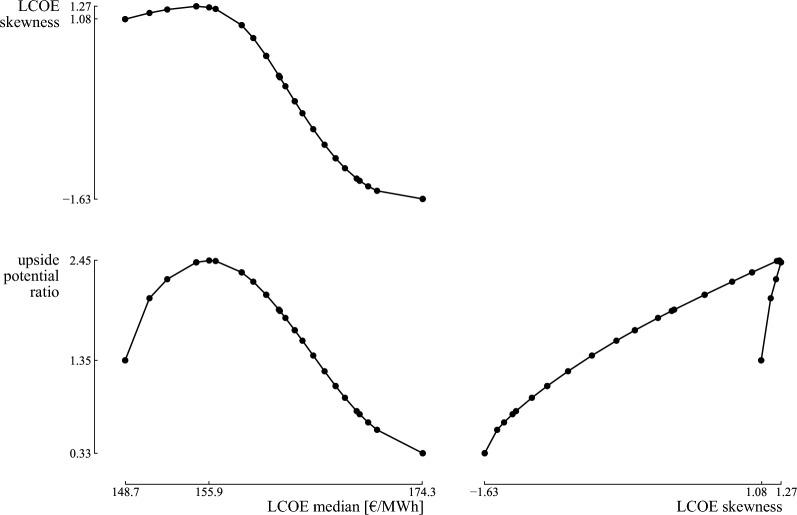
Despite the considerable uncertainty in predicting critical parameters of renewable energy systems, the uncertainty during system design is often marginally addressed and consistently underestimated. Therefore, the resulting designs are fragile, with suboptimal performances when reality deviates significantly from the predicted scenarios. To address this limitation, we propose an antifragile design optimization framework that redefines the indicator to optimize variability and introduces an antifragility indicator. The variability is optimized by favoring upside potential and providing downside protection towards a minimum acceptable performance, while the skewness indicates (anti)fragility. An antifragile design primarily enhances positive outcomes when the uncertainty of the random environment exceeds initial estimations. Hence, it circumvents the issue of underestimating the uncertainty in the operating environment. We applied the methodology to the design of a wind turbine for a community, considering the Levelized Cost Of Electricity (LCOE) as the quantity of interest. The design with optimized variability proves beneficial in 81% of the possible scenarios when compared to the conventional robust design. The antifragile design flourishes (LCOE drops by up to 120%) when the real-world uncertainty is higher than initially estimated in this paper. In conclusion, the framework provides a valid metric for optimizing the variability and detects promising antifragile design alternatives.
尽管可再生能源系统的关键参数预测存在相当大的不确定性,但在系统设计过程中,这种不确定性通常只是被略微考虑到,而且一直被低估。因此,所得到的设计是脆弱的,当现实与预测场景有很大偏差时,其性能就会不佳。为了解决这个局限性,我们提出了一个抗脆弱性设计优化框架,该框架重新定义了要优化的变量指标,并引入了一个抗脆弱性指标。通过偏向于上行潜力并为最低可接受性能提供下行保护来优化变量,同时偏度表示(反)脆弱性。当随机环境的不确定性超过初始估计时,抗脆弱性设计主要会增强积极结果。因此,它避免了低估操作环境不确定性的问题。我们将该方法应用于设计一个面向社区的风力涡轮机,将平准化度电成本(LCOE)作为感兴趣的数量。与传统的稳健设计相比,优化了变量的设计在 81%的可能场景中都是有益的。当实际不确定性高于本文中的初始估计时,抗脆弱性设计会蓬勃发展(LCOE 下降高达 120%)。总之,该框架提供了一个有效的指标来优化变量,并可以检测出有前途的抗脆弱性设计方案。




 Zotero 插件