
评估英国脱欧和 COVID-19 对英国经济的影响:数据分析。
Evaluating the Brexit and COVID-19's influence on the UK economy: A data analysis.
机构信息
Cardiff School of Technologies, Cardiff Metropolitan University, Cardiff, United Kingdom.
Department of Computer Science and Engineering, Asian University of Bangladesh, Ashulia, Dhaka, Bangladesh.
出版信息
PLoS One. 2023 Jun 15;18(6):e0287342. doi: 10.1371/journal.pone.0287342. eCollection 2023.
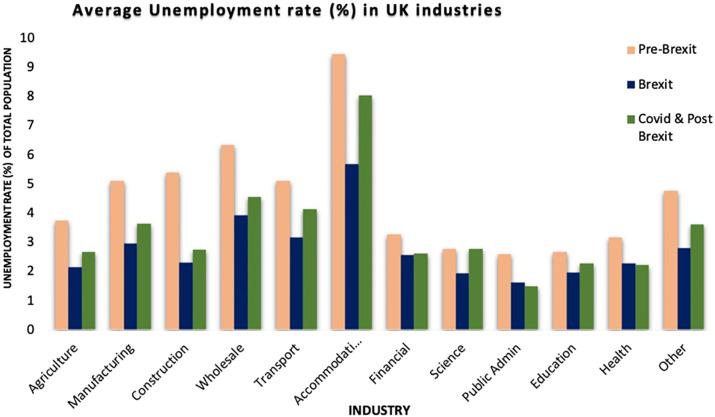
The economic landscape of the United Kingdom has been significantly shaped by the intertwined issues of Brexit, COVID-19, and their interconnected impacts. Despite the country's robust and diverse economy, the disruptions caused by Brexit and the COVID-19 pandemic have created uncertainty and upheaval for both businesses and individuals. Recognizing the magnitude of these challenges, academic literature has directed its attention toward conducting immediate research in this crucial area. This study sets out to investigate key economic factors that have influenced various sectors of the UK economy and have broader economic implications within the context of Brexit and COVID-19. The factors under scrutiny include the unemployment rate, GDP index, earnings, and trade. To accomplish this, a range of data analysis tools and techniques were employed, including the Box-Jenkins method, neural network modeling, Google Trend analysis, and Twitter-sentiment analysis. The analysis encompassed different periods: pre-Brexit (2011-2016), Brexit (2016-2020), the COVID-19 period, and post-Brexit (2020-2021). The findings of the analysis offer intriguing insights spanning the past decade. For instance, the unemployment rate displayed a downward trend until 2020 but experienced a spike in 2021, persisting for a six-month period. Meanwhile, total earnings per week exhibited a gradual increase over time, and the GDP index demonstrated an upward trajectory until 2020 but declined during the COVID-19 period. Notably, trade experienced the most significant decline following both Brexit and the COVID-19 pandemic. Furthermore, the impact of these events exhibited variations across the UK's four regions and twelve industries. Wales and Northern Ireland emerged as the regions most affected by Brexit and COVID-19, with industries such as accommodation, construction, and wholesale trade particularly impacted in terms of earnings and employment levels. Conversely, industries such as finance, science, and health demonstrated an increased contribution to the UK's total GDP in the post-Brexit period, indicating some positive outcomes. It is worth highlighting that the impact of these economic factors was more pronounced on men than on women. Among all the variables analyzed, trade suffered the most severe consequences in the UK. By early 2021, the macroeconomic situation in the country was characterized by a simple dynamic: economic demand rebounded at a faster pace than supply, leading to shortages, bottlenecks, and inflation. The findings of this research carry significant value for the UK government and businesses, empowering them to adapt and innovate based on forecasts to navigate the challenges posed by Brexit and COVID-19. By doing so, they can promote long-term economic growth and effectively address the disruptions caused by these interrelated issues.
英国的经济格局受到英国脱欧、COVID-19 及其相互影响的复杂问题的显著塑造。尽管英国拥有强大而多样化的经济,但英国脱欧和 COVID-19 大流行造成的破坏给企业和个人都带来了不确定性和动荡。认识到这些挑战的巨大规模,学术文献已经将注意力集中在这一关键领域进行即时研究。本研究旨在调查影响英国经济各个部门的关键经济因素,并在英国脱欧和 COVID-19 的背景下对更广泛的经济产生影响。受审查的因素包括失业率、国内生产总值指数、收入和贸易。为此,使用了一系列数据分析工具和技术,包括 Box-Jenkins 方法、神经网络建模、Google 趋势分析和 Twitter 情绪分析。分析涵盖了不同的时期:英国脱欧前(2011-2016 年)、英国脱欧期间(2016-2020 年)、COVID-19 期间和英国脱欧后(2020-2021 年)。分析结果提供了过去十年的有趣见解。例如,失业率在 2020 年之前呈下降趋势,但在 2021 年出现飙升,并持续了六个月。与此同时,每周总收入呈逐渐增加趋势,国内生产总值指数在 2020 年之前呈上升趋势,但在 COVID-19 期间下降。值得注意的是,贸易在英国脱欧和 COVID-19 之后经历了最大的下降。此外,这些事件的影响在英国的四个地区和十二个行业之间存在差异。威尔士和北爱尔兰是受英国脱欧和 COVID-19 影响最大的地区,住宿、建筑和批发贸易等行业在收入和就业水平方面受到特别影响。相比之下,金融、科学和医疗保健等行业在英国脱欧后对英国的国内生产总值增长贡献增加,表明存在一些积极的结果。值得注意的是,这些经济因素对男性的影响比女性更为明显。在所有分析的变量中,贸易在英国受到的影响最为严重。到 2021 年初,该国的宏观经济形势呈现出一种简单的动态:经济需求的反弹速度快于供应,导致短缺、瓶颈和通货膨胀。本研究的结果对英国政府和企业具有重要价值,使他们能够根据预测进行调整和创新,以应对英国脱欧和 COVID-19 带来的挑战。通过这样做,他们可以促进长期经济增长,并有效地解决这些相互关联的问题所带来的破坏。




 Zotero 插件