
新冠疫情隔离期间急诊科就诊人次下降。
Decline in emergency department visits during the COVID-19 quarantine.
机构信息
Department of Otolaryngology - Head and Neck Surgery, Galilee Medical Center, Nahariya, Israel.
Department of Otolaryngology - Head and Neck Surgery, Galilee Medical Center, Nahariya, Israel; Azrieli Faculty of Medicine, Bar Ilan University, Safed, Israel.
出版信息
Am J Emerg Med. 2023 Sep;71:74-80. doi: 10.1016/j.ajem.2023.06.002. Epub 2023 Jun 7.
BACKGROUND
Emergency department (ED) visits can be divided into urgent and non-urgent. A delay in seeking medical help, especially in urgent cases, can lead to fatal consequences, along with a higher rate of complications and morbidity. Coronavirus disease 2019 (COVID-19) pandemic spread led to restrictions and eventually quarantines. We investigated the impact of the COVID-19 spread and quarantine on ED visits rates comparing to parallel periods in preceding years (2013-2019). In addition, we compared this decrease to holidays and weekends, times in which a decrease in ED visits is seen.
METHODS
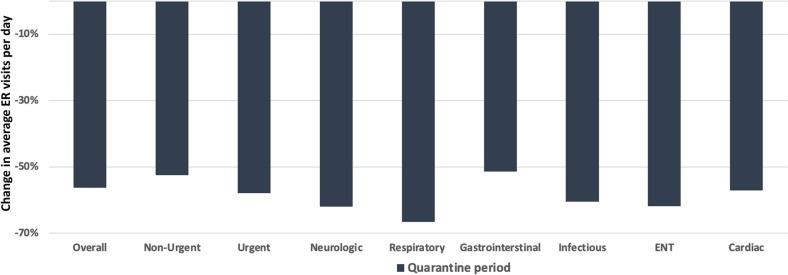
This was a descriptive retrospective study. Causes of ED referrals were divided into urgent and non-urgent, then into different subcategories including infectious, cardiac, etc. RESULTS: For the spring COVID-192020 quarantine period, a 56.3% decrease of mean ED visits per day was seen, as compared to preceding years (55.7% and 98.9% respectively). This decrease was also statistically evident when comparing the urgent and non-urgent causes separately and for all sub-categories. This pattern of decrease also showed statistical evidence of fewer ED visits during holidays for most comparisons, in which lower ED visit rates are expected. Significantly lower rates of ED visits were demonstrated during the COVID-19 quarantine period, as compared to preceding years and main holidays and weekends, a decrease that was also demonstrated for urgent life-threatening causes.
CONCLUSION
Our findings can be used to inform a wide range of stakeholders, including regional planners, historians, sociologists, and international healthcare organizations. Healthcare providers should understand the reasons for this ED visit decline pattern, attempt to address patients' concerns, and increase awareness regarding alarming symptoms in urgent medical situations.
背景
急诊科(ED)就诊可分为紧急和非紧急。延迟寻求医疗帮助,特别是在紧急情况下,可能导致致命后果,同时并发症和发病率也会更高。2019 年冠状病毒病(COVID-19)大流行的传播导致了限制,最终导致了隔离。我们调查了 COVID-19 传播和隔离对急诊科就诊率的影响,并与前几年(2013-2019 年)同期进行了比较。此外,我们将这种下降与节假日和周末进行了比较,节假日和周末通常就诊人数会减少。
方法
这是一项描述性回顾性研究。急诊科转诊的原因分为紧急和非紧急,然后分为不同的亚类,包括传染病、心脏病等。
结果
与前几年相比,春季 COVID-192020 隔离期间,急诊科每天就诊人数平均下降了 56.3%(分别为 55.7%和 98.9%)。这种下降在分别比较紧急和非紧急原因以及所有亚类时也具有统计学意义。这种就诊人数下降的模式在大多数比较中也显示出节假日就诊人数较少的统计学证据,在节假日预计就诊人数会减少。与前几年以及主要节假日和周末相比,COVID-19 隔离期间急诊科就诊人数显著减少,这种情况也在危及生命的紧急原因中有所体现。
结论
我们的发现可用于为广泛的利益相关者提供信息,包括区域规划者、历史学家、社会学家和国际医疗保健组织。医疗保健提供者应了解这种急诊科就诊人数下降模式的原因,尝试解决患者的担忧,并提高对紧急医疗情况下警报症状的认识。
 Zotero 插件