
小干扰RNA介导的血管性血友病因子在体外和体内的等位基因选择性沉默
Small interfering RNA-mediated allele-selective silencing of von Willebrand factor in vitro and in vivo.
作者信息
Jongejan Yvonne K, Schrader Echeverri Elisa, Dirven Richard J, Paunovska Kalina, Linthorst Noa A, de Jong Annika, Wellershoff Johannes C, van der Gouw Kim D, van Vlijmen Bart J M, Dahlman James E, Eikenboom Jeroen C J
机构信息
Division of Thrombosis and Hemostasis, Department of Internal Medicine, Einthoven Laboratory for Vascular and Regenerative Medicine, Leiden University Medical Center, Leiden, The Netherlands.
Wallace H. Coulter Department of Biomedical Engineering, Georgia Institute of Technology and Emory University School of Medicine, Atlanta, GA.
出版信息
Blood Adv. 2023 Oct 24;7(20):6108-6119. doi: 10.1182/bloodadvances.2023010643.
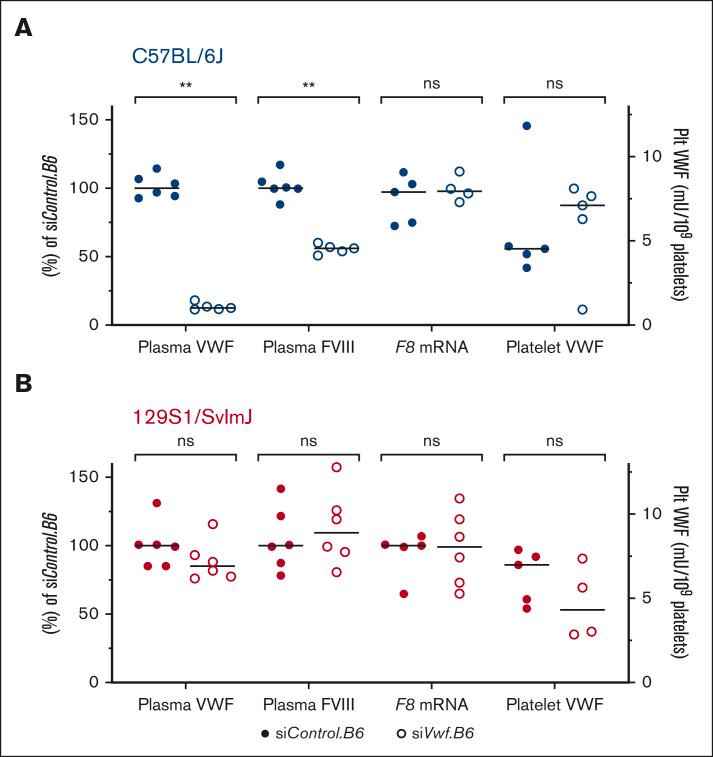
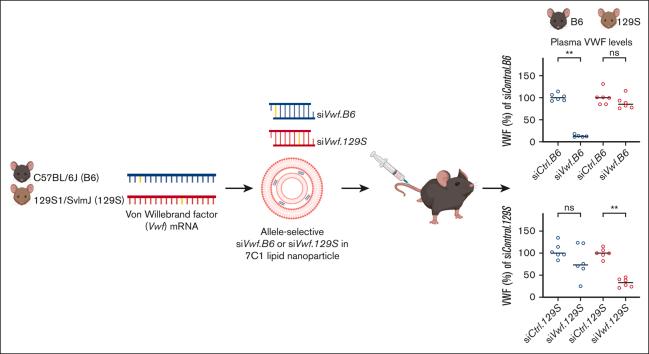
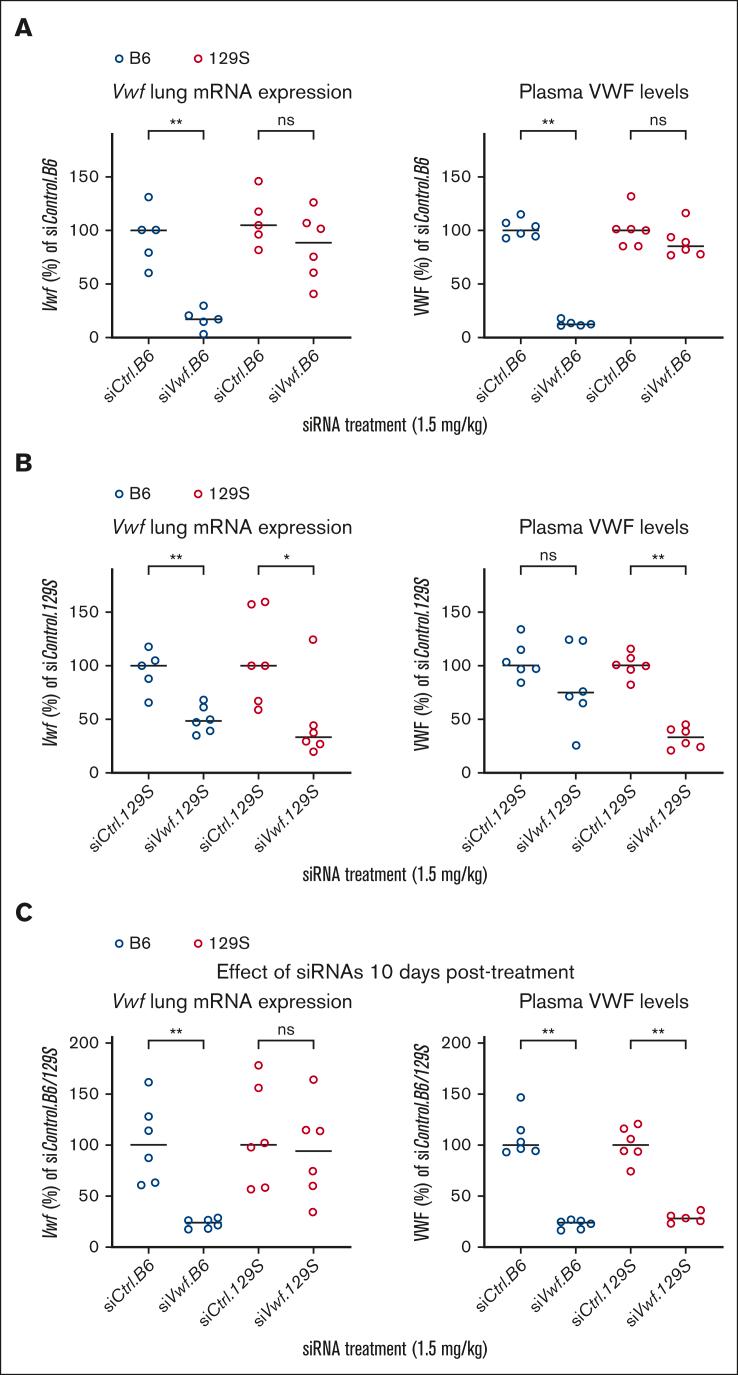
An imbalance in von Willebrand factor (VWF) may either lead to bleeding (von Willebrand disease, VWD) or thrombosis. Both disorders have shortcomings in the currently available treatments. VWF itself could be a potential therapeutic target because of its role in both bleeding and thrombosis. Inhibiting VWF gene expression through allele-selective silencing of VWF with small interfering RNAs (siRNAs) could be a personalized approach to specifically inhibit mutant VWF in VWD or to normalize increased VWF levels in thrombotic disorders without complete VWF knockdown. Therefore, we investigated a method to allele-selectively silence the VWF gene in mice as a therapeutic strategy. Fourteen candidate siRNAs targeting murine Vwf of either the C57BL/6J (B6) or the 129S1/SvImJ (129S) strain were tested in vitro in cells expressing B6- and 129S-Vwf for inhibitory effect and allele-selective potential. Together with a nonselective siVwf, 2 lead candidate siRNAs, siVwf.B6 and siVwf.129S, were further tested in vivo in B6 and 129S mice. Efficient endothelial siRNA delivery was achieved by siRNA encapsulation into 7C1 oligomeric lipid nanoparticles. Treatment with the nonselective siVwf resulted in dose-dependent inhibition of up to 80% of both lung messenger RNA and plasma VWF protein in both mouse strains. In contrast, the allele-selective siVwf.B6 and siVwf.129S were shown to be effective in and selective solely for their corresponding mouse strain. To conclude, we showed efficient endothelial delivery of siRNAs that are highly effective in allele-selective inhibition of Vwf in mice, which constitutes an in vivo proof of principle of allele-selective VWF silencing as a therapeutic approach.
血管性血友病因子(VWF)失衡可能导致出血(血管性血友病,VWD)或血栓形成。这两种病症在目前可用的治疗方法上都存在缺陷。VWF本身可能是一个潜在的治疗靶点,因为它在出血和血栓形成中都起作用。通过小干扰RNA(siRNA)对VWF进行等位基因选择性沉默来抑制VWF基因表达,可能是一种个性化方法,可特异性抑制VWD中的突变型VWF,或使血栓形成性疾病中升高的VWF水平恢复正常,而不会完全敲低VWF。因此,我们研究了一种在小鼠中等位基因选择性沉默VWF基因的方法作为治疗策略。在体外,针对C57BL/6J(B6)或129S1/SvImJ(129S)品系的小鼠Vwf设计了14种候选siRNA,在表达B6-和129S-Vwf的细胞中测试其抑制作用和等位基因选择性潜力。与非选择性siVwf一起,进一步在B6和129S小鼠体内测试了2种主要候选siRNA,即siVwf.B6和siVwf.129S。通过将siRNA封装到7C1寡聚脂质纳米颗粒中实现了有效的内皮siRNA递送。用非选择性siVwf处理导致两种小鼠品系的肺信使RNA和血浆VWF蛋白均出现剂量依赖性抑制,最高可达80%。相比之下,等位基因选择性的siVwf.B6和siVwf.129S仅对其相应的小鼠品系有效且具有选择性。总之,我们展示了siRNA在内皮细胞中的有效递送,这些siRNA在小鼠中对Vwf具有高效的等位基因选择性抑制作用,这构成了等位基因选择性VWF沉默作为一种治疗方法的体内原理验证。


 Zotero 插件