
城市园林中两种生活型树种的叶片养分再吸收及其对土壤养分有效性的响应。
Leaf nutrient resorption of two life-form tree species in urban gardens and their response to soil nutrient availability.
机构信息
College of Urban and Rural Construction, Shanxi Agricultural University, Taigu, Shanxi, China.
Shanxi Key Laboratory of Functional Oil Tree Cultivation and Utilization, Taigu, Shanxi, China.
出版信息
PeerJ. 2023 Jul 19;11:e15738. doi: 10.7717/peerj.15738. eCollection 2023.
BACKGROUND
Leaf nutrient resorption is a key strategy in plant conservation that minimizes nutrient loss and enhances productivity. However, the differences of the nutrient resorption among garden tree species in urban ecosystems were not clearly understood, especially the differences of nitrogen resorption efficiency (NRE) and phosphorous resorption efficiency (PRE) between evergreen and deciduous trees.
METHODS
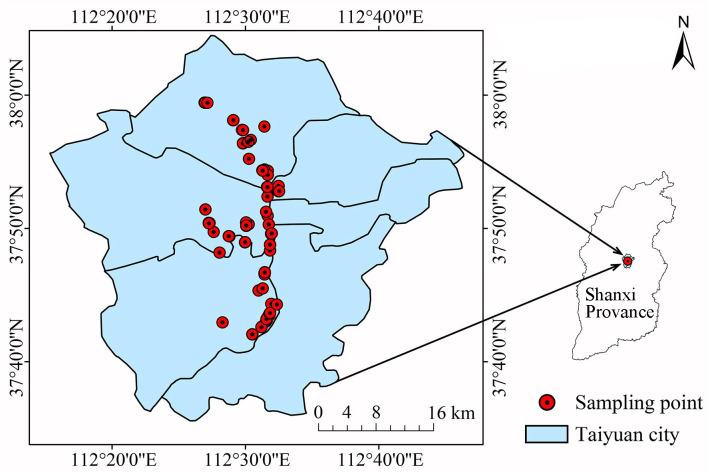
We selected 40 most generally used garden tree specie belonged two life forms (evergreen and deciduous) and investigated the nitrogen (N) and phosphorus (P) concentrations in green and senesced leaves and soil nutrient concentrations of nine samples trees for each species. Then, the nutrient concentrations and resorption efficiency were compared, and the soil nutrients utilization strategies were further analyzed.
RESULTS
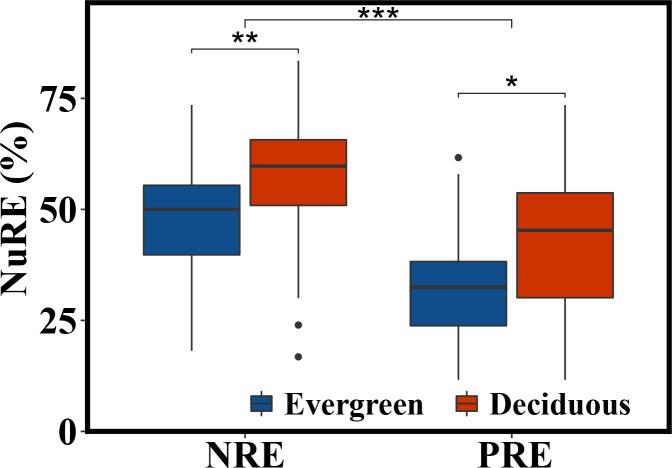
The results showed that the N concentration was significantly higher in the green and senesced leaves of deciduous trees than in the leaves of evergreen trees. The two life-form trees were both N limited and evergreen trees were more sensitive to N limitation. The NRE and PRE in the deciduous trees were significantly higher than those in the evergreen trees. The NRE was significantly positively correlated with the PRE in the deciduous trees. As the soil N and P concentrations increased, the nutrient resorption efficiency (NuRE) of the evergreen trees increased, but that of the deciduous trees decreased. Compared with the deciduous trees, the evergreen trees were more sensitive to the feedback of soil N and P concentrations. These findings reveal the N and P nutrient resorption mechanism of evergreen and deciduous trees and fill a gap in the understanding of nutrient resorption in urban ecosystems.
背景
叶片养分再吸收是植物保护的一种关键策略,可最大程度减少养分损失并提高生产力。然而,城市生态系统中园林树种养分再吸收的差异尚不清楚,特别是常绿树种和落叶树种之间的氮再吸收效率(NRE)和磷再吸收效率(PRE)的差异。
方法
我们选择了两种生活型(常绿和落叶)的 40 种最常用的园林树种,调查了 9 棵样树的绿色和衰老叶片以及土壤养分浓度中的氮(N)和磷(P)浓度。然后,比较了养分浓度和再吸收效率,并进一步分析了土壤养分利用策略。
结果
结果表明,落叶树的绿色和衰老叶片中的 N 浓度明显高于常绿树种。两种生活型的树木均受到 N 限制,而常绿树种对 N 限制更为敏感。落叶树的 NRE 和 PRE 明显高于常绿树种。落叶树的 NRE 与 PRE 呈显著正相关。随着土壤 N 和 P 浓度的增加,常绿树种的养分再吸收效率(NuRE)增加,而落叶树种的养分再吸收效率降低。与落叶树相比,常绿树种对土壤 N 和 P 浓度的反馈更为敏感。这些发现揭示了常绿树种和落叶树种的 N 和 P 养分再吸收机制,填补了城市生态系统中养分再吸收认识的空白。



 Zotero 插件