
通过深度神经网络进行表面缺陷分类实现碳外观部件的质量控制
Quality Control of Carbon Look Components via Surface Defect Classification with Deep Neural Networks.
作者信息
Silenzi Andrea, Castorani Vincenzo, Tomassini Selene, Falcionelli Nicola, Contardo Paolo, Bonci Andrea, Dragoni Aldo Franco, Sernani Paolo
机构信息
Dipartimento di Ingegneria dell'Informazione, Università Politecnica delle Marche, Via Brecce Bianche 12, 60131 Ancona, Italy.
HP Composites S.p.A., Via del Lampo S.N., Z.Ind.le Campolungo, 63100 Ascoli Piceno, Italy.
出版信息
Sensors (Basel). 2023 Sep 1;23(17):7607. doi: 10.3390/s23177607.
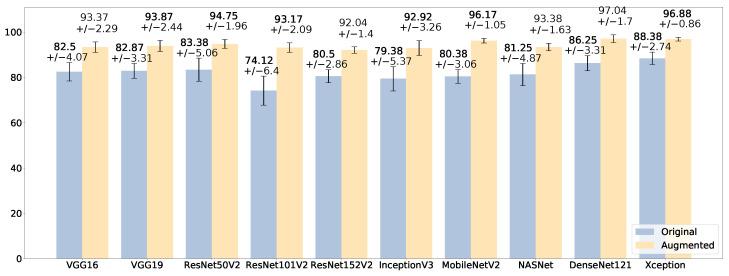
Many "Industry 4.0" applications rely on data-driven methodologies such as Machine Learning and Deep Learning to enable automatic tasks and implement smart factories. Among these applications, the automatic quality control of manufacturing materials is of utmost importance to achieve precision and standardization in production. In this regard, most of the related literature focused on combining Deep Learning with Nondestructive Testing techniques, such as Infrared Thermography, requiring dedicated settings to detect and classify defects in composite materials. Instead, the research described in this paper aims at understanding whether deep neural networks and transfer learning can be applied to plain images to classify surface defects in carbon look components made with Carbon Fiber Reinforced Polymers used in the automotive sector. To this end, we collected a database of images from a real case study, with 400 images to test binary classification (defect vs. no defect) and 1500 for the multiclass classification (components with no defect vs. recoverable vs. non-recoverable). We developed and tested ten deep neural networks as classifiers, comparing ten different pre-trained CNNs as feature extractors. Specifically, we evaluated VGG16, VGG19, ResNet50 version 2, ResNet101 version 2, ResNet152 version 2, Inception version 3, MobileNet version 2, NASNetMobile, DenseNet121, and Xception, all pre-trainined with ImageNet, combined with fully connected layers to act as classifiers. The best classifier, i.e., the network based on DenseNet121, achieved a 97% accuracy in classifying components with no defects, recoverable components, and non-recoverable components, demonstrating the viability of the proposed methodology to classify surface defects from images taken with a smartphone in varying conditions, without the need for dedicated settings. The collected images and the source code of the experiments are available in two public, open-access repositories, making the presented research fully reproducible.
许多“工业4.0”应用依赖于机器学习和深度学习等数据驱动方法来实现自动任务并打造智能工厂。在这些应用中,制造材料的自动质量控制对于实现生产的精度和标准化至关重要。在这方面,大多数相关文献聚焦于将深度学习与无损检测技术相结合,如红外热成像,这需要专门设置来检测和分类复合材料中的缺陷。相反,本文所述研究旨在了解深度神经网络和迁移学习是否可应用于普通图像,以对汽车行业中使用的碳纤维增强聚合物制成的碳外观部件的表面缺陷进行分类。为此,我们从一个实际案例研究中收集了一个图像数据库,其中有400张图像用于测试二分类(缺陷与无缺陷),1500张用于多分类(无缺陷部件与可修复部件与不可修复部件)。我们开发并测试了十个深度神经网络作为分类器,比较了十个不同的预训练卷积神经网络作为特征提取器。具体而言,我们评估了VGG16、VGG19、ResNet50版本2、ResNet101版本2、ResNet152版本2、Inception版本3、MobileNet版本2、NASNetMobile、DenseNet121和Xception,所有这些都使用ImageNet进行了预训练,并与全连接层相结合以充当分类器。最佳分类器,即基于DenseNet121的网络,在对无缺陷部件、可修复部件和不可修复部件进行分类时达到了97%的准确率,证明了所提出的方法在不同条件下对用智能手机拍摄的图像中的表面缺陷进行分类的可行性,而无需专门设置。所收集的图像和实验的源代码可在两个公共的开放获取存储库中获取,这使得所呈现的研究完全可重复。




 Zotero 插件