
基于三维组织学-磁共振图像融合的肝细胞癌微血管侵犯的精确定位:一项实验研究
Precise localization of microvascular invasion in hepatocellular carcinoma based on three-dimensional histology-MR image fusion: an experimental study.
作者信息
Li Liujun, Chen Jiaxin, Huang Yongquan, Wu Chaoqun, Ye Dalin, Wu Wenhao, Zhou Xuan, Qin Peixin, Jia Taoyu, Lin Yuhong, Su Zhongzhen
机构信息
Department of Ultrasound, The Fifth Affiliated Hospital of Sun Yat-sen University, Zhuhai, China.
Guangdong Provincial Key Laboratory of Biomedical Imaging and Guangdong Provincial Engineering Research Center of Molecular Imaging, The Fifth Affiliated Hospital of Sun Yat-sen University, Zhuhai, China.
出版信息
Quant Imaging Med Surg. 2023 Sep 1;13(9):5887-5901. doi: 10.21037/qims-23-220. Epub 2023 Jun 29.
BACKGROUND
Microvascular invasion (MVI) is an independent risk factor for postoperative recurrence of hepatocellular carcinoma (HCC). However, MVI cannot be detected by conventional imaging. To localize MVI precisely on magnetic resonance (MR) images, we evaluated the feasibility and accuracy of 3-dimensional (3D) histology-MR image fusion of the liver.
METHODS
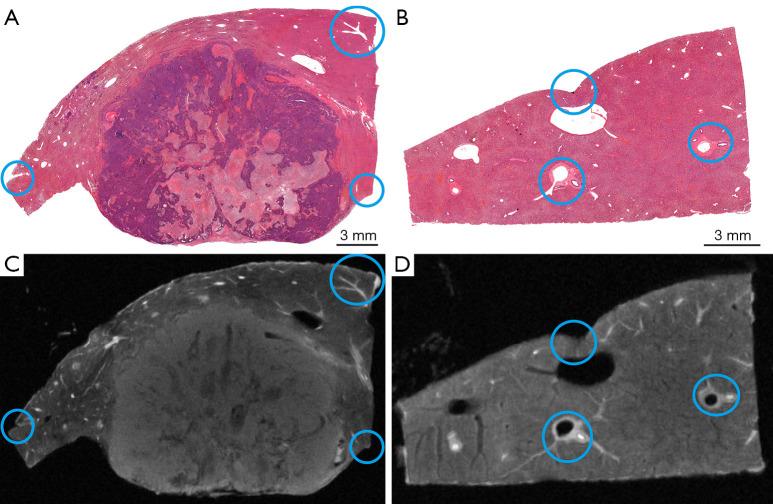
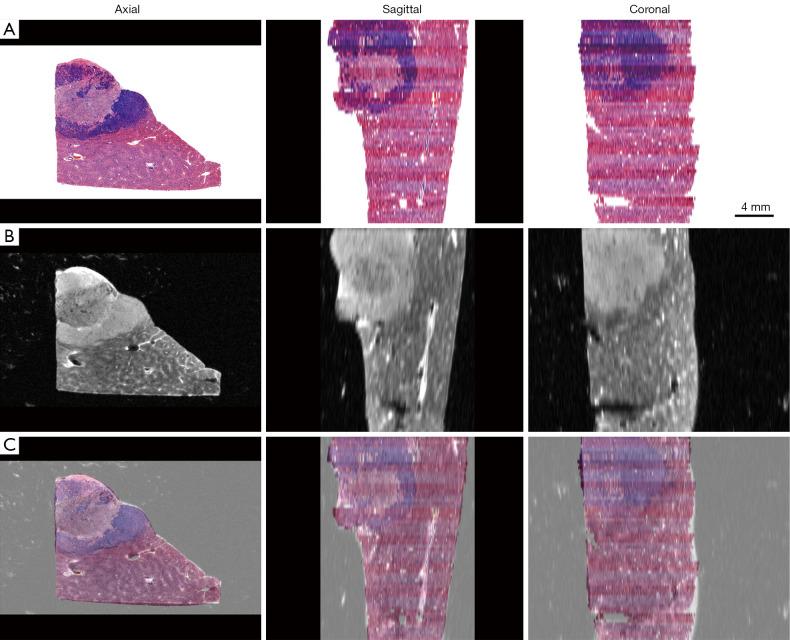
Animal models of VX2 liver tumors were established in 10 New Zealand white rabbits under ultrasonographic guidance. The whole liver lobe containing the VX2 tumor was extracted and divided into 4 specimens, for a total of 40 specimens. MR images were obtained with a T2-weighted sequence for each specimen, and then histological images were obtained by intermittent, serial pathological sections. 3D histology-MR image fusion was performed via landmark registration in 3D Slicer software. We calculated the success rate and registration errors of image fusion, and then we located the MVI on MR images. Regarding influencing factors, we evaluated the uniformity of tissue thickness after sampling and the uniformity of tissue shrinkage after dehydration.
RESULTS
The VX2 liver tumor model was successfully established in the 10 rabbits. The incidence of MVI was 80% (8/10). 3D histology-MR image fusion was successfully performed in the 39 specimens, and the success rate was 97.5% (39/40). The average registration error was 0.44±0.15 mm. MVI was detected in 20 of the 39 successfully registered specimens, resulting in a total of 166 MVI lesions. The specific location of all MVI lesions was accurately identified on MR images using 3D histology-MR image fusion. All MVI lesions showed as slightly hyperintense on the high-resolution MR T2-weighted images. The results of the influencing factor assessment showed that the tissue thickness was uniform after sampling (P=0.38), but the rates of the tissue shrinkage was inconsistent after dehydration (P<0.001).
CONCLUSIONS
3D histology-MR image fusion of the isolated liver tumor model is feasible and accurate and allows for the successful identification of the specific location of MVI on MR images.
背景
微血管侵犯(MVI)是肝细胞癌(HCC)术后复发的独立危险因素。然而,传统影像学无法检测到MVI。为了在磁共振(MR)图像上精确定位MVI,我们评估了肝脏三维(3D)组织学-MR图像融合的可行性和准确性。
方法
在超声引导下,为10只新西兰白兔建立VX2肝肿瘤动物模型。提取包含VX2肿瘤的整个肝叶并分成4个标本,共40个标本。对每个标本采用T2加权序列获取MR图像,然后通过间歇性连续病理切片获得组织学图像。在3D Slicer软件中通过地标配准进行3D组织学-MR图像融合。我们计算了图像融合的成功率和配准误差,然后在MR图像上定位MVI。关于影响因素,我们评估了取样后组织厚度的均匀性以及脱水后组织收缩的均匀性。
结果
10只兔子成功建立了VX2肝肿瘤模型。MVI的发生率为80%(8/10)。39个标本成功进行了3D组织学-MR图像融合,成功率为97.5%(39/40)。平均配准误差为0.44±0.15毫米。在39个成功配准的标本中有20个检测到MVI,共166个MVI病灶。使用3D组织学-MR图像融合在MR图像上准确识别了所有MVI病灶的具体位置。所有MVI病灶在高分辨率MR T2加权图像上均表现为轻度高信号。影响因素评估结果显示,取样后组织厚度均匀(P = 0.38),但脱水后组织收缩率不一致(P < 0.001)。
结论
离体肝肿瘤模型的3D组织学-MR图像融合可行且准确,能够在MR图像上成功识别MVI的具体位置。






 Zotero 插件