
使用固定小多叶准直器场的虚拟圆锥技术治疗三叉神经痛的立体定向放射外科的可行性。
Viability of the virtual cone technique using a fixed small multi-leaf collimator field for stereotactic radiosurgery of trigeminal neuralgia.
机构信息
Department of Physics, Florida Atlantic University, Boca Raton, Florida, USA.
RSO, South Florida Proton Therapy Institute, Delray Beach, Florida, USA.
出版信息
J Appl Clin Med Phys. 2023 Dec;24(12):e14148. doi: 10.1002/acm2.14148. Epub 2023 Sep 18.
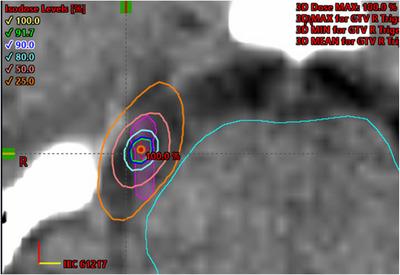
Dosimetric uncertainties in very small (≤1.5 × 1.5 cm ) photon fields are remarkably higher, which undermines the validity of the virtual cone (VC) technique with a diminutive and variable MLC fields. We evaluate the accuracy and reproducibility of the VC method with a very small, fixed MLC field setting, called a fixed virtual cone (fVC), for small target radiosurgery such as trigeminal neuralgia (TGN). The fVC is characterized by 0.5 cm x 0.5 cm high-definition (HD) MLC field of 10MV FFF beam defined at 100 cm SAD, while backup jaws are positioned at 1.5 cm x 1.5 cm. A spherical dose distribution equivalent to 5 mm (diameter) physical cone was generated using 10-14 non-coplanar, partial arcs. Dosimetric accuracy was validated using SRS diode (PTW 60018), SRS MapCHECK (SNC) measurements. As a quality assurance measure, 10 treatment plans (SRS) for TGN, consisting of various arc ranges at different collimator angles were analyzed using 6 MV FFF and 10 MV FFF beams, including a field-by-field study (n = 130 fields). Dose outputs were compared between the Eclipse TPS and measurements (SRS MapCHECK). Moreover, dosimetric changes in the field defining fVC, prompted by a minute (± 0.5-1.0 mm) leaf shift, was examined among TPS, diode measurements, and Monte Carlo (MC) simulations. The beam model for fVC was validated (≤3% difference) using SRS MapCHECK based absolute dose measurements. The equivalent diameters of the 50% isodose distribution were found comparable to that of a 5 mm cone. Additionally, the comparison of field output factors, dose per MU between the TPS and SRS diode measurements using the fVC field, including ± 1 mm leaf shift, yielded average discrepancies within 5.5% and 3.5% for 6 MV FFF and 10 MV FFF beams, respectively. Overall, the fVC method is a credible alternative to the physical cone (5 mm) that can be applied in routine radiosurgical treatment of TGN.
在非常小的(≤1.5×1.5 厘米)光子射野中,剂量学不确定性显著增加,这使得微小且可变的多叶准直器(MLC)射野的虚拟圆锥(VC)技术的有效性受到质疑。我们评估了一种非常小的、固定的多叶准直器设置(称为固定虚拟圆锥(fVC))的 VC 方法的准确性和可重复性,用于治疗三叉神经痛(TGN)等小靶区立体定向放射外科。fVC 的特点是在 100cmSAD 处定义的 10MVFFF 射束的 0.5cmx0.5cm 高清晰度(HD)MLC 场,而备用准直器位于 1.5cmx1.5cm。使用 10-14 个非共面的部分弧生成等效于 5mm(直径)物理圆锥的球形剂量分布。使用 SRS 二极管(PTW60018)、SRSMapCHECK(SNC)测量验证剂量学准确性。作为质量保证措施,对包括不同准直器角度的各种弧范围在内的 10 个 TGN 治疗计划(SRS)进行了分析,使用 6MVFFF 和 10MVFFF 射线进行分析,包括场研究(n=130 个场)。在 EclipseTPS 和测量(SRSMapCHECK)之间比较剂量输出。此外,还研究了在 TPS、二极管测量和蒙特卡罗(MC)模拟中,由叶片微小(±0.5-1.0mm)移动引起的定义 fVC 的射野的剂量学变化。使用基于 SRSMapCHECK 的绝对剂量测量验证了 fVC 的束模型(≤3%差异)。发现 50%等剂量分布的等效直径与 5mm 圆锥的等效直径相当。此外,使用 fVC 场比较 TPS 和 SRS 二极管测量的场输出因子和每 MU 的剂量,包括±1mm 叶片移动,对于 6MVFFF 和 10MVFFF 射线,分别产生平均差异在 5.5%和 3.5%以内。总体而言,fVC 方法是物理圆锥(5mm)的可靠替代方法,可用于 TGN 的常规放射外科治疗。



 Zotero 插件