
粪便短链脂肪酸和尿 3-吲哚硫酸酯不能区分克罗恩病和溃疡性结肠炎患者,也不能用于预测疾病严重程度的诊断。
Fecal short chain fatty acids and urinary 3-indoxyl sulfate do not discriminate between patients with Crohn´s disease and ulcerative colitis and are not of diagnostic utility for predicting disease severity.
机构信息
Department of Internal Medicine I, Gastroenterology, Hepatology, Endocrinology, Rheumatology, and Infectious Diseases, University Hospital Regensburg, 93053, Regensburg, Germany.
Institute of Clinical Chemistry and Laboratory Medicine, University Hospital Regensburg, 93053, Regensburg, Germany.
出版信息
Lipids Health Dis. 2023 Oct 3;22(1):164. doi: 10.1186/s12944-023-01929-6.
BACKGROUND
Urinary 3-indoxyl sulfate levels as well as fecal short chain fatty acid (SCFA) concentrations are surrogate markers for gut microbiota diversity. Patients with inflammatory bowel diseases (IBDs) and patients with primary sclerosing cholangitis (PSC), a disease closely associated with IBD, have decreased microbiome diversity. In this paper, the fecal SCFAs propionate, acetate, butyrate and isobutyrate of patients with IBD and patients with PSC-IBD and urinary 3-indoxyl sulfate of IBD patients were determined to study associations with disease etiology and severity.
METHODS
SCFA levels in feces of 64 IBD patients and 20 PSC-IBD patients were quantified by liquid chromatography with tandem mass spectrometry (LC-MS/MS). Urinary 3-indoxyl sulfate levels of 45 of these IBD patients were analysed by means of reversed-phase liquid chromatography-electrospray ionization-tandem mass spectrometry. Feces of 17 healthy controls and urine of 13 of these controls were analyzed in parallel. These cohorts had comparable sex distribution and age.
RESULTS
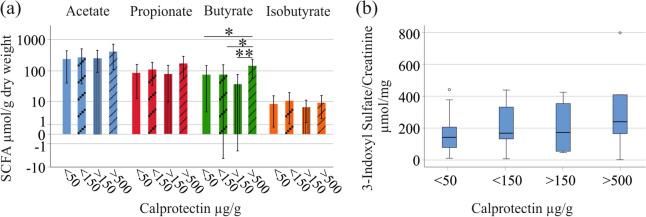
Urinary 3-indoxyl sulfate concentrations (normalized to urinary creatinine levels) was increased (P = 0.030) and fecal isobutyrate levels (normalized to dry weight of the stool sample) of IBD patients were decreased (P = 0.035) in comparison to healthy controls. None of the analyzed metabolites differed between patients with Crohn´s disease (CD) and patients with ulcerative colitis (UC). Fecal acetate and butyrate positively correlated with fecal calprotectin (P = 0.040 and P = 0.005, respectively) and serum C-reactive protein (P = 0.024 and P = 0.025, respectively) in UC but not CD patients. UC patients with fecal calprotectin levels above 150 µg/g, indicating intestinal inflammatory activity, had higher fecal acetate (P = 0.016), butyrate (P = 0.007) and propionate (P = 0.046) in comparison to patients with fecal calprotectin levels < 50 µg/g. Fecal SCFA levels of PSC-IBD and IBD patients were comparable.
CONCLUSIONS
Current findings suggest that analysis of urinary 3-indoxyl-sulfate as well as fecal SCFAs has no diagnostic value for IBD and PSC-IBD diagnosis or monitoring of disease severity.
背景
尿液 3-吲哚硫酸水平和粪便短链脂肪酸(SCFA)浓度是肠道微生物多样性的替代标志物。患有炎症性肠病(IBD)和原发性硬化性胆管炎(PSC)的患者,一种与 IBD 密切相关的疾病,其微生物组多样性降低。在本文中,我们测定了 IBD 患者、PSC-IBD 患者的粪便 SCFA 丙酸、乙酸、丁酸和异丁酸以及 IBD 患者的尿液 3-吲哚硫酸,以研究与疾病病因和严重程度的关系。
方法
通过液相色谱-串联质谱法(LC-MS/MS)定量分析 64 例 IBD 患者和 20 例 PSC-IBD 患者的粪便 SCFA 水平。通过反相液相色谱-电喷雾电离-串联质谱法分析其中 45 例 IBD 患者的尿液 3-吲哚硫酸水平。同时分析了 17 名健康对照者的粪便和其中 13 名对照者的尿液。这些队列具有可比的性别分布和年龄。
结果
与健康对照组相比,IBD 患者的尿液 3-吲哚硫酸浓度(按尿液肌酐水平校正)升高(P=0.030),粪便异丁酸水平(按粪便样本干重校正)降低(P=0.035)。克罗恩病(CD)患者和溃疡性结肠炎(UC)患者之间未检测到任何分析代谢物的差异。UC 患者的粪便乙酸和丁酸与粪便钙卫蛋白呈正相关(P=0.040 和 P=0.005),与血清 C 反应蛋白呈正相关(P=0.024 和 P=0.025),而 CD 患者无此相关性。粪便钙卫蛋白水平>150μg/g 表明肠道炎症活动的 UC 患者,其粪便乙酸(P=0.016)、丁酸(P=0.007)和丙酸(P=0.046)水平高于粪便钙卫蛋白水平<50μg/g 的患者。PSC-IBD 和 IBD 患者的粪便 SCFA 水平无差异。
结论
目前的研究结果表明,尿液 3-吲哚硫酸和粪便 SCFA 的分析对 IBD 和 PSC-IBD 的诊断或疾病严重程度的监测没有诊断价值。



 Zotero 插件