
牙弓和咬合特征的遗传度:系统评价和荟萃分析。
Heritability of dental arches and occlusal characteristics: a systematic review and meta-analysis.
机构信息
Adelaide Dental School, Faculty of Health and Medical Sciences, The University of Adelaide, Adelaide, SA, Australia.
出版信息
Eur J Orthod. 2023 Nov 30;45(6):854-867. doi: 10.1093/ejo/cjad061.
BACKGROUND AND OBJECTIVE
The genetic basis of dentoalveolar characteristics has been investigated by several studies, however, the findings are equivocal. The objective of this systematic review and meta-analysis was to evaluate the heritability of dental arches and occlusal parameters in different stages of human dentition.
SEARCH METHODS
Electronic databases PubMed, Embase, Scopus, Web of Science, and Dentistry and Oral Science Source were searched up to August 2023 without the restriction of language or publication date.
SELECTION CRITERIA
Empirical studies investigating the heritability of dentoalveolar parameters among twins and siblings were included in the review.
DATA COLLECTION AND ANALYSIS
Study selection, data extraction, and risk of bias assessment were performed independently and in duplicate by two authors and a third author resolved conflicts if needed. Joanna Briggs Institute's critical appraisal tool was used to evaluate the risk of bias among studies and the certainty of evidence was assessed using the Grading of Recommendation, Assessment, Development, and Evaluation (GRADE) criteria.
RESULTS
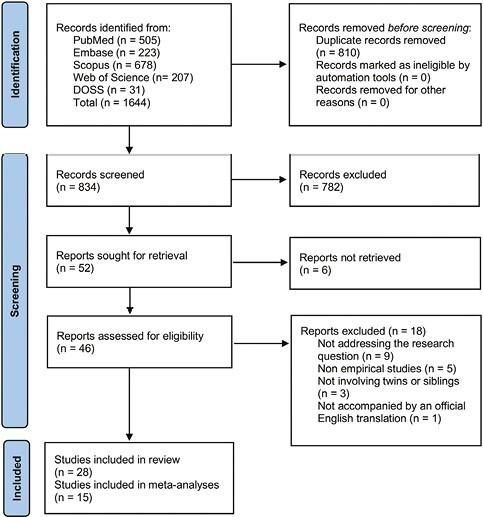
Twenty-eight studies were included in the systematic review, of which 15 studies reporting heritability coefficients in the permanent dentition stages were deemed suitable for the meta-analysis. Random-effects meta-analyses showed high heritability estimates for maxillary intermolar width (0.52), maxillary intercanine width (0.54), mandibular intermolar width (0.55), mandibular intercanine width (0.55), maxillary arch length (0.76), mandibular arch length (0.57), and palatal depth (0.56). The heritability estimates for the occlusal parameters varied considerably, with relatively moderate values for crossbite (0.46) and overbite (0.44) and low values for buccal segment relationship (0.32), overjet (0.22), and rotation and displacement of teeth (0.16). However, the certainty of evidence for most of the outcomes was low according to the GRADE criteria.
CONCLUSIONS
Based on the available evidence, it can be concluded that the dental arch dimensions have a high heritability while the occlusal parameters demonstrate a moderate to low heritability.
REGISTRATION
PROSPERO (CRD42022358442).
背景与目的
多项研究已经探讨了牙牙槽特征的遗传基础,但研究结果存在争议。本系统评价和荟萃分析的目的是评估人类不同牙列阶段牙弓和咬合参数的遗传性。
检索方法
截至 2023 年 8 月,我们在电子数据库 PubMed、Embase、Scopus、Web of Science 和 Dentistry and Oral Science Source 中进行了检索,未对语言或发表日期进行限制。
选择标准
纳入了评估双胞胎和兄弟姐妹之间牙牙槽参数遗传性的实证研究。
数据收集与分析
两位作者独立并重复进行研究选择、数据提取和偏倚风险评估,如果需要,第三位作者解决了冲突。使用 Joanna Briggs Institute 的批判性评估工具评估研究的偏倚风险,并使用推荐、评估、开发和评估 (GRADE) 标准评估证据的确定性。
结果
本系统评价纳入了 28 项研究,其中有 15 项研究报告了恒牙列阶段的遗传系数,适合进行荟萃分析。随机效应荟萃分析显示,上颌磨牙间宽度(0.52)、上颌尖牙间宽度(0.54)、下颌磨牙间宽度(0.55)、下颌尖牙间宽度(0.55)、上颌弓长(0.76)、下颌弓长(0.57)和腭深(0.56)的遗传度估计值较高。咬合参数的遗传度估计值差异较大,反颌(0.46)和覆盖(0.44)的遗传度估计值相对适中,颊侧段关系(0.32)、覆合(0.22)、牙齿旋转和移位(0.16)的遗传度估计值较低。然而,根据 GRADE 标准,大多数结果的证据确定性较低。
结论
根据现有证据,可以得出结论,牙弓尺寸具有高度遗传性,而咬合参数则表现出中度至低度遗传性。
注册
PROSPERO(CRD42022358442)。



 Zotero 插件