
医学文献中因伦理违规而被撤回的出版物分析。
Analysis of Retracted Publications in Medical Literature Due to Ethical Violations.
机构信息
Department of Physical Medicine and Rehabilitation, Faculty of Medicine, Kahramanmaraş Sütçü İmam University, Kahramanmaraş, Türkiye.
Physiotherapy and Rehabilitation Application and Research Center, Hasan Kalyoncu University, Gaziantep, Türkiye.
出版信息
J Korean Med Sci. 2023 Oct 16;38(40):e324. doi: 10.3346/jkms.2023.38.e324.
BACKGROUND
Retraction is an essential procedure for correcting scientific literature and informing readers about articles containing significant errors or omissions. Ethical violations are one of the significant triggers of the retraction process. The objective of this study was to evaluate the characteristics of retracted articles in the medical literature due to ethical violations.
METHODS
The Retraction Watch Database was utilized for this descriptive study. The 'ethical violations' and 'medicine' options were chosen. The date range was 2010 to 2023. The collected data included the number of authors, the date of publication and retraction, the journal of publication, the indexing status of the journal, the country of the corresponding author, the subject area of the article, and the particular retraction reasons.
RESULTS
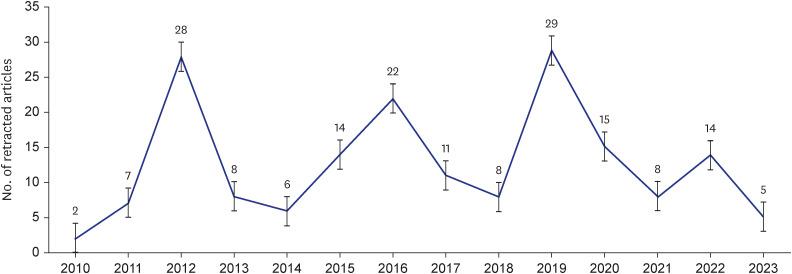
A total of 177 articles were analyzed. The most retractions were detected in 2019 (n = 29) and 2012 (n = 28). The median time period between the articles' first publication date and the date of retraction was 647 (0-4,295) days. The leading countries were China (n = 47), USA (n = 25), South Korea (n = 23), Iran (n = 14), and India (n = 12). The main causes of retraction were ethical approval issues (n = 65), data-related concerns (n = 51), informed consent issues (n = 45), and fake-biased peer review (n = 30).
CONCLUSION
Unethical behavior is one of the most significant obstacles to scientific advancement. Obtaining appropriate ethics committee approvals and informed consent forms is crucial in ensuring the ethical conduct of medical research. It is the responsibility of journal editors to ensure that raw data is controlled and peer review processes are conducted effectively. It is essential to educate young researchers on unethical practices and the negative outcomes that may result from them.
背景
撤稿是纠正科学文献并告知读者文章中存在重大错误或遗漏的重要程序。违反伦理规范是撤稿过程的重要触发因素之一。本研究的目的是评估医学文献中因违反伦理规范而被撤稿的文章的特征。
方法
本研究采用描述性研究方法,利用 Retraction Watch 数据库,选择“伦理违规”和“医学”选项,时间范围为 2010 年至 2023 年。收集的数据包括作者人数、发表和撤稿日期、发表期刊、期刊索引状态、通讯作者所在国家、文章主题领域以及具体的撤稿原因。
结果
共分析了 177 篇文章。撤稿最多的年份是 2019 年(n=29)和 2012 年(n=28)。文章首次发表日期与撤稿日期之间的中位数时间间隔为 647(0-4295)天。主要国家是中国(n=47)、美国(n=25)、韩国(n=23)、伊朗(n=14)和印度(n=12)。撤稿的主要原因是伦理审批问题(n=65)、数据相关问题(n=51)、知情同意问题(n=45)和虚假偏颇同行评审(n=30)。
结论
不道德行为是科学进步的最大障碍之一。获得适当的伦理委员会批准和知情同意书对于确保医学研究的伦理行为至关重要。期刊编辑有责任确保控制原始数据并有效地进行同行评审过程。教育年轻研究人员了解不道德行为及其可能产生的负面后果非常重要。



 Zotero 插件