
接受质子治疗的小儿脑肿瘤患者的摆位不确定性:一项前瞻性研究。
Setup Uncertainty of Pediatric Brain Tumor Patients Receiving Proton Therapy: A Prospective Study.
作者信息
Becksfort Jared, Uh Jinsoo, Saunders Andrew, Byrd Julia A, Worrall Hannah M, Marker Matt, Melendez-Suchi Christian, Li Yimei, Chang Jenghwa, Raghavan Kavitha, Merchant Thomas E, Hua Chia-Ho
机构信息
Department of Radiation Oncology, St. Jude Children's Research Hospital, Memphis, TN 38105, USA.
Department of Biostatistics, St. Jude Children's Research Hospital, Memphis, TN 38105, USA.
出版信息
Cancers (Basel). 2023 Nov 20;15(22):5486. doi: 10.3390/cancers15225486.
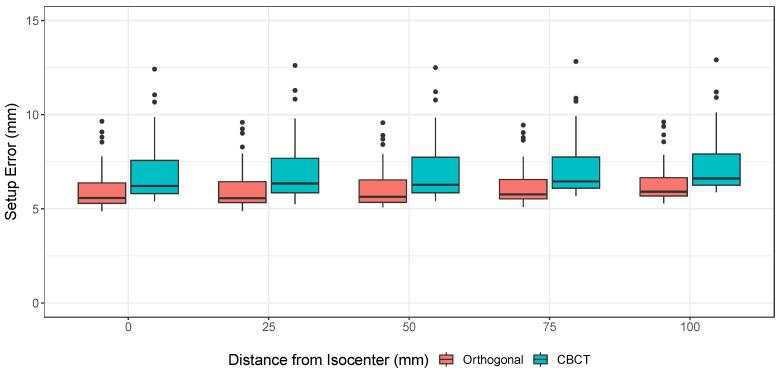
This study quantifies setup uncertainty in brain tumor patients who received image-guided proton therapy. Patients analyzed include 165 children, adolescents, and young adults (median age at radiotherapy: 9 years (range: 10 months to 24 years); 80 anesthetized and 85 awake) enrolled in a single-institution prospective study from 2020 to 2023. Cone-beam computed tomography (CBCT) was performed daily to calculate and correct manual setup errors, once per course after setup correction to measure residual errors, and weekly after treatments to assess intrafractional motion. Orthogonal radiographs were acquired consecutively with CBCT for paired comparisons of 40 patients. Translational and rotational errors were converted from 6 degrees of freedom to a scalar by a statistical approach that considers the distance from the target to the isocenter. The 95th percentile of setup uncertainty was reduced by daily CBCT from 10 mm (manual positioning) to 1-1.5 mm (after correction) and increased to 2 mm by the end of fractional treatment. A larger variation existed between the roll corrections reported by radiographs vs. CBCT than for pitch and yaw, while there was no statistically significant difference in translational variation. A quantile mixed regression model showed that the 95th percentile of intrafractional motion was 0.40 mm lower for anesthetized patients (p=0.0016). Considering additional uncertainty in radiation-imaging isocentricity, the commonly used total plan robustness of 3 mm against positional uncertainty would be appropriate for our study cohort.
本研究对接受图像引导质子治疗的脑肿瘤患者的摆位不确定性进行了量化。分析的患者包括165名儿童、青少年和青年(放疗时的中位年龄:9岁(范围:10个月至24岁);80名麻醉状态和85名清醒状态),这些患者入选了2020年至2023年在单一机构开展的一项前瞻性研究。每天进行锥束计算机断层扫描(CBCT)以计算和校正手动摆位误差,在摆位校正后每个疗程进行一次以测量残余误差,并在治疗后每周进行一次以评估分次治疗期间的运动。与CBCT连续采集正交X线片,用于对40例患者进行配对比较。通过一种考虑从靶区到等中心距离的统计方法,将平移和旋转误差从6个自由度转换为一个标量。通过每日CBCT,摆位不确定性的第95百分位数从10毫米(手动定位)降至1 - 1.5毫米(校正后),到分次治疗结束时增加至2毫米。X线片与CBCT报告的横滚校正之间的差异大于俯仰和偏航校正,而平移差异无统计学显著差异。分位数混合回归模型显示,麻醉患者的分次治疗期间运动的第95百分位数低0.40毫米(p = 0.0016)。考虑到放射成像等中心性的额外不确定性,常用的针对位置不确定性的3毫米总计划稳健性适用于我们的研究队列。




 Zotero 插件