
识别创伤性脑损伤后弥漫性轴索损伤的表型。
Identifying the Phenotypes of Diffuse Axonal Injury Following Traumatic Brain Injury.
作者信息
Krieg Justin L, Leonard Anna V, Turner Renée J, Corrigan Frances
机构信息
Translational Neuropathology Laboratory, School of Biomedicine, Faculty of Health and Medical Sciences, The University of Adelaide, Adelaide 5000, Australia.
出版信息
Brain Sci. 2023 Nov 20;13(11):1607. doi: 10.3390/brainsci13111607.
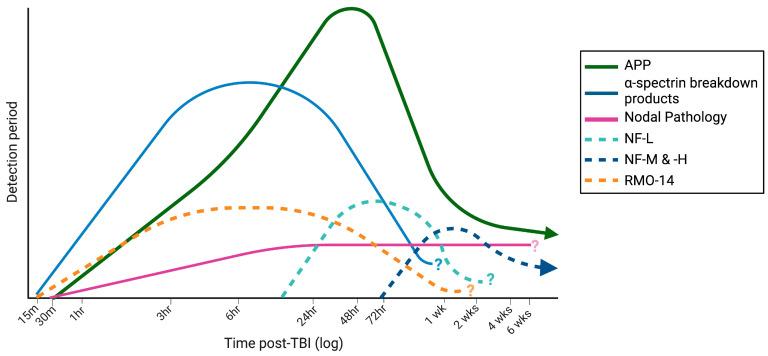
Diffuse axonal injury (DAI) is a significant feature of traumatic brain injury (TBI) across all injury severities and is driven by the primary mechanical insult and secondary biochemical injury phases. Axons comprise an outer cell membrane, the axolemma which is anchored to the cytoskeletal network with spectrin tetramers and actin rings. Neurofilaments act as space-filling structural polymers that surround the central core of microtubules, which facilitate axonal transport. TBI has differential effects on these cytoskeletal components, with axons in the same white matter tract showing a range of different cytoskeletal and axolemma alterations with different patterns of temporal evolution. These require different antibodies for detection in post-mortem tissue. Here, a comprehensive discussion of the evolution of axonal injury within different cytoskeletal elements is provided, alongside the most appropriate methods of detection and their temporal profiles. Accumulation of amyloid precursor protein (APP) as a result of disruption of axonal transport due to microtubule failure remains the most sensitive marker of axonal injury, both acutely and chronically. However, a subset of injured axons demonstrate different pathology, which cannot be detected via APP immunoreactivity, including degradation of spectrin and alterations in neurofilaments. Furthermore, recent work has highlighted the node of Ranvier and the axon initial segment as particularly vulnerable sites to axonal injury, with loss of sodium channels persisting beyond the acute phase post-injury in axons without APP pathology. Given the heterogenous response of axons to TBI, further characterization is required in the chronic phase to understand how axonal injury evolves temporally, which may help inform pharmacological interventions.
弥漫性轴索损伤(DAI)是所有严重程度创伤性脑损伤(TBI)的一个显著特征,由原发性机械性损伤和继发性生化损伤阶段驱动。轴突由外层细胞膜即轴膜组成,轴膜通过血影蛋白四聚体和肌动蛋白环锚定在细胞骨架网络上。神经丝作为填充空间的结构聚合物,围绕微管的中央核心,促进轴突运输。TBI对这些细胞骨架成分有不同影响,同一白质束中的轴突表现出一系列不同的细胞骨架和轴膜改变,且具有不同的时间演变模式。在死后组织中检测这些改变需要不同的抗体。本文全面讨论了不同细胞骨架成分内轴突损伤的演变,以及最合适的检测方法及其时间特征。由于微管功能障碍导致轴突运输中断,淀粉样前体蛋白(APP)的积累仍然是急性和慢性轴突损伤最敏感的标志物。然而,一部分受损轴突表现出不同的病理变化,无法通过APP免疫反应检测到,包括血影蛋白降解和神经丝改变。此外,最近的研究强调郎飞结和轴突起始段是轴突损伤特别易损的部位,在没有APP病理变化的轴突中,钠通道的丧失在损伤后急性期过后仍持续存在。鉴于轴突对TBI的异质性反应,在慢性期需要进一步表征以了解轴突损伤如何随时间演变,这可能有助于指导药物干预。

 Zotero 插件