
口服营养补充剂有助于改善依赖透析患者的营养状况:一项随机对照试验的系统评价和荟萃分析。
Oral nutritional supplement helps to improve nutritional status of dialysis dependent patients: a systematic review and meta-analysis of randomized controlled trials.
作者信息
Ren Song, Yao Xiaoxiu, Ren Shangqing, Feng Yunlin
机构信息
Nephrology Department, Sichuan Provincial People's Hospital, Chengdu, Sichuan, China.
Department of Health Management, Damian Honghe Community Health Service Center of Longquanyi District, Chengdu, China.
出版信息
Front Nutr. 2023 Nov 23;10:1294064. doi: 10.3389/fnut.2023.1294064. eCollection 2023.
BACKGROUND
The prevention and treatment of malnutrition holds remarkable implications in the overall management of dialysis patients. However, there remains a dearth of comprehensive evaluations regarding the impact of oral nutrition supplement (ONS) on all pertinent dimensions of malnutrition in the dialysis population.
METHODS
A systematic search was conducted in MEDLINE, EMBASE, and Cochrane Central Library. RCTs that had assessed the effects of oral nutritional supplement in dialysis-dependent populations were considered eligible. Outcomes included laboratory indicators, anthropometric measures, nutritional indices, dialysis adequacy, body composition analysis measures, and systemic inflammation indicators. The risk of bias was assessed according to Cochrane guidelines. Weighted mean difference (WMD) or standardized mean difference (SMD) with 95% confidence intervals (CIs) were pooled using a random-effects model.
RESULTS
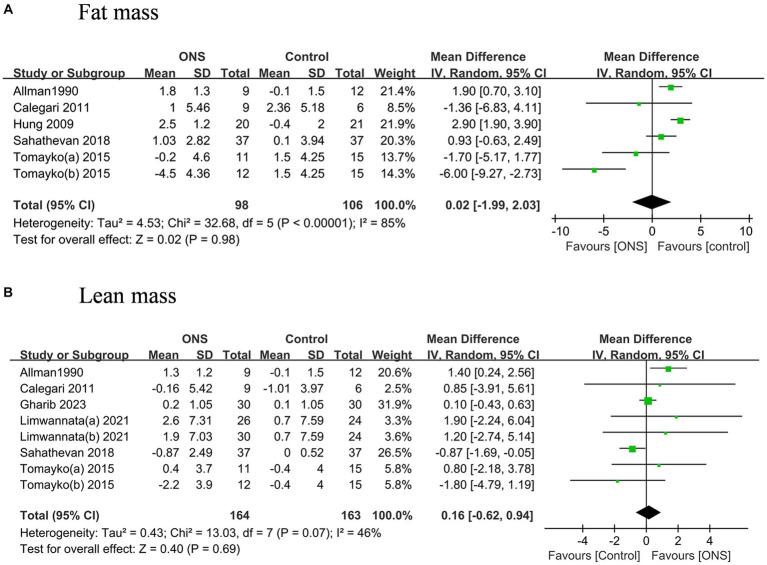
In all, 22 RCTs with 1,281 patients were included. The pooled analyses revealed the serum ALB, BMI, nPCR, and MIS improved by 1.44 g/L (95% CI: 0.76, 2.57), 0.35 kg/m (95% CI: 0.17, 0.52), 0.07 g/(kg d) (95% CI, 0.05, 0.10), and -2.75 (95% CI, -3.95, -1.54), respectively following ONS treatments when compared to control treatments. However, no significant differences were observed in relation to the other outcomes examined. 15 studies were rated as having high risk of bias. Visual inspection of the funnel plot and Egger test argued against the presence of publication bias.
CONCLUSION
ONS treatments helps to improve the nutritional status of dialysis dependent patients. More evidence is needed from future investigations with longer study duration and standardized procedures to support long-term use of ONS in this population.
SYSTEMATIC REVIEW REGISTRATION
https://www.crd.york.ac.uk/prospero/, Identifier CRD 42023441987.
背景
营养不良的防治在透析患者的整体管理中具有重要意义。然而,对于口服营养补充剂(ONS)对透析人群营养不良所有相关方面的影响,仍缺乏全面评估。
方法
在MEDLINE、EMBASE和Cochrane中央图书馆进行系统检索。评估口服营养补充剂对依赖透析人群影响的随机对照试验(RCT)被认为符合纳入标准。结局指标包括实验室指标、人体测量指标、营养指数、透析充分性、身体成分分析指标和全身炎症指标。根据Cochrane指南评估偏倚风险。采用随机效应模型汇总加权平均差(WMD)或标准化平均差(SMD)及95%置信区间(CI)。
结果
共纳入22项RCT,涉及1281例患者。汇总分析显示,与对照治疗相比,ONS治疗后血清白蛋白(ALB)、体重指数(BMI)、标准化蛋白分解代谢率(nPCR)和营养不良炎症评分(MIS)分别改善了1.44g/L(95%CI:0.76,2.57)、0.35kg/m²(95%CI:0.17,0.52)、0.07g/(kg·d)(95%CI,0.05,0.10)和-2.75(95%CI,-3.95,-1.54)。然而,在其他所检查的结局方面未观察到显著差异。15项研究被评为具有高偏倚风险。通过漏斗图的直观检查和Egger检验排除了发表偏倚的存在。
结论
ONS治疗有助于改善依赖透析患者的营养状况。未来需要进行更多研究时长更长且程序标准化的调查,以提供更多证据支持在该人群中长期使用ONS。
系统评价注册
https://www.crd.york.ac.uk/prospero/,标识符CRD 42023441987。



 Zotero 插件