
MTL 神经元与人类海马体 theta 锁相。
MTL neurons phase-lock to human hippocampal theta.
机构信息
Department of Neuroscience, Perelman School of Medicine, University of Pennsylvania, Philadelphia, United States.
Department of Psychology, University of Pennsylvania, Philadelphia, United States.
出版信息
Elife. 2024 Jan 9;13:e85753. doi: 10.7554/eLife.85753.
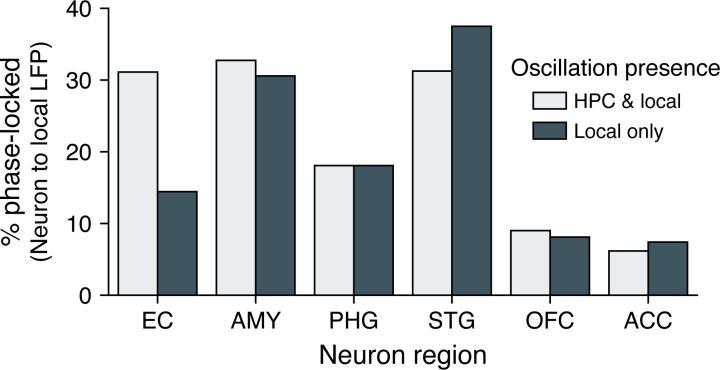
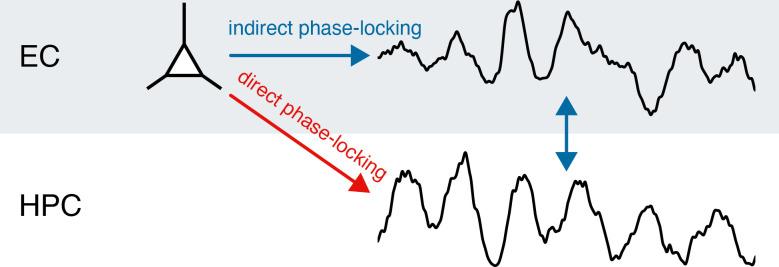
Memory formation depends on neural activity across a network of regions, including the hippocampus and broader medial temporal lobe (MTL). Interactions between these regions have been studied indirectly using functional MRI, but the bases for interregional communication at a cellular level remain poorly understood. Here, we evaluate the hypothesis that oscillatory currents in the hippocampus synchronize the firing of neurons both within and outside the hippocampus. We recorded extracellular spikes from 1854 single- and multi-units simultaneously with hippocampal local field potentials (LFPs) in 28 neurosurgical patients who completed virtual navigation experiments. A majority of hippocampal neurons phase-locked to oscillations in the slow (2-4 Hz) or fast (6-10 Hz) theta bands, with a significant subset exhibiting nested slow theta × beta frequency (13-20 Hz) phase-locking. Outside of the hippocampus, phase-locking to hippocampal oscillations occurred only at theta frequencies and primarily among neurons in the entorhinal cortex and amygdala. Moreover, extrahippocampal neurons phase-locked to hippocampal theta even when theta did not appear locally. These results indicate that spike-time synchronization with hippocampal theta is a defining feature of neuronal activity in the hippocampus and structurally connected MTL regions. Theta phase-locking could mediate flexible communication with the hippocampus to influence the content and quality of memories.
记忆的形成依赖于包括海马体和更大的内侧颞叶(MTL)在内的一系列区域的神经活动。这些区域之间的相互作用已经使用功能磁共振成像(fMRI)进行了间接研究,但细胞水平上的区域间通信的基础仍知之甚少。在这里,我们评估了这样一个假设,即海马体中的振荡电流可以同步海马体内部和外部神经元的放电。我们在 28 名接受神经外科手术的患者中同时记录了 1854 个单元和多单元的细胞外尖峰和海马局部场电位(LFPs),这些患者完成了虚拟导航实验。大多数海马体神经元与慢(2-4 Hz)或快(6-10 Hz)θ频段的振荡同步,其中一个显著子集表现出嵌套的慢θ×β频率(13-20 Hz)的相位锁定。在海马体之外,只有在θ频率时才会与海马体的振荡发生相位锁定,并且主要发生在内嗅皮层和杏仁核的神经元中。此外,即使在局部没有出现θ时,海马体以外的神经元也会与海马体的θ同步。这些结果表明,与海马体θ的尖峰时间同步是海马体和结构上连接的 MTL 区域神经元活动的一个特征。θ 相位锁定可以介导与海马体的灵活通信,以影响记忆的内容和质量。


 Zotero 插件