
基于 DNA 测序显微镜的图像重建纠错策略。
An error correction strategy for image reconstruction by DNA sequencing microscopy.
机构信息
Department of Medical Biochemistry and Biophysics, Karolinska Institutet, Stockholm, Sweden.
出版信息
Nat Comput Sci. 2024 Feb;4(2):119-127. doi: 10.1038/s43588-023-00589-x. Epub 2024 Jan 22.
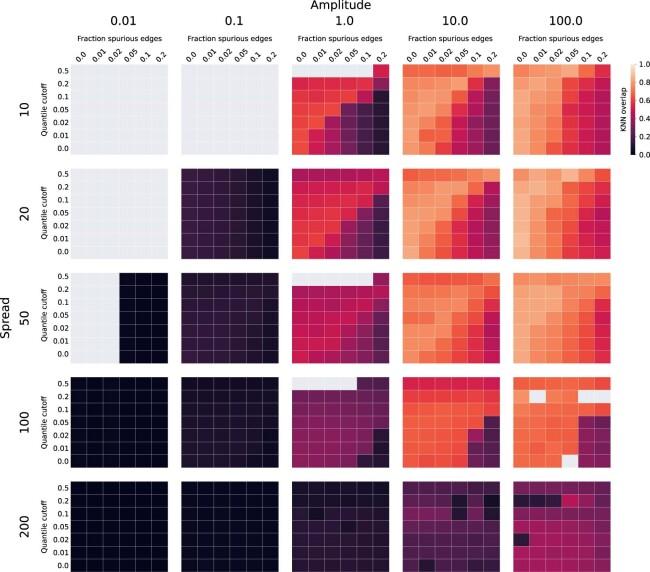
By pairing adjacent molecules in situ and then mapping these pairs, DNA microscopy could substantially reduce the workload in spatial omics methods by directly inferring geometry from sequencing data alone. However, experimental artifacts can lead to errors in the adjacency data, which distort the spatial reconstruction. Here we describe a method to correct two such errors: spurious crosslinks formed between any two nodes, and fused nodes that are formed out of multiple molecules. We build on the principle that spatially close molecules should be connected and show that these errors violate this principle, allowing for their detection and correction. Our method corrects errors in simulated data, even in the presence of up to 20% errors, and proves to be more efficient at removing errors from experimental data than a read count filter. Integrating this method in DNA microscopy will substantially improve the accuracy of spatial reconstructions with lower data loss.
通过原位配对相邻分子,然后对这些分子对进行映射,DNA 显微镜可以通过仅从测序数据中直接推断几何形状,从而大大减少空间组学方法的工作量。然而,实验伪影可能导致相邻数据中的错误,从而扭曲空间重建。在这里,我们描述了一种纠正两种此类错误的方法:任何两个节点之间形成的虚假交联,以及由多个分子形成的融合节点。我们基于空间上接近的分子应该连接的原理,并表明这些错误违反了这一原理,从而可以检测和纠正这些错误。我们的方法可以纠正模拟数据中的错误,即使在存在高达 20%错误的情况下,并且在从实验数据中去除错误方面比读取计数过滤器更有效。将这种方法集成到 DNA 显微镜中,将极大地提高空间重建的准确性,同时数据丢失更少。




 Zotero 插件