
卫生保健专业人员对被动感知、人工智能和机器学习在精神卫生保健中的应用的看法:系统评价与元综合。
Health Care Professionals' Views on the Use of Passive Sensing, AI, and Machine Learning in Mental Health Care: Systematic Review With Meta-Synthesis.
机构信息
Division of Psychology and Mental Health, School of Health Sciences, Faculty of Biology, Medicine and Health, Manchester Academic Health Sciences, The University of Manchester, Manchester, United Kingdom.
Greater Manchester Mental Health NHS Foundation Trust, Manchester, United Kingdom.
出版信息
JMIR Ment Health. 2024 Jan 23;11:e49577. doi: 10.2196/49577.
BACKGROUND
Mental health difficulties are highly prevalent worldwide. Passive sensing technologies and applied artificial intelligence (AI) methods can provide an innovative means of supporting the management of mental health problems and enhancing the quality of care. However, the views of stakeholders are important in understanding the potential barriers to and facilitators of their implementation.
OBJECTIVE
This study aims to review, critically appraise, and synthesize qualitative findings relating to the views of mental health care professionals on the use of passive sensing and AI in mental health care.
METHODS
A systematic search of qualitative studies was performed using 4 databases. A meta-synthesis approach was used, whereby studies were analyzed using an inductive thematic analysis approach within a critical realist epistemological framework.
RESULTS
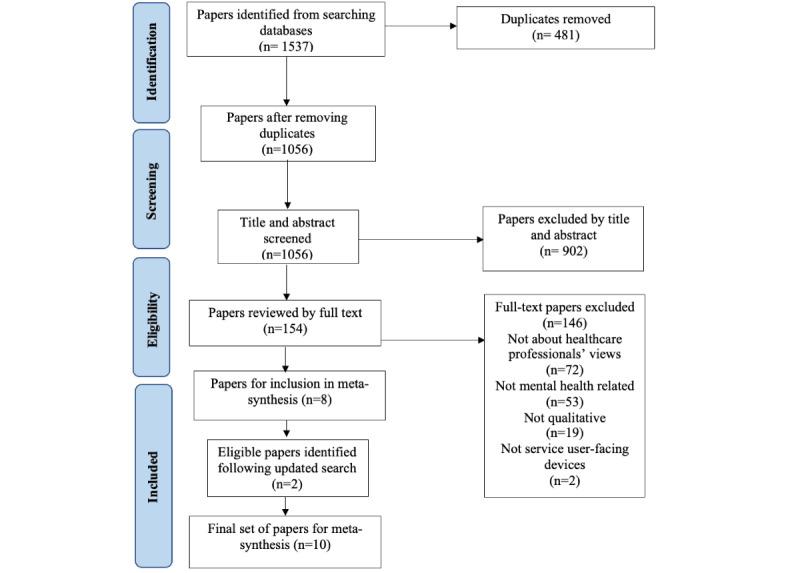
Overall, 10 studies met the eligibility criteria. The 3 main themes were uses of passive sensing and AI in clinical practice, barriers to and facilitators of use in practice, and consequences for service users. A total of 5 subthemes were identified: barriers, facilitators, empowerment, risk to well-being, and data privacy and protection issues.
CONCLUSIONS
Although clinicians are open-minded about the use of passive sensing and AI in mental health care, important factors to consider are service user well-being, clinician workloads, and therapeutic relationships. Service users and clinicians must be involved in the development of digital technologies and systems to ensure ease of use. The development of, and training in, clear policies and guidelines on the use of passive sensing and AI in mental health care, including risk management and data security procedures, will also be key to facilitating clinician engagement. The means for clinicians and service users to provide feedback on how the use of passive sensing and AI in practice is being received should also be considered.
TRIAL REGISTRATION
PROSPERO International Prospective Register of Systematic Reviews CRD42022331698; https://www.crd.york.ac.uk/prospero/display_record.php?RecordID=331698.
背景
心理健康问题在全球范围内普遍存在。被动感应技术和应用人工智能(AI)方法可以为支持管理心理健康问题和提高护理质量提供一种创新手段。然而,了解利益相关者对其实施的潜在障碍和促进因素的看法非常重要。
目的
本研究旨在回顾、批判性评价和综合与心理健康护理专业人员对在心理健康护理中使用被动感应和 AI 的看法相关的定性研究结果。
方法
使用 4 个数据库对定性研究进行了系统搜索。采用元综合方法,在批判实在论认识论框架内,使用归纳主题分析方法对研究进行分析。
结果
总体而言,10 项研究符合入选标准。3 个主要主题是被动感应和 AI 在临床实践中的应用、实践中使用的障碍和促进因素以及对服务使用者的影响。确定了 5 个子主题:障碍、促进因素、赋权、对幸福感的风险以及数据隐私和保护问题。
结论
尽管临床医生对在心理健康护理中使用被动感应和 AI 持开放态度,但需要考虑的重要因素是服务使用者的幸福感、临床医生的工作量和治疗关系。必须让服务使用者和临床医生参与开发数字技术和系统,以确保易用性。制定并培训关于在心理健康护理中使用被动感应和 AI 的明确政策和指南,包括风险管理和数据安全程序,也将是促进临床医生参与的关键。还应考虑为临床医生和服务使用者提供反馈的机制,了解在实践中使用被动感应和 AI 的情况。
试验注册
PROSPERO 国际前瞻性系统评价注册中心 CRD42022331698;https://www.crd.york.ac.uk/prospero/display_record.php?RecordID=331698。

 Zotero 插件