
化学成分对真空渗碳低合金钢组织和力学性能的影响
Influence of Chemical Composition on Structure and Mechanical Properties of Vacuum-Carburized Low-Alloy Steels.
作者信息
Kochmański Paweł, Chylińska Renata, Figiel Paweł, Fryska Sebastian, Kochmańska Agnieszka E, Kwiatkowska Magdalena, Kwiatkowski Konrad, Niemczyk Agata, Słowik Justyna, Maziarz Wojciech, Rogal Łukasz, Dybowski Konrad, Baranowska Jolanta
机构信息
Faculty of Mechanical Engineering and Mechatronics, West Pomeranian University of Technology in Szczecin, Av. Piastów 19, 70-310 Szczecin, Poland.
Institute of Metallurgy and Materials Science, Polish Academy of Sciences, Reymonta 25 Str., 30-059 Krakow, Poland.
出版信息
Materials (Basel). 2024 Jan 21;17(2):515. doi: 10.3390/ma17020515.
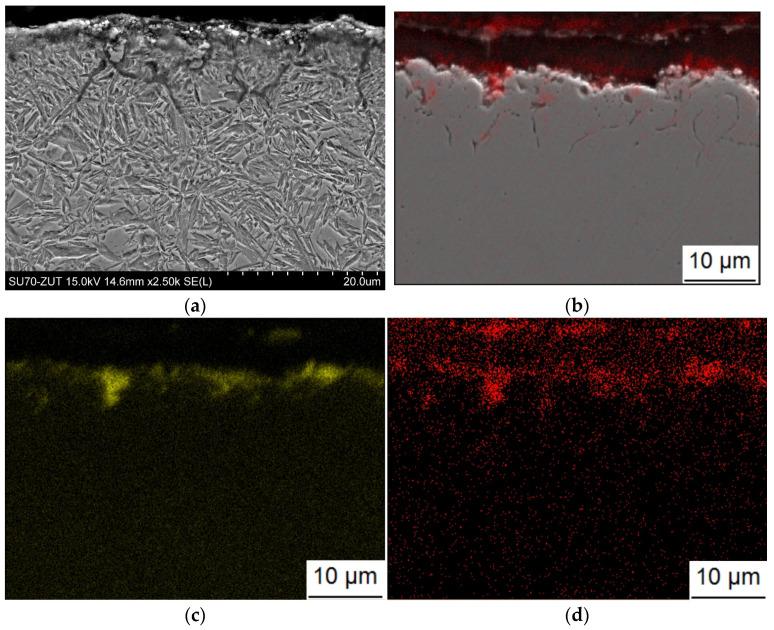
This study presents research results concerning the vacuum carburizing of four steel grades, specifically conforming to European standards 1.7243, 1.6587, 1.5920, and 1.3532. The experimental specimens exhibited variations primarily in nickel content, ranging from 0 to approximately 3.8 wt. %. As a comparative reference, gas carburizing was also conducted on the 1.3532 grade, which had the highest nickel content. Comprehensive structural analysis was carried out on the resultant carburized layers using a variety of techniques, such as optical and electron scanning, transmission microscopy, and X-ray diffraction. Additionally, mechanical properties such as hardness and fatigue strength were assessed. Fatigue strength evaluation was performed on un-notched samples having a circular cross-section with a diameter of 12 mm. Testing was executed via a three-point bending setup subjected to sinusoidally varying stresses ranging from 0 to maximum stress levels. The carburized layers produced had effective thicknesses from approximately 0.8 to 1.4 mm, surface hardness levels in the range of 600 to 700 HV, and estimated retained austenite contents from 10 to 20 vol%. The observed fatigue strength values for the layers varied within the range from 1000 to 1350 MPa. It was found that changing the processing method from gas carburizing, which induced internal oxidation phenomena, to vacuum carburizing improved the fatigue properties to a greater extent than increasing the nickel content of the steel.
本研究展示了关于四种钢种真空渗碳的研究结果,这四种钢种具体符合欧洲标准1.7243、1.6587、1.5920和1.3532。实验样本主要在镍含量上存在差异,范围从0到约3.8 wt.%。作为对比参考,还对镍含量最高的1.3532钢种进行了气体渗碳。使用多种技术,如光学和电子扫描、透射显微镜以及X射线衍射,对所得渗碳层进行了全面的结构分析。此外,还评估了硬度和疲劳强度等力学性能。对直径为12 mm的圆形横截面无缺口样本进行了疲劳强度评估。测试通过三点弯曲装置进行,施加从0到最大应力水平的正弦变化应力。所产生的渗碳层有效厚度约为0.8至1.4 mm,表面硬度水平在600至700 HV范围内,估计残余奥氏体含量为10至20 vol%。观察到的渗碳层疲劳强度值在1000至1350 MPa范围内变化。研究发现,将加工方法从会引发内部氧化现象的气体渗碳改为真空渗碳,比增加钢的镍含量能在更大程度上改善疲劳性能。




 Zotero 插件