
探索蛋白质补充剂来源对进行无氧抗阻运动的女性身体成分的影响:一项初步研究。
Exploring the Impact of Protein Supplement Source on Body Composition in Women Practicing Anaerobic Resistance Exercise: A Pilot Study.
作者信息
Ballesteros-Torres Juan Manuel, Escalante-Aburto Anayansi, Villarreal-Arce María Elena, Caballero-Prado Cindy Joanna
机构信息
Departamento de Microbiología e Inmunología, Facultad de Ciencias Biológicas (FCB), Universidad Autónoma de Nuevo León (UANL), Ave. Universidad s/n, Cd. Universitaria, San Nicolás de los Garza 66450, Mexico.
Tecnologico de Monterrey, Institute for Obesity Research, Eugenio Garza Sada 2501, Monterrey 64849, Mexico.
出版信息
Nutrients. 2024 Jan 22;16(2):321. doi: 10.3390/nu16020321.
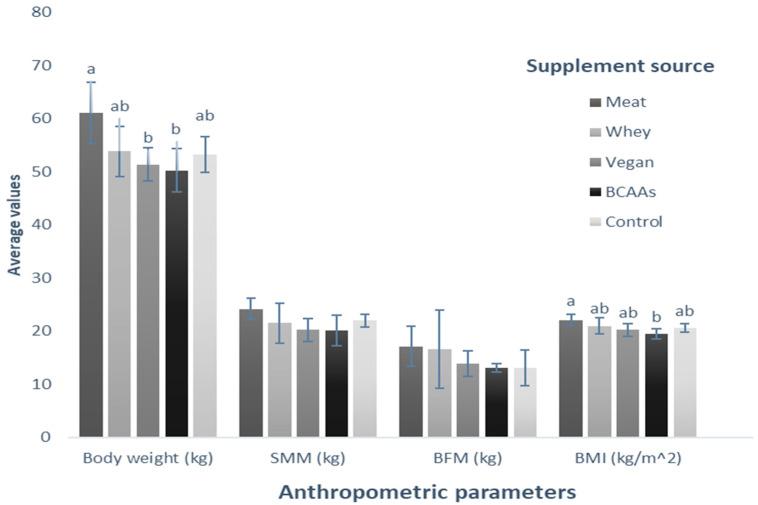
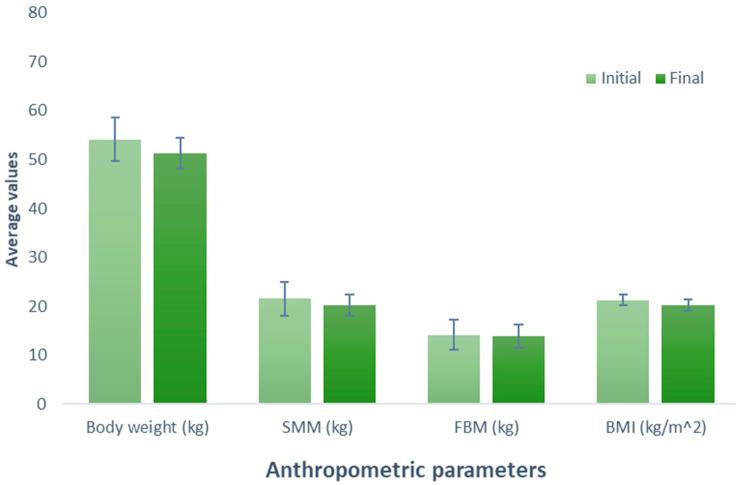
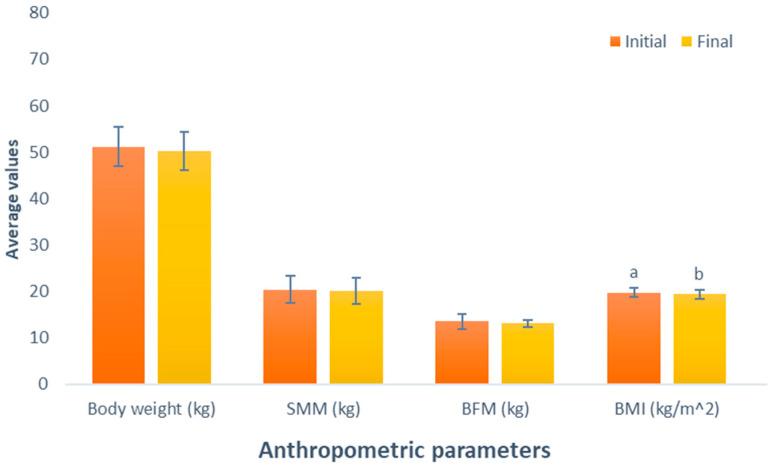
Supplements based on protein hydrolysates have been used as an effective source to access amino acids with greater bioavailability, promoting absorption to improve body composition. Five groups of young women were randomly selected. They followed a personalized eating plan that included different protein supplements (meat, vegan, branched-chain amino acids [BCAAs], whey, and control group), combined with an exercise plan, for eight weeks, aiming to assess their consumption effects combined with resistance exercise on body composition. Bioelectrical impedance before and after the treatment was conducted. The results showed that the supplementation with BCAAs presented a significant decrease ( < 0.05) on the BMI in this group (initial BMI = 19.7 kg/m; final BMI = 19.4 kg/m). When comparing the final measures among the groups, the BCAAs and vegan supplements caused a significant decrease in body weight (50.24 kg and 51.34 kg, respectively). The BMI of the group supplemented with meat proteins was statistically higher (22.06 kg/m) than that the group supplemented with BCAAs (19.4 kg/m) ( < 0.05). No significant changes were observed in the type of protein consumed to produce muscle mass in the participants after eight weeks of study under a controlled diet and anaerobic resistance exercise. Participants exhibited energy deficiencies, but their macronutrient distribution appeared normal. Following an 8-week intervention, meat and BCAAs reduced weight and BMI, although no statistical differences were observed. It is recommended to extend the treatment for a more comprehensive understanding.
基于蛋白质水解物的补充剂已被用作获取生物利用度更高的氨基酸的有效来源,促进吸收以改善身体成分。随机选择了五组年轻女性。她们遵循个性化饮食计划,其中包括不同的蛋白质补充剂(肉类、纯素食、支链氨基酸[BCAAs]、乳清蛋白和对照组),并结合运动计划,持续八周,旨在评估它们与抗阻运动相结合对身体成分的消耗效果。在治疗前后进行了生物电阻抗测量。结果显示,补充BCAAs的这组人群的BMI显著下降(<0.05)(初始BMI = 19.7 kg/m²;最终BMI = 19.4 kg/m²)。在比较各组的最终测量结果时,BCAAs和纯素食补充剂导致体重显著下降(分别为50.24 kg和51.34 kg)。补充肉类蛋白组的BMI在统计学上高于补充BCAAs组(19.4 kg/m²)(<0.05)。在为期八周的受控饮食和无氧抗阻运动研究后,参与者摄入用于增加肌肉量的蛋白质类型未观察到显著变化。参与者表现出能量不足,但其常量营养素分布看起来正常。经过8周的干预,肉类和BCAAs降低了体重和BMI,尽管未观察到统计学差异。建议延长治疗时间以获得更全面的了解。



 Zotero 插件