
扩张-点刺技术可成功治疗后循环串联病变。
The Dilator-Dotter technique can successfully treat tandem lesions of posterior circulation.
作者信息
Han Ning, Ma Liang, Zhao Lei, Xu Guodong, Jia Yangjuan, Wang Hebo
机构信息
Department of Graduate School, Hebei Medical University, Shijiazhuang, Hebei, China.
Neurointerventional department, Hebei General Hospital, Shijiazhuang, Hebei, China.
出版信息
Medicine (Baltimore). 2024 Jan 26;103(4):e37044. doi: 10.1097/MD.0000000000037044.
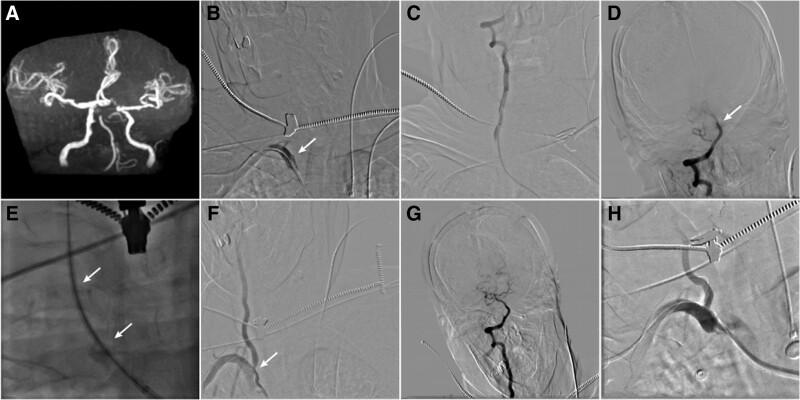
In this study, we applied the Dilator-Dotter technique, a catheter-based angioplasty, to cross through severely stenotic or occluded vertebral arteries during mechanical thrombectomy, and we explored its efficacy and safety in treating tandem lesions of posterior circulation. We performed a retrospective analysis of patients with acute stroke caused by tandem lesions of posterior circulation treated with the Dilator-Dotter technique and thrombectomy between July 2017 and December 2021. In addition to collecting clinical, radiographic, and procedural data from patient records, we also collected information about surgical complications and outcome. We enrolled 9 patients for this study. In all cases, the vertebral artery (VA) on the affected side was crossed through via the Dilator-Dotter technique, and mechanical thrombectomy was successfully performed. The average time from groin puncture to revascularization (TICI 2B-3) was 26 minutes (range 16-50 minutes). Eight patients (89%) achieved complete recanalization with TICI 3, and only 1 patient suffered from thrombus escape to the posterior cerebral artery. Eight patients underwent VA stenting, while the remaining patient was excluded from this procedure because a postoperative brain CT scan recorded obvious staining of the contrast medium within the infarcted area. Five patients had modified Rankin Scale scores ≤ 3 at the 3-month follow-up examination, and 2 patients died due to postoperative cerebral hemorrhage and severe ischemia. The Dilator-Dotter technique may represent a safe and effective treatment for tandem lesions of posterior circulation. Using this method, the lesions can be rapidly recanalized and treated.
在本研究中,我们应用了扩张器-点式技术(一种基于导管的血管成形术),在机械取栓过程中穿过严重狭窄或闭塞的椎动脉,并探讨了其在治疗后循环串联病变中的疗效和安全性。我们对2017年7月至2021年12月期间采用扩张器-点式技术和取栓术治疗的后循环串联病变所致急性卒中患者进行了回顾性分析。除了从患者记录中收集临床、影像学和手术数据外,我们还收集了有关手术并发症和结果的信息。我们纳入了9例患者进行本研究。在所有病例中,均通过扩张器-点式技术穿过患侧椎动脉,并成功进行了机械取栓。从腹股沟穿刺到血管再通(TICI 2B-3)的平均时间为26分钟(范围16-50分钟)。8例患者(89%)实现了TICI 3级完全再通,只有1例患者出现血栓逃逸至大脑后动脉。8例患者接受了椎动脉支架置入术,而其余1例患者因术后脑部CT扫描显示梗死区内造影剂明显染色而未进行该手术。5例患者在3个月随访检查时改良Rankin量表评分≤3分,2例患者因术后脑出血和严重缺血死亡。扩张器-点式技术可能是治疗后循环串联病变的一种安全有效的方法。使用这种方法,可以快速实现病变再通并进行治疗。

 Zotero 插件