
反复的对称弯曲通过对木质部细胞壁的空间分子调控导致矮化。
Recurrent symmetrical bendings cause dwarfing in through spatial molecular regulation of xylem cell walls.
作者信息
Ley-Ngardigal Béra, Roman Hanaé, Brouard Nathalie, Huché-Thélier Lydie, Guérin Vincent, Leduc Nathalie
机构信息
Univ Angers, Institut Agro, INRAE, IRHS, SFR QUASAV, Angers, France.
Hortensia France Company, Rives-du-Loir-en-Anjou, France.
出版信息
Front Plant Sci. 2024 Jan 16;14:1268272. doi: 10.3389/fpls.2023.1268272. eCollection 2023.
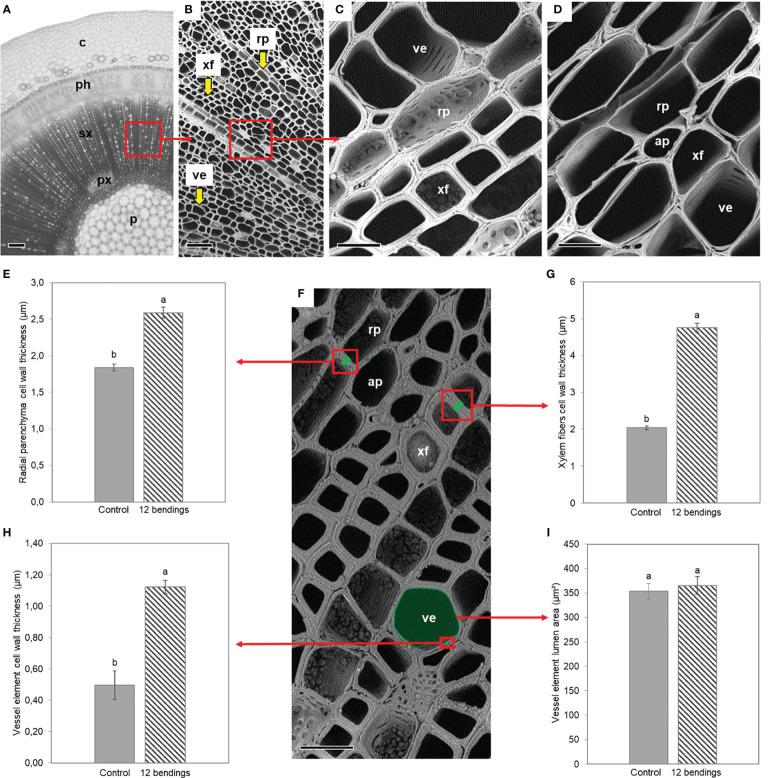
Environmental prejudices progressively lead to the ban of dwarfing molecules in agriculture, and alternatives are urgently required. Mechanical stimulation (MS) is a promising, eco-friendly, and economical technique, but some responses to mechanical stimulation vary from one plant species to another. Additionally, as more frequent and violent wind episodes are forecasted under global climate change, knowledge of plant responses to stimuli mimicking wind sways is decisive for agriculture. However, little is known about plant mechanosensitive responses after long-term, recurrent MS. Here, the effects of 3-week, recurrent, symmetrical bendings (1 or 12 per day) in stems are examined. Bendings repressed internode elongation and leaf area development, whereas the diametrical growth of the basal internode is increased. Responses were dose-dependent, and no desensitization was observed during the 3 weeks of treatment. MS was almost as efficient as daminozide for plant dwarfing, and it improved stem robustness. Histological and molecular responses to MS were spatially monitored and were concordant with ongoing primary or secondary growth in the internodes. Our molecular data provide the first knowledge on the molecular paths controlled by mechanical loads in and revealed for the first time the involvement of in thigmomorphogenetic responses. MS still had a transcriptional impact 48 h after the last bending session, promoting the expression of , , and while repressing the expression of and homologs in accordance with xylogenesis, cell wall thickening, and lignin deposition in the xylem of basal internodes. In upper elongating internodes, repression of , , , and homologs is correlated with ongoing primary, even though stunted, growth. For producers, our findings highlight the potential of MS as a sustainable and economical option for controlling plant compactness in and show valuable reinforcement of stem strength.
环境偏见逐渐导致农业中矮化分子被禁用,因此迫切需要替代方法。机械刺激(MS)是一种有前景、环保且经济的技术,但不同植物物种对机械刺激的反应有所不同。此外,随着全球气候变化预测会出现更频繁、更强烈的风灾,了解植物对模拟风摇曳刺激的反应对农业至关重要。然而,对于长期反复进行机械刺激后植物的机械敏感反应却知之甚少。在此,研究了茎干中为期3周的反复对称弯曲(每天1次或12次)的影响。弯曲抑制了节间伸长和叶面积发育,而基部节间的直径生长增加。反应呈剂量依赖性,在3周的处理过程中未观察到脱敏现象。机械刺激在使植物矮化方面几乎与丁酰肼一样有效,并且提高了茎的坚固性。对机械刺激的组织学和分子反应进行了空间监测,并且与节间正在进行的初生或次生生长一致。我们的分子数据提供了关于机械负荷控制的分子途径的首个知识,并首次揭示了其在触变形态发生反应中的作用。在最后一次弯曲处理48小时后,机械刺激仍然具有转录影响,促进了相关基因的表达,同时根据基部节间木质部的木质化、细胞壁增厚和木质素沉积,抑制了相关同源基因的表达。在上部伸长的节间中,相关同源基因的抑制与正在进行的初生生长相关,尽管生长受阻。对于生产者而言,我们的研究结果突出了机械刺激作为控制植物紧凑度的可持续且经济选择的潜力,并显示出茎强度的显著增强。



 Zotero 插件