
不同的 DNA-PK 和 mTOR 激酶抑制剂联合电离辐射对 HNSCC 和正常组织细胞的影响。
Different Impacts of DNA-PK and mTOR Kinase Inhibitors in Combination with Ionizing Radiation on HNSCC and Normal Tissue Cells.
机构信息
Department of Radiation Oncology, University Hospital Erlangen, Friedrich-Alexander-Universität Erlangen-Nürnberg, Universitätsstr. 27, 91054 Erlangen, Germany.
Comprehensive Cancer Center Erlangen-EMN (CCC ER-EMN), 91054 Erlangen, Germany.
出版信息
Cells. 2024 Feb 6;13(4):304. doi: 10.3390/cells13040304.
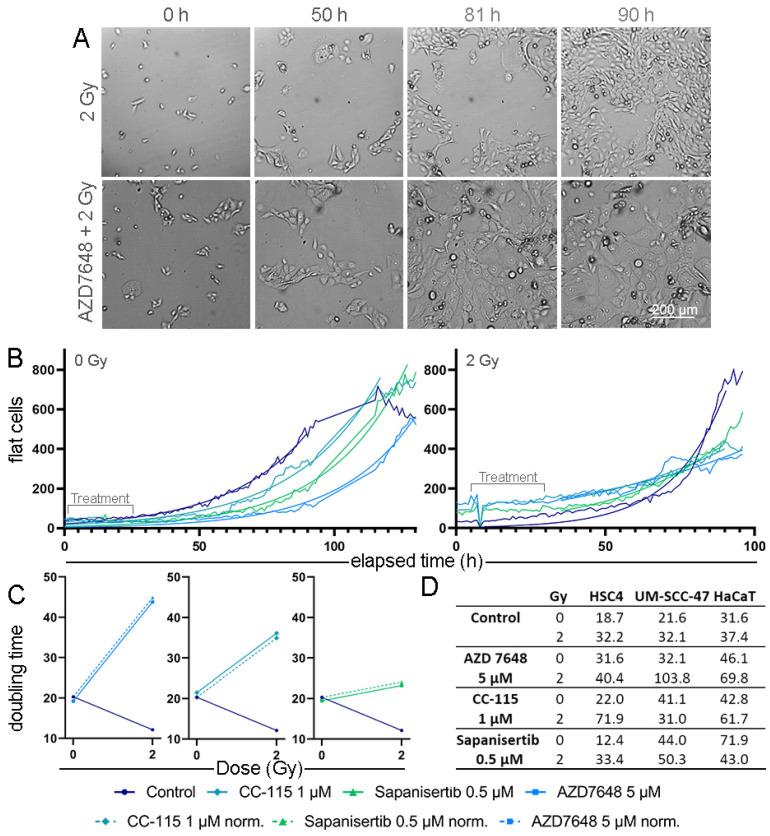
Despite substantial advancements in understanding the pathomechanisms of head and neck squamous cell carcinoma (HNSCC), effective therapy remains challenging. The application of kinase inhibitors (KIs) in HNSCC, specifically mTOR and DNA-PK inhibitors, can increase radiosensitivity and therefore presents a promising strategy when used simultaneously with ionizing radiation (IR) in cancer treatment. Our study focused on the selective DNA-PK-inhibitor AZD7648; the selective mTOR-inhibitor Sapanisertib; and CC-115, a dual inhibitor targeting both mTOR and DNA-PK. The impact of these KIs on HNSCC and normal tissue cells was assessed using various analytical methods including cell death studies, cell cycle analysis, real-time microscopy, colony-forming assays and immunohistochemical staining for γH2AX and downstream mTOR protein p-S6. We detected a strong inhibition of IR-induced DNA double-strand break (DSB) repair, particularly in AZD7648-treated HNSCC, whereas normal tissue cells repaired DNA DSB more efficiently. Additionally, AZD7648 + IR treatment showed a synergistic decline in cell proliferation and clonogenicity, along with an elevated G2/M arrest and cell death in the majority of HNSCC cell lines. CC-115 + IR treatment led to an elevation in G2/M arrest, increased cell death, and a synergistic reduction in cell proliferation, though the effect was notably lower compared to the AZD7648 + IR- treated group. Sapanisertib led to a high cellular toxicity in both HNSCC and normal tissue cells, even in non-irradiated cells. Regarding cell proliferation and the induction of apoptosis and necrosis, Sapanisertib + IR was beneficial only in HPV HNSCC. Overall, this study highlights the potential of AZD7648 as a radiosensitizing agent in advanced-stage HPV-positive and negative HNSCC, offering a promising therapeutic strategy. However, the dual mTOR/DNA-PK-I CC-115 did not provide a distinct advantage over the use of selective KIs in our investigations, suggesting limited benefits for its application in KI + IR therapy. Notably, the selective mTOR-inhibitor Sapanisertib was only beneficial in HPV HNSCC and should not be applied in HPV cases.
尽管对头颈鳞状细胞癌(HNSCC)的发病机制有了实质性的了解,但有效的治疗仍然具有挑战性。激酶抑制剂(KIs)在 HNSCC 中的应用,特别是 mTOR 和 DNA-PK 抑制剂,可以提高放射敏感性,因此在癌症治疗中与电离辐射(IR)同时使用时具有很大的应用前景。我们的研究集中在选择性 DNA-PK 抑制剂 AZD7648、选择性 mTOR 抑制剂 Sapanisertib 和同时靶向 mTOR 和 DNA-PK 的双重抑制剂 CC-115 上。我们使用各种分析方法评估这些 KIs 对 HNSCC 和正常组织细胞的影响,包括细胞死亡研究、细胞周期分析、实时显微镜、集落形成测定和γH2AX 和下游 mTOR 蛋白 p-S6 的免疫组织化学染色。我们发现,IR 诱导的 DNA 双链断裂(DSB)修复受到强烈抑制,尤其是在 AZD7648 处理的 HNSCC 中,而正常组织细胞则更有效地修复 DNA DSB。此外,AZD7648 + IR 治疗显示细胞增殖和集落形成能力协同下降,同时大多数 HNSCC 细胞系中 G2/M 期阻滞和细胞死亡增加。CC-115 + IR 治疗导致 G2/M 期阻滞增加、细胞死亡增加以及细胞增殖协同减少,尽管与 AZD7648 + IR 治疗组相比,效果明显较低。Sapanisertib 导致 HNSCC 和正常组织细胞均出现高细胞毒性,即使在未照射的细胞中也是如此。关于细胞增殖以及细胞凋亡和坏死的诱导,Sapanisertib + IR 仅在 HPV HNSCC 中有益。总的来说,这项研究强调了 AZD7648 作为晚期 HPV 阳性和阴性 HNSCC 的放射增敏剂的潜力,为这种治疗策略提供了希望。然而,双重 mTOR/DNA-PK-I CC-115 在我们的研究中并没有比使用选择性 KI 提供明显的优势,这表明其在 KI + IR 治疗中的应用获益有限。值得注意的是,选择性 mTOR 抑制剂 Sapanisertib 仅在 HPV HNSCC 中有益,不应在 HPV 病例中应用。



 Zotero 插件